What is digital marketing is one of the most important questions for any business that wants more visibility, better leads, and stronger sales online.
Digital marketing means using channels like SEO, PPC, content marketing, email marketing, and social media marketing to reach the right audience, guide the customer journey, and improve conversion tracking and results.
In simple terms, it is the system businesses use to attract attention, build trust, generate demand, and turn online traffic into enquiries, revenue, and profit.
If you want clearer direction on how digital marketing can support more leads and sales, Message Lucidly on WhatsApp.
What Is Digital Marketing in Simple Words?
What is digital marketing?
In simple words, digital marketing is the use of online channels to help a business become more visible, reach the right audience, and drive meaningful actions such as enquiries, bookings, purchases, or repeat sales.
A practical digital marketing definition is the use of digital platforms and tools to support business growth through traffic generation, lead generation, sales support, and performance measurement.
The real digital marketing meaning for businesses is not limited to online promotion.
It is a structured way to attract attention, build trust, and guide people toward action across the digital customer journey.
Unlike traditional marketing, digital marketing can usually be measured more clearly. Businesses can track which channels contribute to traffic, leads, and revenue, which makes improvement more practical over time.
Digital marketing usually includes:
SEO to improve organic visibility in search engines
PPC to generate targeted paid traffic
content marketing to educate, attract, and build trust
email marketing to nurture leads and support retention
social media marketing to increase reach and engagement
analytics and conversion tracking to measure results and improve performance
How Does Digital Marketing Work?
To understand how digital marketing works, start with the customer journey.
A business first attracts attention through channels such as SEO, PPC, content marketing, social media marketing, or email marketing.
Once people arrive, the business needs to give them a clear message, a useful page, and a reason to continue.
From there, digital marketing supports the next step, whether that is reading more, requesting a quote, subscribing, or buying.
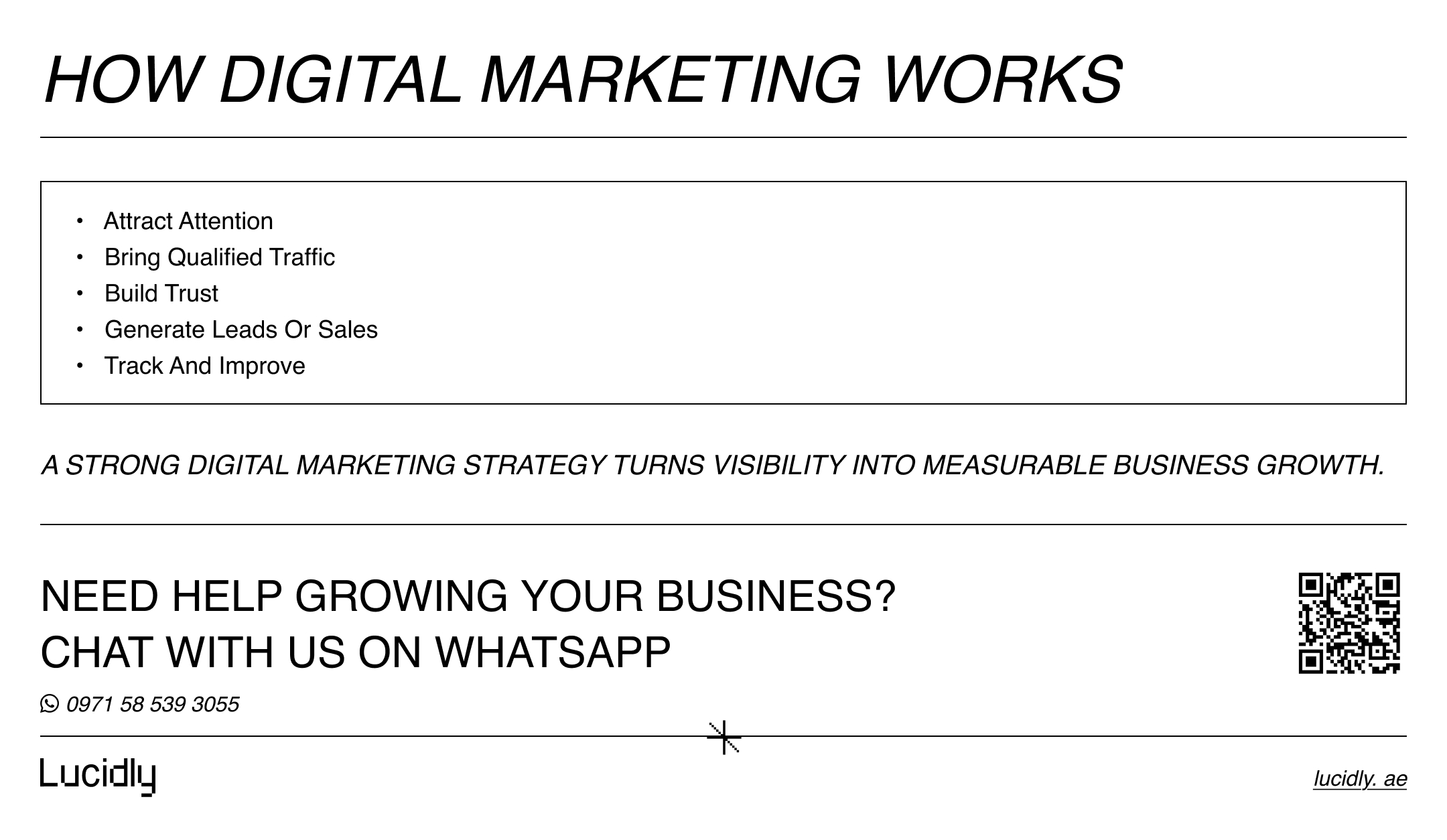
In practice, digital marketing usually works through this sequence:
Attract attention
People discover the business through search engines, social platforms, ads, email, referrals, or content.
Bring qualified traffic
The goal is not random visits. The goal is relevant visitors with real interest or intent.
Build trust
Strong pages, useful content, clear offers, and consistent online branding help visitors feel confident.
Generate leads or sales
This happens through calls to action, landing pages, forms, checkouts, bookings, or direct contact.
Track and improve results
Analytics and conversion tracking help identify what is working and what needs improvement.
Google Analytics 4 specifically supports measurement through key events and conversion reporting, which is why tracking should be built in from the start.
Digital marketing works best when channels support each other. SEO can bring long-term visibility. PPC can capture high-intent demand faster. Content marketing can answer objections.
Email marketing can nurture leads. Social media marketing can expand reach and support retargeting. Together, they create a stronger digital marketing funnel.
Why Is Digital Marketing Important for Business?
The main reason digital marketing matters is simple: customers already spend a large part of their decision-making process online.
They search, compare, read reviews, watch videos, visit websites, and check social profiles before they take action.
That is why the benefits of digital marketing go beyond traffic. A strong strategy can help a business:
increase visibility
reach a more relevant audience
generate better leads
improve sales opportunities
measure performance more accurately
adjust campaigns faster
reduce wasted budget
strengthen online branding across the customer journey
For small and growing businesses, digital marketing offers better control and more precise targeting across services, locations, audiences, and offers.
It also supports both short-term and long-term growth, with PPC helping generate leads faster while SEO and content marketing build stronger visibility over time.
What Comes Under Digital Marketing?
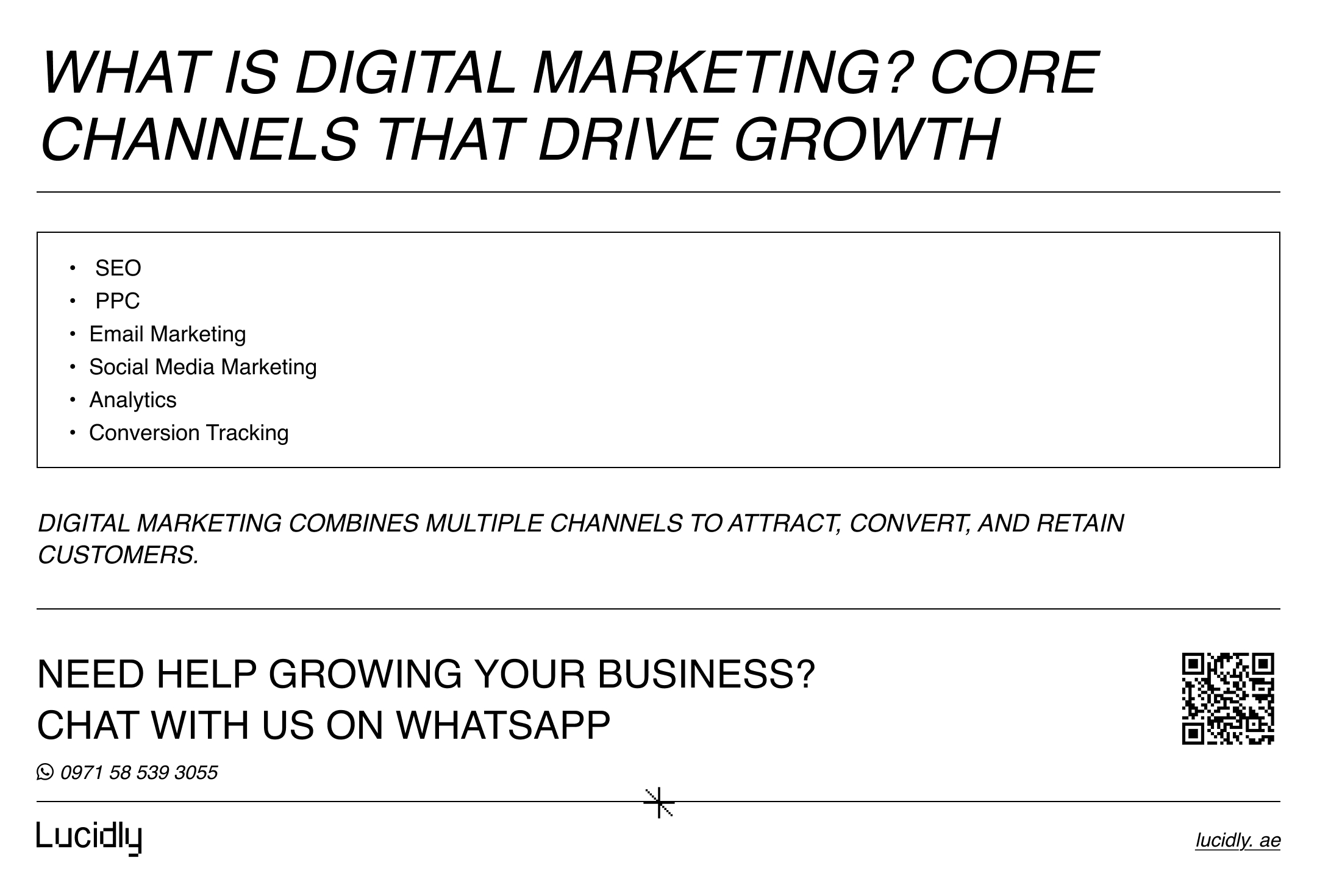
When people ask, what comes under digital marketing, they are usually asking which channels and activities are included.
Digital marketing is not one tactic. It is a group of connected channels and systems.
SEO
SEO helps businesses appear in organic search results when users look for information, services, or products. It supports long-term visibility, trust, and qualified traffic.
PPC
PPC, including Google Ads and paid search campaigns, helps businesses appear faster for targeted searches. It is often useful when a business wants immediate visibility, quick testing, or direct response traffic.
Content marketing
Content marketing includes blogs, landing pages, guides, videos, and other educational or persuasive assets. It helps attract traffic, answer search intent, and support conversion.
Email marketing
Email marketing helps businesses nurture leads, stay visible, recover abandoned opportunities, and encourage repeat engagement or repeat sales.
Social media marketing
Social media marketing can support awareness, engagement, community building, remarketing, and lead generation, depending on the platform and strategy.
Analytics and conversion tracking
Analytics is what turns activity into learning. It helps businesses see which channels bring results, where users drop off, and which actions create value.
These are the core building blocks of understanding digital marketing in a business context.
Types of Digital Marketing Explained
There are many types of digital marketing, but most can be grouped into practical categories.
Organic digital marketing
This includes SEO, organic content, and non-paid visibility strategies. Organic channels often take longer to build, but they can produce compounding returns and stronger trust over time.
Paid digital marketing
This includes PPC, paid social, display ads, video ads, and sponsored placements. Paid channels are useful when speed, scale, and tighter audience targeting matter.
Owned digital marketing
Owned channels are assets the business controls directly, such as its website, email list, blog, and landing pages.
Earned digital marketing
Earned visibility includes mentions, shares, backlinks, reviews, and other exposure gained through credibility, relevance, or audience response.
This breakdown helps explain digital marketing what is it in a more useful way. It is not only about ads. It includes owned, organic, and paid systems working together.
Digital Marketing Examples in Real Business Situations
Clear digital marketing examples make the concept easier to apply.
Example 1: Local service business
A local business uses SEO to rank for service keywords, runs Google Ads for urgent searches, sends visitors to a focused landing page, and tracks calls and form submissions. This setup supports lead generation directly.
Example 2: Ecommerce brand
An online store runs PPC campaigns for product demand, uses email marketing for abandoned carts and repeat offers, improves product page content, and retargets visitors through social media ads. This supports both new sales and retention.
Example 3: B2B company
A B2B company publishes useful articles, offers downloadable resources, uses LinkedIn campaigns for targeted reach, and follows up through email nurturing. This supports a longer customer journey and helps qualify leads before the sales conversation.
These examples show that how to do digital marketing depends on the business model, the offer, and the buying process.
The Digital Marketing Funnel for Leads and Sales
The digital marketing funnel explains how businesses move people from first attention to final action.
Awareness
At the top of the funnel, the goal is visibility. SEO, content marketing, social media marketing, and video content often play a major role here.
Consideration
At this stage, users compare options and look for proof, clarity, and relevance. Service pages, comparison content, reviews, case studies, and email follow-up become more important.
Conversion
Now the user is closer to action. Strong landing pages, good offers, PPC campaigns, clear calls to action, and friction-free forms can make a major difference.
Retention
After the first conversion, businesses can use email marketing, remarketing, and repeat engagement strategies to increase customer lifetime value.
A strong digital marketing strategy does not focus only on awareness. It supports the full path from attention to trust to action.
Fundamentals of Digital Marketing Every Business Should Understand
The fundamentals of digital marketing are more important than chasing every new tactic. Many weak strategies fail because the basics were never clear.
Audience clarity
A business must know who it wants to reach, what that audience needs, and what problems it wants solved.
Offer clarity
If the offer is vague, the marketing will be weak. The audience needs to understand what is being offered and why it matters.
Channel fit
Not every channel is right for every business. A company should choose channels based on audience behavior, buying intent, and internal resources.
Strong content and pages
Traffic without strong pages usually underperforms. Content must match intent, build trust, and support the next step.
Conversion tracking
Without tracking, businesses often confuse activity with progress. Conversion tracking helps connect marketing effort to real outcomes.
Continuous improvement
Digital marketing improves through testing, review, and adjustment. That is one reason it can be more effective than static promotion.
How to Do Digital Marketing Step by Step
If someone asks, how do I start digital marketing, the answer should be practical.
1. Set a business goal
Start with one clear objective. That could be more calls, more form leads, more bookings, more purchases, or better retention.
2. Understand your audience
Know what people search for, what they care about, what objections they have, and what stage of the customer journey they are in.
3. Choose the right channels
A business does not need every channel at once. It needs the right mix. That might be SEO and PPC. It might be content marketing and email marketing. It might be social media marketing plus remarketing.
4. Build the right destination pages
Traffic needs somewhere useful to go. Service pages, landing pages, product pages, and lead forms must be clear and conversion-focused.
5. Set up analytics and conversion tracking
Before scaling, a business should know how it will measure success. Google’s official documentation emphasizes key events, conversions, and business-relevant actions, which is why setup matters early.
6. Launch, review, and improve
Digital marketing is not a one-time action. It improves through repeated learning. Review traffic quality, conversion rate, cost per lead, search queries, and landing page performance.
This is the simplest way to approach marketing digital without overcomplicating it.
What Are the Main Channels in Digital Marketing?
The main channels in digital marketing are the ones most businesses use to attract, convert, and retain customers.
Channel | Main Role | Best Use |
SEO | Organic visibility | Long-term traffic and trust |
PPC | Paid visibility | Fast demand capture |
Content marketing | Education and trust | Search intent and nurturing |
Email marketing | Follow-up and retention | Lead nurturing and repeat sales |
Social media marketing | Reach and engagement | Awareness and remarketing |
Analytics | Performance measurement | Better decisions and optimisation |
This overview helps answer both what comes under digital marketing and what are the main channels in digital marketing.
Common Digital Marketing Mistakes That Hurt Results
Many businesses do digital marketing without building a real system. That often leads to weak results.
Chasing traffic without lead generation: Traffic alone does not produce business growth. The real goal is qualified traffic that leads to action.
Using too many channels too early: Trying to do everything at once often creates weak execution. Focus usually works better than early complexity.
Ignoring conversion tracking: Without analytics, a business cannot tell which channels, campaigns, or pages are producing value.
Weak landing pages: A campaign can bring the right visitor, but poor page structure, weak messaging, or friction can still reduce performance.
Inconsistent messaging: If ads, pages, emails, and social content all sound different, trust becomes harder to build.
Treating digital marketing as separate tactics: The strongest results usually come when SEO, PPC, content marketing, email marketing, and analytics work together.
How Do I Start Digital Marketing?
The best way to start digital marketing is to keep it simple.
Choose one clear goal. Identify one main audience. Pick one or two realistic channels. Build a clear page or offer. Set up measurement. Then improve based on what the data shows.
A small business might start with local SEO and a lead form. An ecommerce business might begin with PPC and email recovery flows. A B2B company might begin with content marketing and LinkedIn lead generation.
The right first step is not the same for every business, but the structure is similar: goal, audience, channel, page, tracking, improvement.
For businesses looking for a more structured and confident starting point, Lucidly can be a practical partner in building digital marketing that supports real growth.
How Do I Make Money From Digital Marketing?
People usually make money from digital marketing in four main ways.
Selling products
An ecommerce business uses traffic, product pages, and campaigns to generate direct purchases.
Selling services
A service business uses digital marketing to bring in qualified leads, calls, and booked consultations.
Generating leads for later sales
Some businesses do not sell immediately online. They use digital marketing to collect enquiries, demo requests, or consultations that later become revenue.
Building customer value over time
Email marketing, remarketing, and retention campaigns help businesses earn more from existing customers, not just new ones.
So if someone asks, how do I make money from digital marketing, the answer is not only through traffic. It is through a well-built system that turns attention into business outcomes.
FAQ
What is digital marketing in simple words?
Digital marketing means promoting a business online through channels like SEO, PPC, email marketing, content marketing, and social media marketing to attract people and turn them into leads or customers.
How does digital marketing work?
It works by bringing the right audience to a business through digital channels, guiding them through the customer journey, and improving results through analytics and conversion tracking.
What comes under digital marketing?
SEO, PPC, content marketing, email marketing, social media marketing, analytics, landing pages, online branding, and lead generation systems all come under digital marketing.
Why is digital marketing important for business?
It helps businesses become visible online, reach the right audience, generate leads, support sales, and measure performance more clearly.
What are the main channels in digital marketing?
The main channels are SEO, PPC, content marketing, email marketing, social media marketing, and analytics.
How do I start digital marketing?
Start with a clear goal, understand your audience, choose one or two channels, build a strong page or offer, and track results from the start.
What are the 4 types of digital marketing?
A practical way to group them is organic, paid, owned, and earned digital marketing.
How do I make money from digital marketing?
You make money from digital marketing by generating leads, selling products or services, improving conversions, and increasing customer value over time.
What is digital marketing? It is the structured use of digital channels to attract attention, build trust, generate leads, and support sales.
The businesses that perform best usually do not chase every platform. They focus on the right audience, the right message, the right channels, and the right measurement.
That is what turns digital marketing from scattered activity into a real growth system.
For businesses that want a clearer digital marketing strategy focused on leads, sales, and measurable growth, Message Lucidly on WhatsApp or use the phone numbers listed on the Contact Us page
References
Google Analytics Help.