Keyword research is the difference between content that ranks and content that disappears. In 30 minutes, you can uncover the exact phrases your customers type into Google, spot the intent behind them, and choose keywords you can realistically win.
This guide walks you through a proven 2026 workflow: collect real customer language, expand it with free data, check keyword volume and difficulty, and prioritize long-tail terms that drive qualified leads—not vanity traffic. Then map each keyword to the right page.
Want Lucidly to find the keywords your customers actually use? Message Lucidly on WhatsApp for a free website evaluation.
What Is Keyword Research in SEO?
At its core, keyword research in SEO is the process of finding the exact queries people type into Google—and using them to decide what pages to create, what to say on them, and how to structure your site.
Done right, it tells you three things fast: what your customers want (search intent), how many people want it (keyword volume), and how hard it is to win (keyword difficulty).
That’s why keyword research isn’t a “blog task”—it’s a revenue filter.
It helps you stop guessing and start targeting terms that can actually bring qualified leads.
Why Keyword Research Still Matters in 2026
Search engines have evolved, but the fundamentals haven’t changed: they still match queries to the most relevant, useful pages.
According to Google’s Search Central guidance, Google’s ranking systems are designed to prioritize helpful, reliable information for people—not content created mainly to manipulate rankings.
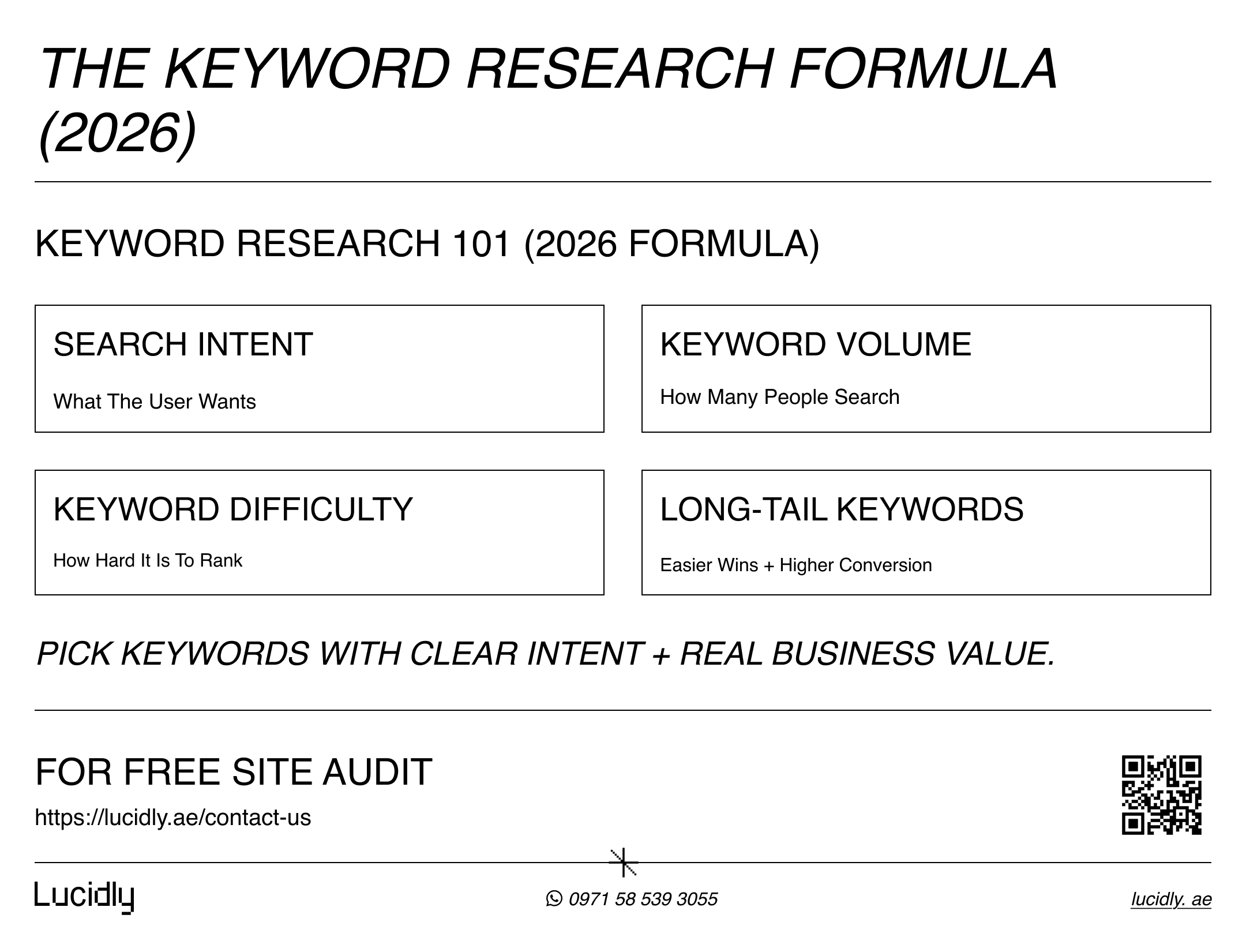
Keyword research matters because it helps you:
Capture real demand instead of guessing topics.
Match search intent (so your page fits what users want).
Prioritize opportunities using keyword volume and keyword difficulty.
Find long-tail keywords that are easier to win and convert better.
Track search trends to spot rising demand before competitors.
The 2026 Keyword Research Workflow (Step by Step)
If you want keywords your customers actually use, you need a repeatable process—not brainstorming.
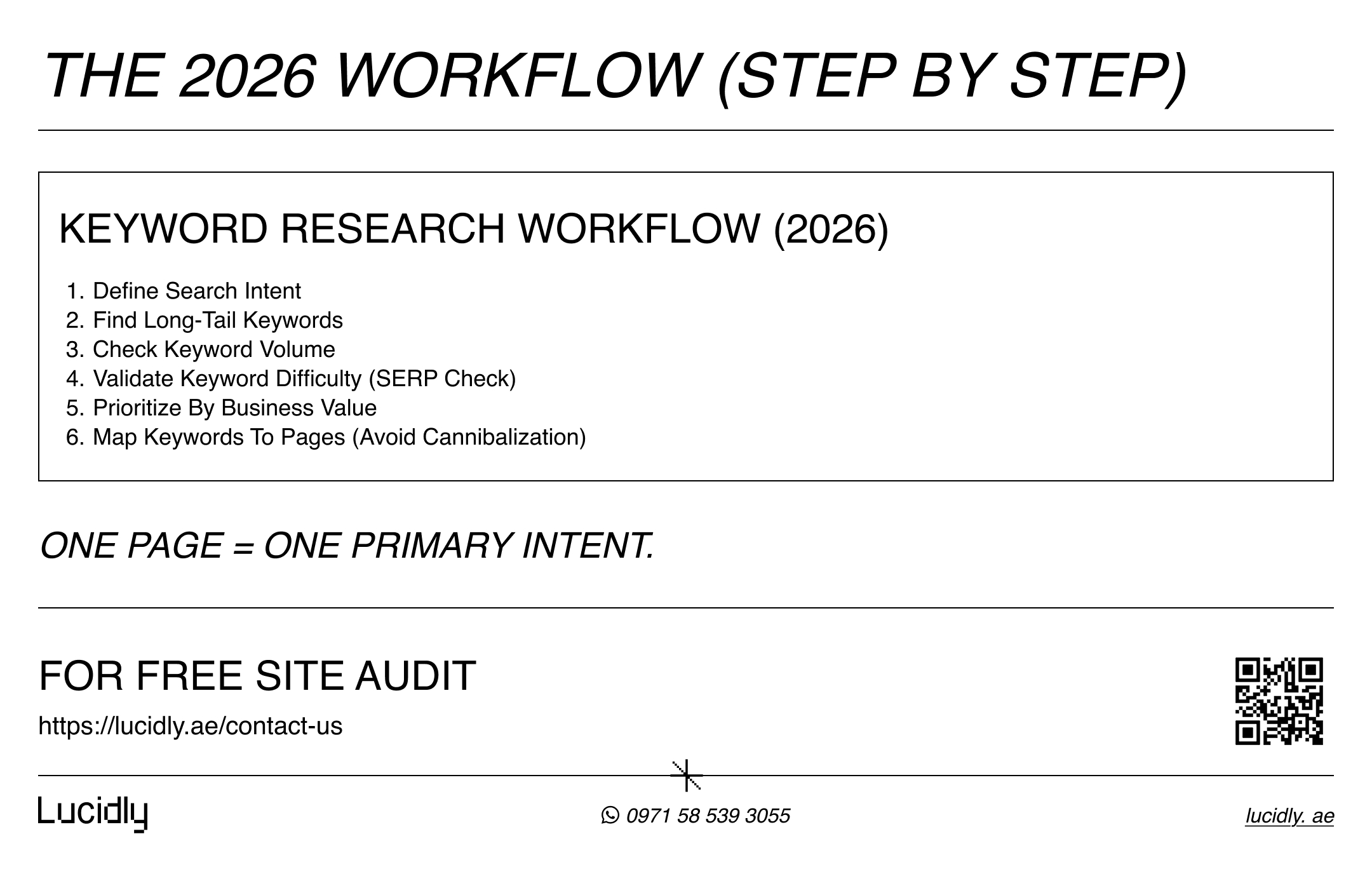
This workflow takes you from raw ideas to a prioritized list you can confidently build pages around:
Start with search intent: what the user is trying to do (learn, compare, buy).
Expand into long-tail keywords: specific phrases with clearer intent and easier wins.
Validate demand: check keyword volume so you don’t target “zero-search” terms.
Assess competition: use keyword difficulty (and SERP reality checks) to pick. battles
Follow search trends: spot rising queries before they get crowde.
Now, let’s break this workflow down and go deeper into each step—starting with search intent.
1- Start With Search Intent (Not Keywords)
Before you look at volume or difficulty, get clear on search intent—what the user actually wants. In most cases, intent falls into these buckets:
Informational (Learn)
The user wants an answer or explanation.
Examples: “what is keyword research”, “how to do keyword research”, “google indexing explained”.Commercial Investigation (Compare)
The user is researching options before choosing.
Examples: “best SEO tools”, “Ahrefs vs Semrush”, “keyword research tool for beginners”.Transactional (Buy/Request)
The user is ready to take action—buy, sign up, or contact.
Examples: “buy SEO service”, “SEO agency Dubai”, “request SEO audit”.Local (Find Nearby)
The user wants a nearby provider or location-based result.
Examples: “SEO company near me”, “SEO services Dubai”, “keyword research consultant Abu Dhabi”.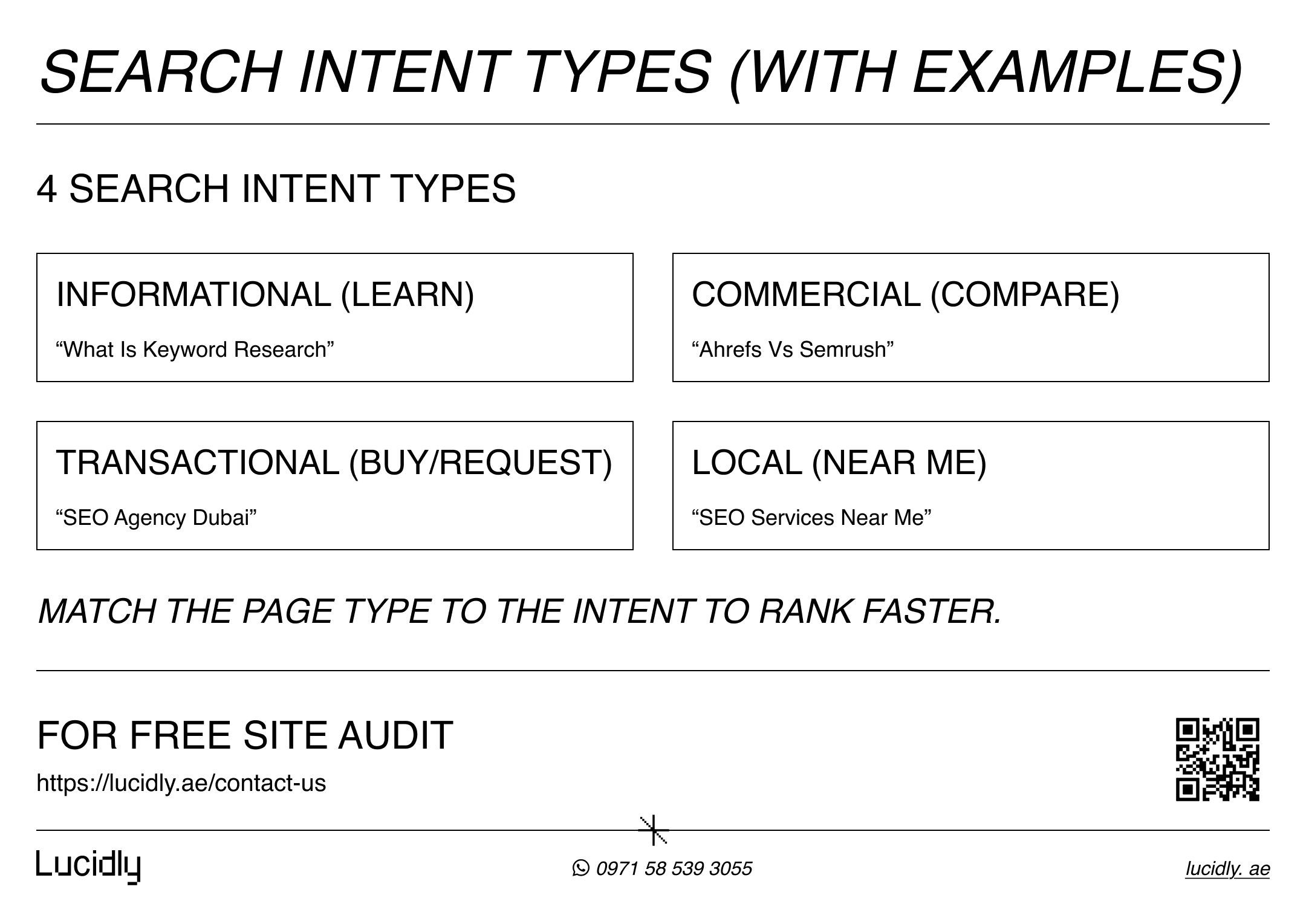
Why this matters: Google ranks pages that match intent, not pages that simply “mention the keyword.” If the query implies pricing or “best,” a basic educational blog post will struggle. Label intent first—then you’ll know what type of page to create.
2- Find Long-Tail Keywords Your Customers Actually Use
Once intent is clear, your next win is long-tail keywords—specific, multi-word queries that reveal exactly what the searcher wants.
They usually have lower volume, but higher conversion potential, because the intent is sharper.
The fastest way to find them is to start with a broad seed term, then add real-world modifiers your customers use (price, problem, location, comparison, brand).
Long tails also make content planning easier: you can build one strong page around a main topic, then include related long-tail variations as supporting sections.
Example (seed → long tails):
Seed keyword: “keyword research”
Long tails:
1- “keyword research for SEO beginners”
2- “how to do keyword research for a new website”
3- “keyword research tool free”
4- “keyword research for local businesses in Dubai”
5- “how to choose keywords for a service page”
3- Check Keyword Volume (So You Don’t Chase “Zero Demand”)
Once you have a list, sanity-check demand with keyword volume.
Google Ads’ Keyword Planner uses historical search data to provide estimates and forecasts, so treat keyword volume as directional—not exact.
Volume isn’t perfect, but it helps you avoid building pages for terms nobody searches. Use it as a filter—not a goal. In practice, you want a mix: a few higher-volume terms for reach, plus many long-tail keywords for easy wins and qualified leads.
Also watch out for misleading numbers: the same topic can be searched in multiple ways (synonyms, spelling variants, Arabic/English phrasing), and volume tools may split that demand across different keywords.
Your job is to spot the topic-level opportunity, not obsess over one exact phrase.
4- Evaluate Keyword Difficulty (Pick Battles You Can Win)
Keyword difficulty is a shortcut—nothing more. It helps you quickly estimate whether a keyword is a near-term win or a long-term play. But the real test is simple: can you realistically publish a page that’s better than what’s already on page one?
Use difficulty to screen keywords, then confirm with a fast SERP check:
If the top results are mostly big brands + deep guides: expect a longer climb
If the results are thin, outdated, or off-intent: you’ve likely found an opening
If you can create the clearest, most complete answer for the intent: it’s a good target
Rule of thumb: target keywords where you can realistically create the most helpful page on the topic.
5- Prioritize Keywords (Pick Winners, Not Just Ideas)
Now you’ll have more keywords than you can target. The goal is to prioritize the ones most likely to drive results. A simple way to do it is to score each keyword on four factors:
Search intent: does it match what you offer—and what the user wants?
Keyword volume: is there enough demand to justify a page?
Keyword difficulty: can you realistically compete right now?
Business value: will this query attract qualified leads or buyers?
Rule: prioritize keywords with clear intent + strong business value, then choose the ones with the best volume-to-difficulty balance.
6- Map Keywords to Pages (Avoid Cannibalization)
Keyword research only works if you turn it into a clear site plan. That means assigning each keyword cluster to the right page.
The rule is simple: one page = one primary intent. If you try to target different intents on the same page, you dilute relevance.
If you create multiple pages targeting the same intent, you risk keyword cannibalization—your pages compete with each other, and none of them ranks as well as it could.
Practical mapping tips:
If you’re building for users in the UAE, structured breadcrumbs can also support SEO—the UAE Design System highlights Schema.org microdata breadcrumbs as an SEO-friendly pattern.
Use one primary keyword per page, then add closely related long-tail variations as secondary targets.
If two keywords have the same intent, they usually belong on the same page.
If two keywords have different intents (pricing vs guide), they need different pages.
7- Turn Keywords Into a Content Brief That Actually Ranks
A keyword list is not a strategy until you turn it into a page plan. Your content brief should make the intent impossible to miss—and make writing (and ranking) predictable.
For each target keyword, define:
Primary intent: what the user wants (learn, compare, buy, local)
Page type: blog post, service page, product page, landing page
Core angle: “best”, “pricing”, “template”, “step-by-step”, “for beginners”
Outline: H1 + H2/H3 sections that fully answer the query
Supporting keywords: long-tail variations to include naturally
FAQ block: questions people ask (great for SEO and AI overviews)
Internal links: where this page fits in your site (and what it should link to)
Rule: Write for intent first. Keywords guide structure—but the goal is the best answer on the page.
Get better results and learn on-page seo basics and How Search Engines Work with us.
Do You Need Paid Tools for Keyword Research?
No—not to get started. You can do strong keyword research with free tools like Google Autocomplete, “People also ask,” related searches, Google Trends, Google Keyword Planner, and Google Search Console.
These are perfect for discovering real queries, understanding intent, and spotting search trends.
Paid tools—like Semrush, Ahrefs, Moz, SE Ranking, and KWFinder (Mangools)—become worth it when you need faster expansion, competitor gap analysis, and quicker prioritization at scale.
The rule is simple: start free, upgrade when time and competition demand it.
Learn more and request on-page support on our Best SEO company in Dubai page.
Common Keyword Research Mistakes (2026 Edition)
Even a solid keyword list can fail if you make a few classic mistakes. Here are the ones that hurt rankings—and lead quality—most often:
Chasing volume and ignoring intent
High volume doesn’t help if the query attracts the wrong audience.Targeting too many intents on one page
A page can’t be “pricing,” “best,” and “how-to” at the same time without losing focus.Skipping the SERP check
If Google is ranking service pages and you publish a blog post, you’re fighting the current.Picking keywords you can’t realistically win
If page one is dominated by big brands, start with long-tail terms and build authority first.Not mapping keywords to pages
Without a clear mapping, you create duplicates and cannibalize your own rankings.Forgetting search trends
Demand changes. If you don’t refresh, your “best keyword” can become yesterday’s keyword.
FAQ
What is keyword research in SEO?
Keyword research is the process of finding the exact queries people search for and using them to plan pages that match search intent, demand (keyword volume), and competition (keyword difficulty).
How do I choose the right keywords?
Choose keywords with clear intent, strong business value, realistic difficulty, and enough volume to justify a page. Prioritize long-tail keywords first for faster wins.
Do I need paid tools for keyword research?
No. You can start with free sources like Google Autocomplete, “People also ask,” related searches, Google Trends, Keyword Planner, and Search Console. Paid tools help you move faster and analyze competitors.
How many keywords should I target per page?
Start with one primary keyword per page (one main intent), then include a small set of closely related long-tail variations naturally. If the intent changes, it’s a new page.
Keyword research isn’t about collecting as many keywords as possible—it’s about choosing the right opportunities.
When you focus on search intent, build out long-tail keywords, validate demand with keyword volume, and sanity-check competition with keyword difficulty, you stop guessing and start targeting terms that bring qualified leads.
Keep it simple: pick winnable keywords, map them to the right pages, and refresh based on search trends as demand shifts.
Contact us to get a free website evaluation—message Lucidly on WhatsApp and we’ll highlight what’s holding you back.
References
Google Search Central — Creating Helpful, Reliable, People-First Content: https://developers.google.com/search/docs/fundamentals/creating-helpful-content Google for Developers (Google for Developers)
Google Ads Help — About Keyword Planner forecasts: https://support.google.com/google-ads/answer/3022575 Google Ads Help (Google Help)
UAE Design System (gov.ae) — Breadcrumbs + Schema.org microdata (SEO): https://designsystem.gov.ae/docs/components/breadcrumbs UAE Design System (UAE design system)