What Is SEO?
SEO (search engine optimization) is the process of improving your website so it appears higher in Google search results and other search engine results pages (SERPs).
The goal of SEO is to increase organic traffic by making your pages more relevant, accessible, and trustworthy for both search engines and users.
For businesses, SEO boosts online visibility, drives qualified leads, and supports a long-term digital marketing strategy—especially as AI-powered results summarize the best answers.
It strengthens brand credibility and authority. Done well, SEO connects what you offer with people actively searching, turning searches into customers.
Want Lucidly to handle your SEO for you? message us on WhatsApp to get a free SEO audit and a practical plan for growth.
What Is SEO in Simple Terms? What It Means and Why It Matters
If you’re wondering what is SEO in simple terms, it’s how search engines decide which pages deserve to show up when people search online.
In practice, SEO helps the right customers find your business at the exact moment they’re looking for what you offer—whether that’s a service, product, answer, or local provider.
What SEO means for a business isn’t “gaming Google.” It’s building pages that deserve to rank—clear, helpful, fast, and credible.
That usually includes aligning content with user intent, structuring pages so they’re easy to understand, ensuring strong technical performance, and earning trust signals from other reputable websites.
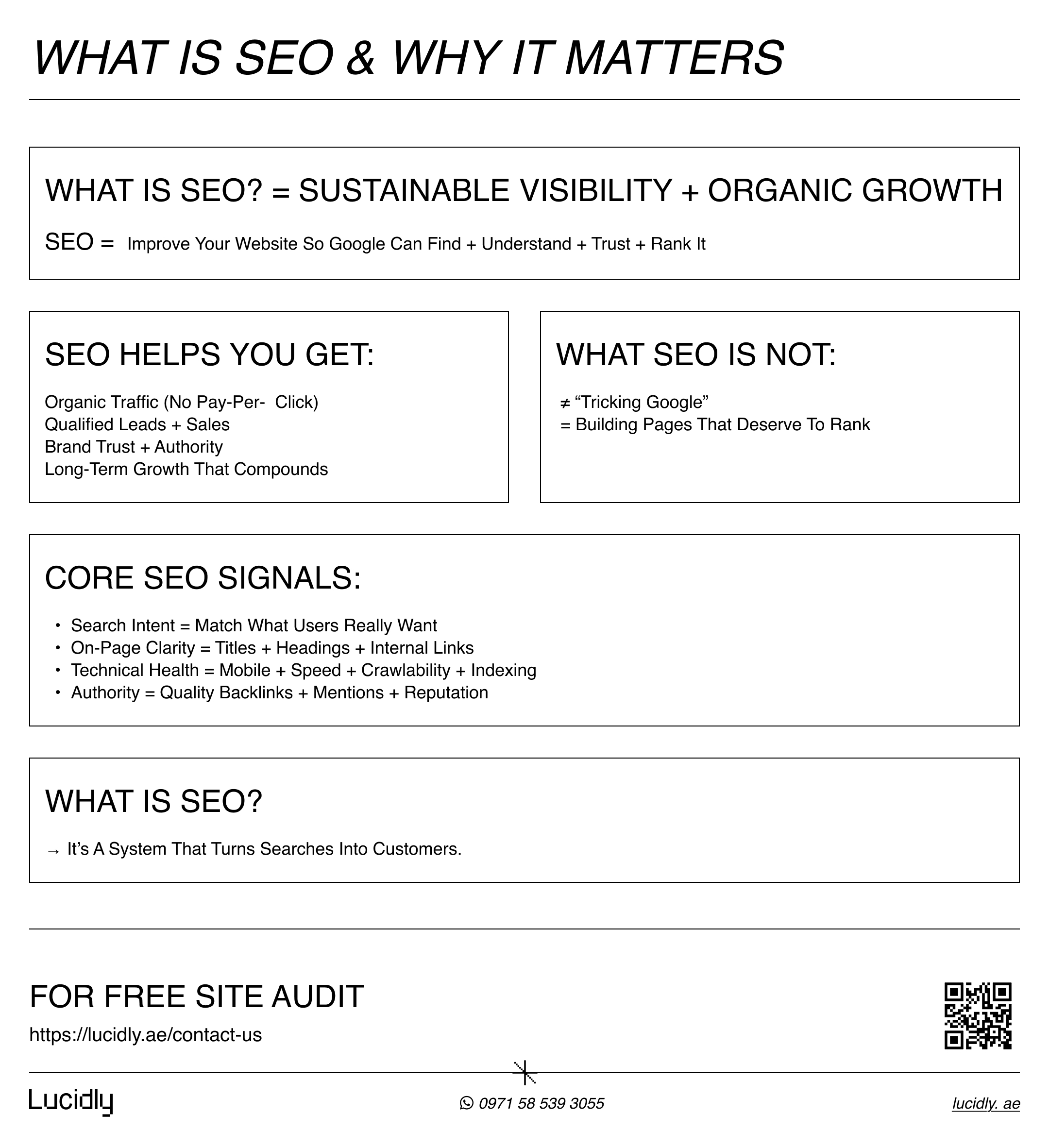
When SEO is done well, it turns search demand into long-term visibility, qualified organic traffic, and consistent growth—without relying on paid ads for every click.
and That usually includes:
Matching Search Intent: The Foundation of What Is SEO
Search intent is the real goal behind a query—what the user expects to find when they search.
For example, someone typing “what is SEO” wants a clear explanation, not a sales page. Someone searching “SEO agency in Amsterdam” is more likely comparing providers, reviews, and pricing.
Matching search intent means shaping your page to meet that expectation. This usually involves:
The right format: guide, checklist, or service page
The right depth: a quick, direct answer supported by helpful details
The right next step: examples, FAQs, or a quote request
When your content satisfies search intent quickly and completely, users stay longer, engage more, and are more likely to convert—signals that often correlate with stronger SERP performance and higher organic traffic.
On-Page SEO Signals That Help Google Understand Your Pages
On-page SEO signals are the elements on your page that help both users and search engines understand the topic fast.
Start with a clear title tag that reflects the main keyword and the benefit (not just a generic label).
Use headings strategically: one clear H1, descriptive H2s for the main sections, and H3s to break each section into easy-to-scan answers—this also improves how content is interpreted in SERPs and AI summaries.
Then use internal links to connect related pages (e.g., “keyword research,” “technical SEO,” “link building”) so search engines can discover more of your site and users can move deeper into your content.
The best on-page SEO feels natural: it improves clarity, reduces confusion, and guides the reader to the next helpful step.
Solid Technical SEO (Mobile Usability, Speed, Crawlability, Indexing)
Technical SEO is the foundation that makes your website easy for search engines to access and reliable for users to use. Even the best content can underperform if Google can’t crawl it properly, pages load slowly, or the site breaks on mobile devices.
Strong technical SEO focuses on removing friction and ensuring your site works smoothly across key areas, including:
Mobile usability: readable layouts, responsive design, and tappable elements that work well on small screens
Speed and performance: fast loading times, stable pages, and good Core Web Vitals
Crawlability: clean site architecture, working internal links, and accurate XML sitemaps that help search engines find your pages
Clean indexing: avoiding duplicate content, using canonical tags correctly, and applying noindex only where it truly makes sense
When these technical foundations are in place, search engines can discover, understand, and rank your content more consistently. In short, solid technical SEO protects your rankings, supports long-term visibility, and allows your content to perform at its full potential.
Off-Page SEO: Building Authority, Trust, and Rankings
Off-page SEO builds credibility beyond your website. If you’re learning what is SEO, this is the part that proves your site deserves trust compared to competitors. It focuses on how your brand is perceived across the web—not just what’s on your pages.
The strongest signal is high-quality backlinks from reputable, relevant websites. However, off-page SEO goes beyond links. It also includes:
Brand mentions across trusted websites and media
PR coverage and digital press exposure
Expert citations and references
Reviews and online reputation, especially for local businesses
The goal isn’t more links—it’s better links. A few strong references from trusted sources can outperform hundreds of low-quality links. Sustainable off-page growth comes from earning attention, not forcing it. That includes:
Publishing standout, link-worthy resources
Doing digital PR and thought leadership
Building real partnerships
Strengthening overall brand presence
All while avoiding risky shortcuts like spammy link schemes that can damage trust.
Result: stronger online visibility on search engine results pages (SERPs) and steady organic traffic—without paying for every click like paid ads.
SEO matters because it compounds. A well-optimized page can bring qualified visitors for months or years, support your wider digital marketing strategy, improve trust in your brand, and generate leads and sales consistently.
It also helps your content perform across modern search features—like snippets, local packs, and AI-driven summaries—because structured, trustworthy pages are easier to interpret and recommend.
How Does SEO Work? Crawling, Indexing, and Ranking
If you’re wondering what is seo in practice, it helps to think of search engines as systems that find, understand, and choose pages.
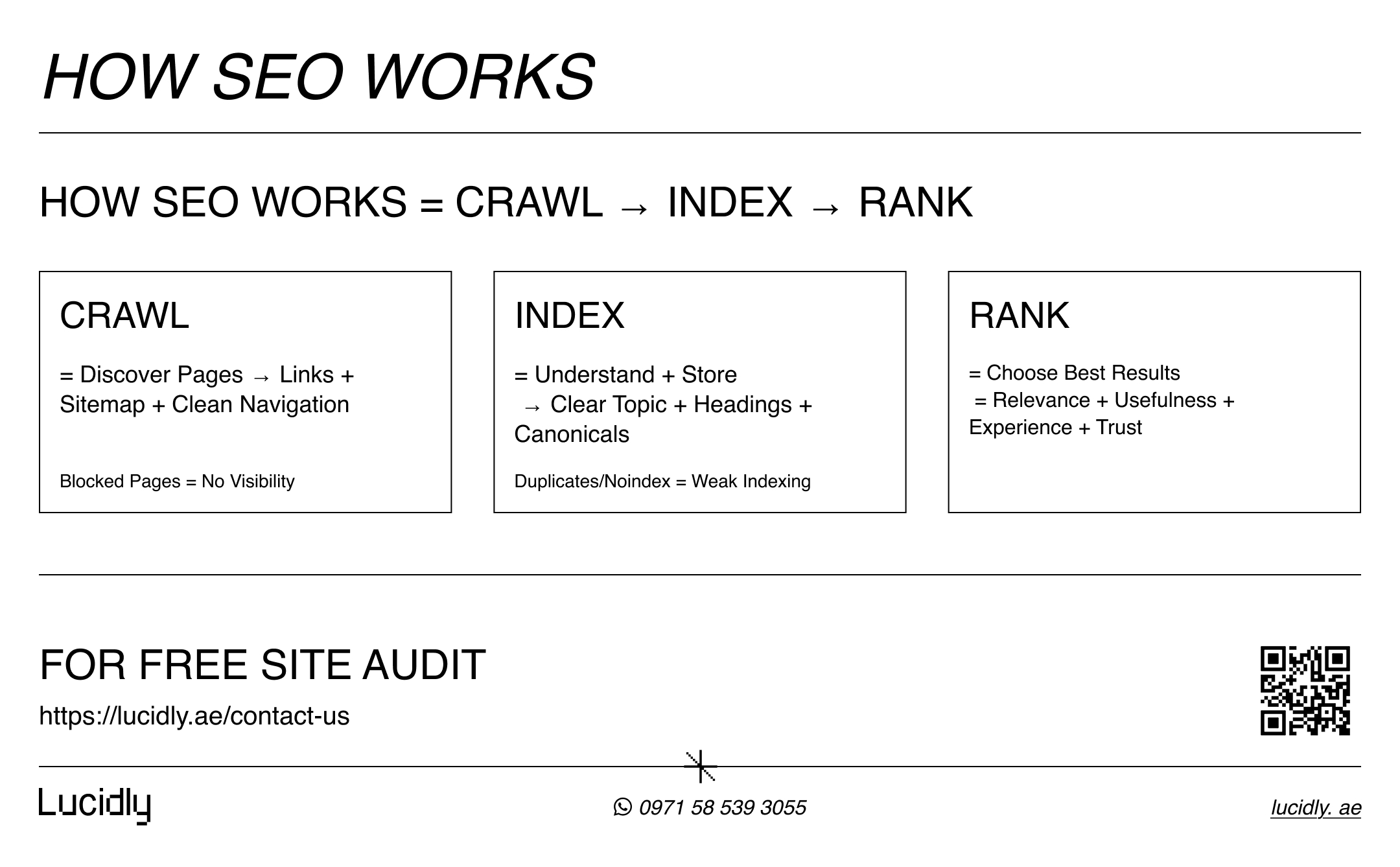
At a high level, every page must pass three gates: crawling (being discovered), indexing (being understood and stored), and ranking (being selected for top results). If a page fails at any gate, visibility drops—no matter how good the content is.
Crawling (How Search Engines Discover Your Pages)
Search engines use bots to follow links and read sitemaps to discover pages. Crawling improves when your site has clean navigation, strong internal links, and no accidental blocks (like robots.txt mistakes).
Pages that are buried, orphaned (no internal links), or behind broken redirects may be crawled less—or missed entirely.
Indexing (How Search Engines Understand and Store Content)
After crawling, the search engine tries to understand what the page is about and whether it’s worth adding to its index.
Clear structure helps: descriptive titles, logical headings, focused topics, and consistent internal linking. Indexing issues often come from duplicates, thin pages, conflicting canonical tags, or “noindex” applied to important content.
Ranking (How Google Chooses What Shows Up First)
When someone searches, the engine compares indexed pages and ranks them based on relevance and quality. The biggest drivers are typically:
Relevance: does the page match the query and search intent?
Usefulness: does it answer thoroughly and clearly?
Experience: is it fast, mobile-friendly, and easy to use?
Trust/authority: do reputable sources and signals support it?
Together, these three steps explain what is seo at a system level—not tactics, but how search engines actually decide who ranks.
learn more about: How Search Engines Work.
The SEO Loop (How You Improve Over Time)
SEO is iterative: publish or optimize a page, monitor performance (impressions, clicks, rankings), then improve content, internal links, and technical issues based on what’s working and what’s not. This is how small wins compound into long-term growth.
Why Is SEO Important for Your Business?
SEO is important because it puts your business in front of people exactly when they’re searching—on Google and other search engine results pages (SERPs).
Instead of interrupting an audience, SEO captures existing demand and turns it into online visibility, qualified organic traffic, and measurable growth.
SEO Increases Online Visibility Where Buyers Already Search
Most customer journeys start with a search—even for local services. Ranking for the right queries means your brand shows up consistently for high-intent phrases, not just your name. That visibility builds familiarity and keeps you in the consideration set.
SEO Brings Higher-Quality Traffic (Not Just More Traffic)
When you target the right keywords and match search intent, you attract visitors who are actively looking for what you offer.
That usually leads to better engagement, more inquiries, and stronger conversion rates compared to random social traffic.
SEO Compounds and Lowers Customer Acquisition Cost Over Time
Paid ads can work fast, but the moment you stop paying, the traffic stops. SEO is different: a strong page can keep earning clicks for months or years. Over time, this can reduce your reliance on paid channels and lower your cost per lead.
SEO Builds Trust and Credibility
People trust what ranks. Strong SEO forces you to improve clarity, usefulness, site experience, and authority signals.
That makes your website feel more professional—and trust directly impacts conversions, especially in competitive markets.
SEO Supports Your Entire Digital Marketing Strategy
SEO improves more than rankings. Better site structure and content help email, PPC, social, and sales teams because you’re creating clearer messaging, stronger landing pages, and content that answers real customer questions.
Want a done-for-you SEO strategy that improves rankings and brings qualified leads? request the service from our Professional SEO company in Dubai.
SEO for Beginners: A Practical Step-by-Step Plan
If you’re new to SEO and asking what is seo in practical terms, don’t try to “do everything” at once. SEO works best as a simple, repeatable system.
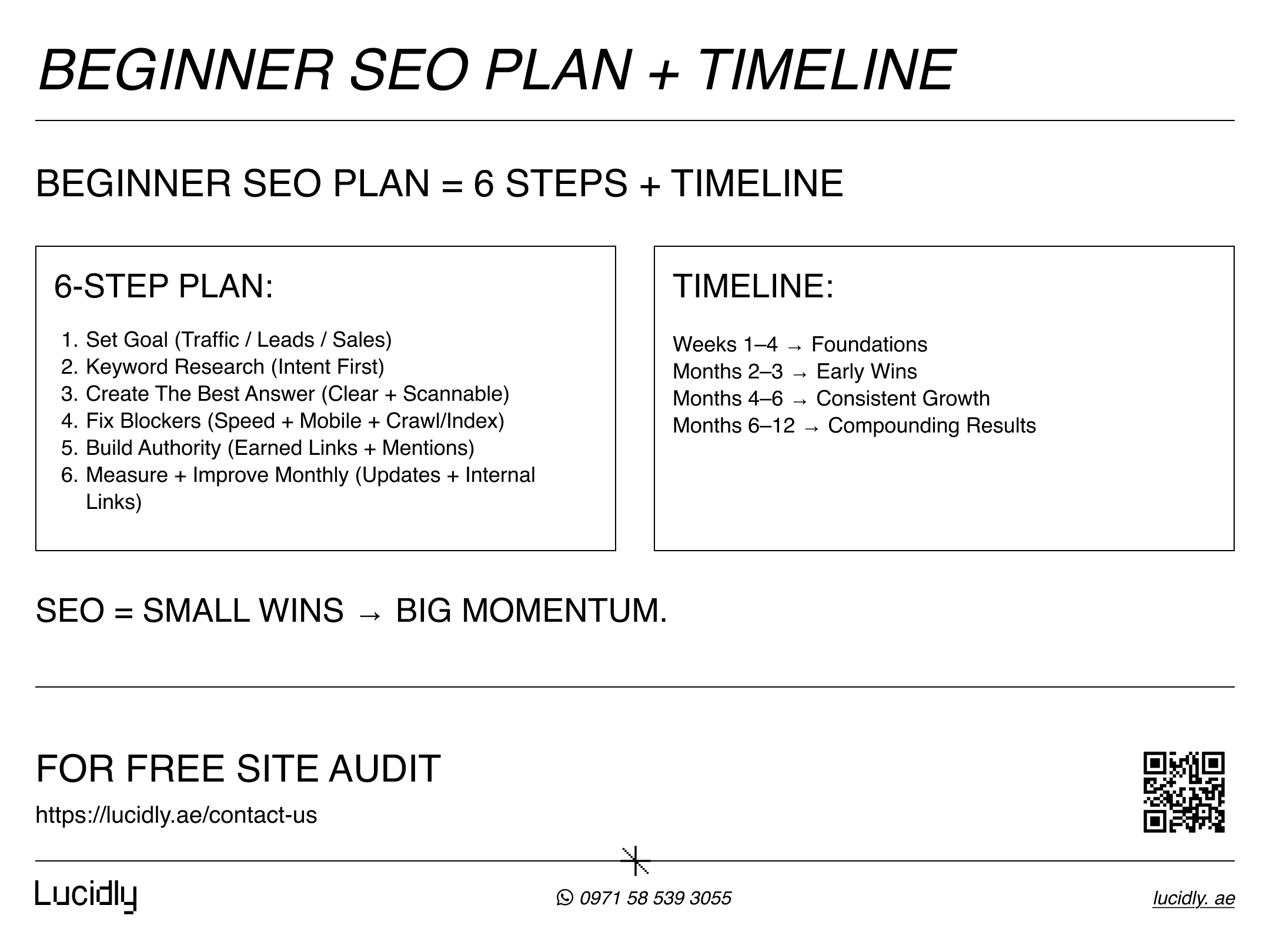
The fastest path is to set a clear goal, target the right keywords, publish pages that satisfy search intent, fix technical blockers, build trust gradually, then measure results and improve over time.
Step 1 — Set Goals (Traffic, Leads, or Sales)
Define what success means: more calls, form submissions, bookings, or ecommerce sales. Your goal determines which keywords you target, which pages you build, and what you track.
Step 2 — Do Keyword Research (Intent First)
Do Keyword Research and Choose keywords based on what your customers are trying to do: learn, compare, or buy. Group keywords into topics (clusters) and map each cluster to one strong page instead of creating many overlapping pages.
Step 3 — Create or Improve Pages That Deserve to Rank
Write content that answers the query clearly, covers the topic fully, and is easy to scan (headings, bullet points, FAQs). Add real examples, clear definitions, and next steps so the page feels complete.
Step 4 — Fix Technical Issues That Block Growth
Make sure important pages are crawlable and indexable, mobile-friendly, fast, and free of duplicate or broken versions. Good technical SEO helps your content get discovered and ranked consistently.
Step 5 — Build Authority Safely (No Shortcuts)
Earn quality backlinks and brand mentions by creating resources worth referencing, doing digital PR, partnerships, and showcasing expertise. Avoid spammy link tactics that can reduce trust.
Step 6 — Measure Results and Iterate
Track impressions, clicks, rankings, and conversions. Improve pages based on what’s already working: update content, strengthen internal links, expand sections, and resolve technical or UX friction.
SEO vs Paid Ads (When to Use Each)
SEO and paid ads (PPC) both drive traffic from search, but they work differently.
Factor | SEO (Organic Search) | Paid Ads (PPC) |
Speed | Slower (weeks to months) | Fast (often same day) |
Cost model | Invest in content/optimization (no cost per click) | Pay per click (or per impression) |
Sustainability | Can keep working long-term after publishing | Stops when budget stops |
Control | Less direct control over placement | High control (targeting, messaging, tests) |
Trust | Often feels more credible for many users | Can feel “ad-like,” but strong for offers |
Best when | You want compounding growth + lower long-term CAC | You need immediate leads/sales or quick testing |
Ideal approach | Build durable traffic + authority | Capture demand now + validate messaging |
How Long Does SEO Take?
SEO is not instant because rankings are earned through discovery, evaluation, and competition. Most businesses start seeing meaningful movement in 3–6 months, while stronger, more stable results often take 6–12 months—especially in competitive industries. The exact timeline depends on your starting point and how much you can invest consistently.
What affects SEO timelines?
SEO isn’t instant because rankings are earned through discovery, evaluation, and competition. According to Google’s Search Central guidance, even after you make improvements, results can take time—some changes may show in a few days, but it can take several months for Google’s systems to learn and confirm site-wide improvement.
In most industries, it’s realistic to expect meaningful movement in 3–6 months, and stronger, more stable gains in 6–12 months—especially when competition is high. This timeline is also reflected in industry benchmarks and month-by-month expectations published by outlets like Search Engine Land and Shopify.
Website age and authority: Established sites with trust signals often move faster than brand-new domains.
Technical health: Crawl/index issues, slow pages, or poor mobile usability can delay results until fixed.
Content quality and intent match: Pages that satisfy search intent clearly tend to improve sooner.
Competition: Ranking for “SEO agency” is harder than “SEO agency for architects in Amsterdam.”
Consistency: Regular publishing and optimization compounds faster than one-off updates.
Backlinks and brand signals: Authority growth accelerates ranking potential over time.
Realistic expectations (what you’ll notice first)
SEO progress usually shows up in stages. Early wins are often about visibility and coverage, before big jumps on competitive keywords.
Weeks 1–4: audits, fixes, keyword mapping, content planning; early indexation improvements
Months 2–3: first ranking lifts on long-tail queries; early organic traffic growth
Months 4–6: stronger visibility on mid-competition terms; more consistent leads
Months 6–12: compounding gains, broader keyword coverage, and more stable top rankings
How to get results faster (without risky shortcuts)
If you want faster progress, focus on actions that remove blockers and improve relevance quickly—without tactics that can backfire.
Fix crawl/index blockers first
Strengthen internal linking to important pages
Refresh pages that already have impressions and partial rankings
Publish a small set of high-intent pages (commercial and local keywords)
Build authority steadily with legitimate links and brand mentions (avoid spam tactics)
Common SEO Mistakes to Avoid
If you’re learning what is seo, it’s just as important to know what not to do. SEO often fails because of small, repeated mistakes that block visibility or waste effort. The good news is that fixing these issues can unlock quick wins and make every future improvement more effective.
Mistake 1: Targeting the wrong keywords (or ignoring search intent)
This usually happens when a page tries to rank for a term that doesn’t match what users want—like writing a sales page for an informational query. The fix is to map each keyword to the right page type (guide, service page, product page) and answer the intent clearly.
Mistake 2: Publishing thin or duplicated content
Pages that repeat what’s already everywhere, or multiple pages that overlap heavily, often struggle to rank. Strong SEO content is specific, complete, and clearly better than the alternatives. Consolidate overlapping pages and upgrade the best one.
Mistake 3: Weak on-page structure (titles, headings, internal links)
If your title is vague, headings are messy, or there’s no internal linking, both users and search engines struggle to understand your site. Use clear H2s for sections, H3s for breakdowns, and link to relevant pages naturally.
Mistake 4: Ignoring technical SEO fundamentals
Slow pages, mobile issues, broken links, indexation errors, and duplicate URLs can silently kill performance. Make sure important pages are crawlable, indexable, fast, and stable.
Mistake 5: Chasing spammy backlinks or “shortcuts”
Buying low-quality links or using link schemes can damage trust and reduce visibility. Focus on earning authority through valuable resources, digital PR, partnerships, and genuine mentions.
Mistake 6: Not measuring what matters
If you only track rankings, you’ll miss the real picture. Measure impressions, clicks, conversions, and which pages actually drive leads/sales—then improve what’s already gaining traction.
What Matters in SEO Today (and What’s a Myth)
SEO is still about one thing: being the best result for the user. What changed is how results look (snippets, local packs, AI summaries) and how competitive most topics have become.
If you focus on fundamentals—helpful content, strong structure, solid technical performance, and real trust—you’ll stay aligned with what search engines reward.
What matters most today:
Intent-first content: pages that answer the query clearly, quickly, and completely
Real usefulness: original insight, examples, depth where needed, and easy scanning
Strong page experience: fast, mobile-friendly, stable pages with low friction
Topical coverage: covering a topic as a whole (clusters) rather than isolated posts
Trust signals: credible brand presence, expert sources, and high-quality backlinks
Clear structure for modern SERPs: headings, FAQs, and formatting that supports snippets and AI summaries
Common SEO Myths (and the Reality)
Many SEO “rules” online are outdated or oversimplified. The table below separates common myths from what actually works today.
Myth | Reality |
“SEO is dead.” | Search behavior is evolving, but businesses still win by being discoverable where customers search. |
“Just add more keywords.” | Keyword stuffing hurts clarity; intent and usefulness matter more than density. |
“Backlinks are all that matter.” | Links help, but weak content and poor UX won’t hold rankings. |
“SEO is a one-time setup.” | Competitors update, SERPs change, and content needs refreshing—SEO is ongoing. |
“AI will replace SEO.” | AI changes presentation, but it still relies on high-quality sources—SEO helps you become one of them. |
Recent SEO Updates and What’s Changing (2026)
SEO fundamentals still win (intent, quality, technical health, trust). What’s changed is the search environment: Google’s AI experiences are expanding, spam enforcement is stricter (especially against scaled/low-value tactics), and core updates continue to reshape visibility.
AI Overviews & AI Mode Are Changing How Visibility Works
Google’s own guidance is clear: the same foundational SEO best practices apply to AI Overviews and AI Mode—there are no special “AI SEO” requirements or new markup needed just to appear there. Your page needs to be indexed and eligible to show in Search (with a snippet).
Practically, this increases the value of:
Clear structure (scannable headings + direct answers)
Text that’s easy to interpret (important info not hidden behind scripts)
Accurate structured data that matches visible content.
Google also notes AI Overviews / AI Mode may use a “query fan-out” approach (multiple related searches) and may show different sets of links, so broad topical coverage + strong internal linking matter more than ever.
Stronger Spam Enforcement (Especially at Scale)
Google’s spam policies (updated 2025-12-10) explicitly call out tactics that try to manipulate rankings at scale, including:
Scaled content abuse (mass-generating pages primarily to manipulate rankings, including via generative AI with little/no added value).
Expired domain abuse (repurposing an expired domain mainly to manipulate rankings with low-value content).
Site reputation abuse (“parasite SEO”: publishing third-party content mainly to borrow a host site’s ranking signals).
Core Updates Continue (Plan for Volatility)
Google’s Search Status Dashboard shows multiple major ranking updates in 2025 (e.g., March 2025 core update, June 2025 core update, August 2025 spam update, and the December 2025 core update—which began Dec 11, 2025 and may take up to 3 weeks).
This is why the safest long-term strategy is still: people-first usefulness, technical reliability, and trust signals—not “shortcuts.”
SEO in the UAE: Driving Business Growth in Dubai and Abu Dhabi
In the UAE, SEO plays a direct role in business growth because customers actively search online—often in both English and Arabic—before contacting a company or requesting a quote.
As the country accelerates its shift toward a technology-driven and digitally enabled economy, supported by national initiatives led by government entities such as the UAE Ministry of Industry and Advanced Technology (MOIAT) (https://moiat.gov.ae/en/), competition in Google search results continues to intensify.
In Dubai, where businesses operate in one of the world’s most competitive commercial environments, SEO helps companies stay visible for high-intent searches and capture demand before competitors do.
At the same time, Abu Dhabi’s rapid digital transformation across government and private sectors has raised customer expectations around online discovery, credibility, and user experience.
In this context, SEO is no longer optional—it is a core marketing channel that connects UAE businesses with ready-to-act customers through local visibility, trust signals, and technically strong websites.
FAQs
What is SEO in simple terms?
SEO is improving your website so it shows up in organic search results when people look for topics related to your business. It helps search engines discover, understand, and trust your pages—so you earn visibility and organic traffic without paying for every click.
Why is SEO important for my business?
Because it brings you customers who are already searching for what you offer. SEO increases online visibility, builds trust, and creates long-term traffic and leads that can compound over time.
How does SEO work?
It works through three steps: search engines crawl your pages, index them (understand/store them), then rank them based on relevance, quality, usability, and authority signals like credible backlinks.
Is SEO worth it for small businesses?
Yes—especially when you target local and niche keywords. SEO can generate steady leads, strengthen credibility, and reduce dependence on paid ads, even with a modest budget.
If you’re still asking what is seo in practical terms, it’s how your business earns sustainable visibility in search results.
SEO works by creating content that matches search intent, improving on-page clarity, strengthening technical performance, and building real trust off-page.
It won’t happen overnight, but when done consistently, SEO compounds into a reliable growth channel—bringing qualified organic traffic, leads, and sales without paying for every click.
Next steps: choose one priority keyword related to what is seo or your core service, map it to the right page type, publish or upgrade a genuinely helpful page, fix any crawl or index blockers, and add internal links to support it. Then track performance and refine monthly based on real data.
Want help turning SEO into consistent traffic and leads? Contact us to get a tailored SEO plan and next steps.
References
Google Search Central — SEO Starter Guide: https://developers.google.com/search/docs/fundamentals/seo-starter-guide Google for Developers
Search Engine Land — How Long Does SEO Take to Work?: https://searchengineland.com/guide/how-long-does-seo-take-to-work Search Engine Land
UAE Design System (gov.ae) — Breadcrumbs + Schema (SEO):https://designsystem.gov.ae/docs/components/breadcrumbs UAE design system