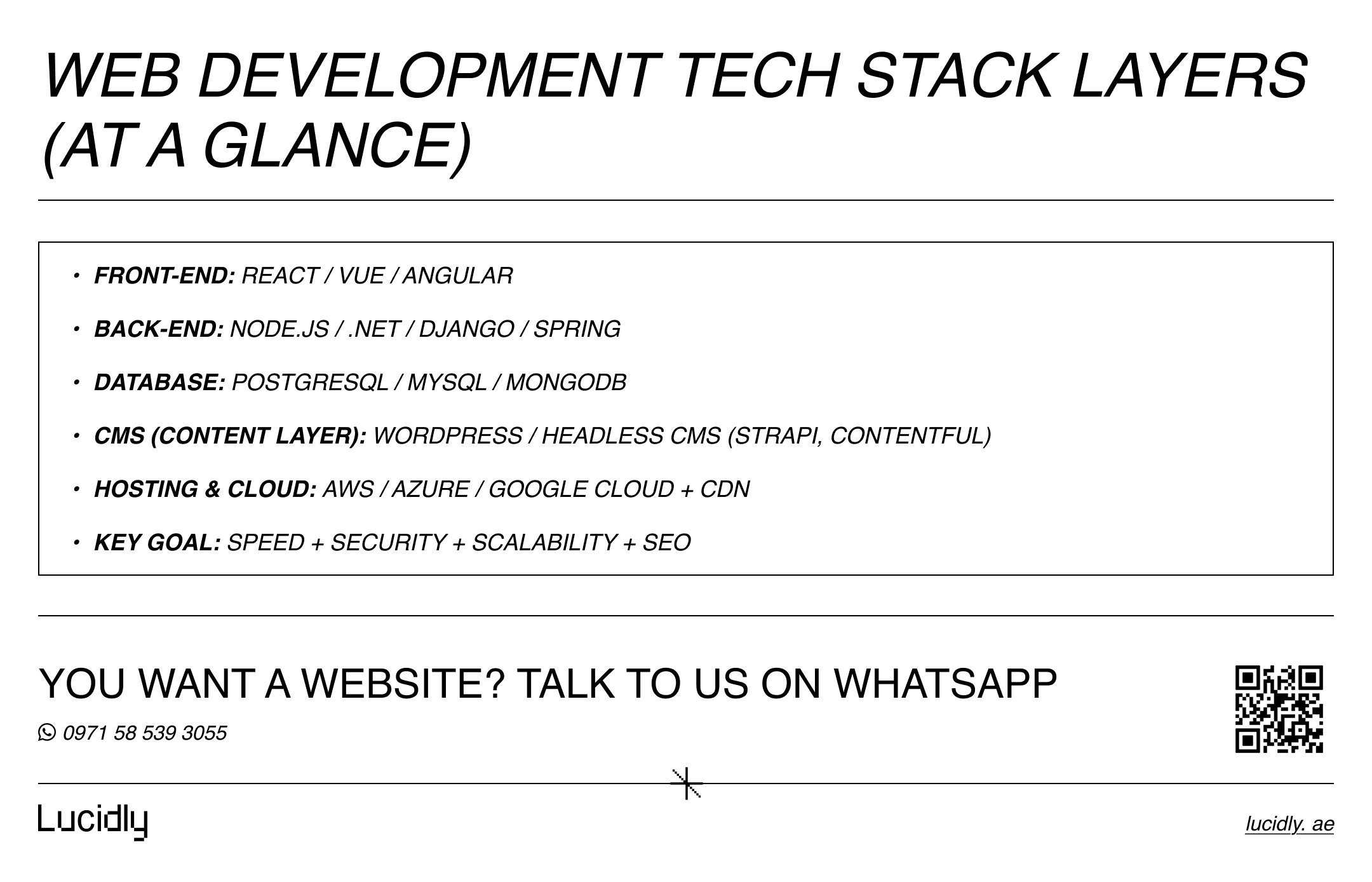
 Choosing the right web development tech stack is one of the most critical decisions in any digital project.
The languages, frameworks, and CMS you select don’t just shape how your website is built—they directly impact scalability, security, performance, and long-term maintenance.
A well-chosen tech stack supports SEO, faster development, and future growth, while a poor choice leads to technical debt and limitations.
This guide explains how to evaluate website technology stack options strategically, with practical insights for modern projects and UAE-based businesses.
Message Lucidly on WhatsApp for a technical website audit—so you can identify security risks, performance gaps, and scalability issues before they become costly problems.
What Is a Web Development Tech Stack and Why Does It Matter?
A web development tech stack refers to the combination of technologies used to build and run a website or web application.
It typically includes front-end technologies (what users see and interact with), back-end technologies (the logic, servers, and databases), and a content layer such as a CMS.
Each layer plays a specific role, but together they determine how fast, secure, scalable, and maintainable a website will be.
Choosing the right stack ensures your site can grow with your business instead of limiting it.
How to Choose the Right Web Development Tech Stack
Choosing the right web technology stack starts with understanding your project’s goals, not with picking the newest tools.
The type of website or application you’re building, expected traffic, scalability needs, and long-term maintenance all influence the decision. Team expertise, development speed, security requirements, and integration needs are equally important.
A strong tech stack balances performance, cost, and flexibility—allowing your product to evolve without constant rebuilds or technical limitations.
Your tech stack starts with how your site is built. This overview of web development services for UAE businesses explains how architecture and code quality affect scalability and performance.
Key Criteria for Evaluating a Website Development Stack
When evaluating a website development stack, focus on these core criteria:
Scalability: Can the stack handle traffic growth and new features without major rewrites?
Performance: Does it support fast load times, smooth interactions, and strong SEO signals?
Security: How well does it protect user data, APIs, and integrations?
Development Speed: Can your team build, test, and launch efficiently?
Maintenance and Cost: How complex and expensive is long-term upkeep?
Team Expertise: Is there strong developer knowledge and hiring availability?
Integration Flexibility: Can it connect easily with third-party tools and platforms?
A strong tech stack balances these factors to support both short-term delivery and long-term growth.
This guide to front-end, back-end, and full-stack web development services in the UAE explains how each layer impacts performance and maintainability.
Choosing Programming Languages for Your Web Development Tech Stack
Programming languages form the foundation of any web application stack, influencing performance, scalability, and development speed.
The right language depends on your product type, team expertise, and long-term goals—not trends alone.
Modern web projects often prioritize languages with strong ecosystems, active communities, and proven stability.
Choosing a language that aligns with your business needs helps reduce technical risk and ensures your stack remains maintainable as the project grows.
Popular Programming Languages and When to Use Each
Different programming languages serve different roles within a modern web stack. The most common options include:
JavaScript / TypeScript: Ideal for full-stack development, especially when using modern front-end frameworks. Strong ecosystem and high demand.
Python: Well-suited for data-driven platforms, APIs, and rapid development with clear, readable code.
C# (.NET): A strong choice for enterprise-level applications requiring security, structure, and long-term stability.
Java: Common in large-scale systems that demand reliability, performance, and complex integrations.
The best choice depends on scalability needs, available talent, and how complex the application will become over time.
Front-End Frameworks in a Modern Website Technology Stack
Front-end frameworks define how users interact with your website and play a major role in performance, usability, and SEO.
In a modern website technology stack, the right front-end framework helps deliver fast load times, smooth navigation, and consistent design across devices.
The choice should balance flexibility, performance, and developer efficiency—especially for content-heavy or conversion-focused websites.
Popular Front-End Frameworks and How to Choose Between Them
The most widely used front-end frameworks in a modern web technology stack include:
React: Highly flexible and widely adopted, ideal for dynamic interfaces and scalable web applications. Strong ecosystem and SEO-friendly when implemented correctly.
Vue.js: Lightweight and approachable, suitable for small to mid-sized projects that need fast development and clean structure.
Angular: A full-featured framework designed for complex, enterprise-level applications with strict architectural requirements.
When choosing a front-end framework, consider project complexity, performance needs, team experience, and long-term maintainability—not popularity alone.
Back-End Frameworks and Architectures
Back-end technologies power the logic, data handling, and integrations behind any web application stack.
They determine how requests are processed, how data is stored, and how securely systems communicate.
A well-chosen back-end framework supports scalability, performance, and clean architecture—making it easier to add features, integrate services, and maintain the application over time.
Popular Back-End Frameworks and When to Use Them
Several back-end frameworks are commonly used in a modern web application stack, each suited to different project needs:
Node.js (Express or NestJS): Ideal for real-time applications, APIs, and projects that benefit from a unified JavaScript stack across front-end and back-end.
Django / FastAPI (Python): Well-suited for data-driven platforms, rapid development, and applications that require clean structure and strong security defaults.
.NET: A reliable choice for enterprise applications that demand performance, security, and long-term support.
Java-based frameworks (Spring): Common in large-scale systems requiring complex business logic and deep integrations.
The right back-end framework depends on scalability goals, integration requirements, and your team’s technical expertise.
Database Technologies in a Web Development Tech Stack
Databases are a core part of any web technology stack, responsible for storing, retrieving, and securing application data. The right database choice affects performance, scalability, and long-term flexibility.
SQL vs NoSQL Databases
SQL Databases (MySQL, PostgreSQL, SQL Server):
Best for structured data, complex queries, and transactional systems where data consistency is critical.NoSQL Databases (MongoDB, DynamoDB):
Suitable for flexible schemas, rapid growth, and applications handling large volumes of unstructured data.
Choosing between SQL and NoSQL depends on your data model, scalability needs, and query complexity.
CMS Options in a Modern Web Development Tech Stack
Content management is often underestimated when choosing a tech stack, yet it has a major impact on SEO, workflows, and scalability.
Traditional CMS vs Headless CMS
Traditional CMS (e.g. WordPress, Drupal):
Ideal for content-heavy websites, faster launches, and marketing teams that need easy content updates.Headless CMS:
Separates content from presentation, offering more flexibility, performance, and multi-channel delivery—but requires stronger technical implementation for SEO.
When to Choose a Custom CMS or No CMS
For highly complex products or applications with custom logic, a fully custom solution may be more appropriate than a standard CMS.
This breakdown of website performance optimization for UAE companies shows how load time affects rankings and conversions.
Cloud Infrastructure and Hosting Considerations
Modern website technology stacks rely heavily on cloud infrastructure to ensure reliability and scalability.
Common Cloud Platforms
AWS: Highly flexible and widely adopted for scalable applications
Azure: Strong integration with enterprise and .NET environments
Google Cloud: Popular for performance-driven and data-heavy platforms
Cloud-native setups support faster deployments, better uptime, and easier scaling.
Tech Stack Considerations for UAE-Based Businesses
Choosing a tech stack for the UAE market involves additional factors beyond pure technology.
Key UAE-Specific Considerations
Support for Arabic language and RTL layouts
High performance expectations and fast load times
Cloud compliance and data security
Availability of local and regional developer talent
Scalability for fast-growing digital businesses
A well-chosen tech stack aligns with both user expectations and operational realities in the UAE.
Example Web Development Tech Stacks by Use Case
There is no single “best” web development tech stack—your ideal choice depends on your product goals and constraints.
The examples below show common stack combinations by use case to help you choose based on real needs, not trends.
Corporate or Content-Driven Websites
Front-end: Modern JavaScript framework or optimized theme
Back-end: CMS-driven or lightweight API
CMS: Traditional or headless CMS with SEO-friendly setup
Startup MVPs
Lightweight stack focused on speed and flexibility
Rapid development with minimal infrastructure overhead
Enterprise Web Applications
Structured back-end frameworks
Strong security, integrations, and long-term maintainability
Tech Stack Decision Matrix: Choosing the Right Option
Before choosing a stack, it helps to compare options by real use case.
The matrix below summarises common web development tech stack choices—along with why they work and the trade-offs to expect.
Use Case | Recommended Tech Stack (Examples) | Why It Works | Key Trade-offs |
Corporate / Content Websites | WordPress + CDN or Next.js + Strapi | Fast publishing, strong SEO, flexible content | Performance & SEO depend on setup quality |
Startup MVP | Next.js + Node.js + PostgreSQL or React + FastAPI | Rapid iteration, flexible architecture | Needs early structure to avoid tech debt |
Enterprise Web Apps | Angular + .NET + SQL (Azure) or React + Spring | Security, governance, scalability | Higher cost and slower change cycles |
Content at Scale | Headless CMS + SSR/SSG framework | High performance, omnichannel delivery | Requires strong technical execution |
High-Traffic Platforms | Cloud-native stack + managed services | Reliability, scalability, uptime | Infrastructure complexity |
Step-by-Step Framework for Choosing the Right Tech Stack
To avoid choosing tools based on hype, use a simple decision framework that ties every tech stack choice to your product goals, team reality, and growth plans.
The steps below help you reduce risk, validate assumptions early, and build a stack that stays scalable and maintainable over time.
Define business goals and product requirements
Assess scalability and performance needs
Evaluate team expertise and hiring availability
Choose front-end and back-end technologies
Decide on CMS or content architecture
Validate with a small proof of concept
This approach reduces risk and prevents costly rebuilds later.
Ready to Build a High-Performance Website?
Turn strategy into results with Lucidly’s custom web development solutions — built for speed, SEO, and business growth.
👉 Book Your Web Development Consultation
FAQ
What is a web development tech stack?
It’s the combination of languages, frameworks, databases, and tools used to build and run a website or application.
How do I choose the right tech stack?
Start with business goals, scalability needs, and team expertise—not trends.
Does the tech stack affect SEO and performance?
Yes. Poor stack choices can limit speed, crawlability, and user experience.
Is a headless CMS better for SEO?
It can be, but only when implemented correctly with proper rendering and metadata handling.
What tech stacks are common in the UAE?
Cloud-based stacks with strong performance, security, and Arabic support are most common.
There is no single “best” web development tech stack—only the best choice for your goals, team, and growth plans.
By evaluating languages, frameworks, CMS options, and infrastructure together, you can build a stack that supports performance, SEO, and long-term scalability instead of limiting it.
Contact us — or message Lucidly on WhatsApp for a clear technical SEO and performance review—so you can prioritise the highest-impact decisions before investing in rebuilds or new features.
References
MDN Web Docs – Web Development Technologies
Google Developers – Web Performance & Architecture
AWS Architecture Center – Building Scalable Web Applications