A brand positioning strategy defines the distinct place a business wants to occupy in the minds of its target customers compared with the alternatives they could choose.
It clarifies who the brand is for, which need it should be associated with, what makes it meaningfully different, and why customers should believe that difference.
Strong positioning should be relevant to the audience, distinct from competitors, credible in the market, defensible over time, and supported by the customer experience.
For UAE businesses competing across crowded categories, different audience segments, and often Arabic and English communication, that clarity can guide marketing, sales, design, and growth decisions.
Quick Answer: What Is a Brand Positioning Strategy?
A brand positioning strategy is the plan for creating and reinforcing a specific, valuable perception of a business in the minds of its target audience relative to competitors and other alternatives.
It should answer five questions:
Who are we trying to win? Define the priority audience.
What are we competing against? Identify the category, competitive set, and alternatives.
What should we be known for? Choose a clear point of difference or customer benefit.
Why should people believe us? Support the claim with evidence or capabilities.
How will the position show up? Translate it into messaging, identity, marketing, sales, service, and customer experience.
The strongest position is not the most creative claim. It is the one that gives the right audience a clear, credible reason to choose the brand.
For businesses working through these decisions in practice, a structured brand strategy and positioning process can connect audience research, competitive analysis, market positioning, and messaging before those decisions move into identity and execution.
What Is Brand Positioning?
Brand positioning is the deliberate process of defining how a brand should be understood relative to competing options. It sits at the intersection of customer needs, market context, competitive differentiation, and what the business can credibly deliver.
Harvard Business School Online explains positioning through the relationship between a target market, competitive set, point of difference, and reasons to believe.
Qualtrics similarly frames positioning around who the brand targets, what need it serves, and why the audience should believe it can meet that need.
Customers compare options. Claims such as “high quality,” “innovative,” or “customer-focused” create little strategic difference if most competitors make similar promises.
A clear brand positioning strategy therefore makes a choice: this is the audience we want to matter most to, this is the competitive frame in which we want to be judged, and this is the idea we want customers to associate with us.
Why Does Brand Positioning Matter?
A strong brand positioning strategy helps customers understand why one business is a better fit than another. Internally, it gives teams a shared filter for decisions.
Clear positioning can guide audience priorities, sales messages, product emphasis, visual direction, campaign language, and customer experience standards.
Qualtrics notes that positioning should extend beyond marketing to functions such as leadership, product, operations, sales, and customer service. Shopify similarly describes the positioning statement as an internal reference that can guide business and marketing decisions.
That is why positioning is not a tagline.
A tagline may express an idea. Positioning defines the strategic logic behind it.
If your business needs broader support across strategy, identity, and implementation, this comparison of top branding agencies in Dubai explains what to compare before choosing a branding partner.
Brand Positioning vs. Brand Strategy: What Is the Difference?
Brand strategy is the broader system; brand positioning is the competitive position within that system.
A brand strategy may cover purpose, values, audiences, architecture, personality, positioning, messaging, and long-term direction. Positioning asks a narrower question:
What should the priority audience associate with this brand instead of competing choices?
In practical terms:
Brand strategy: What kind of brand are we building and for whom?
Brand positioning: What distinctive place should we occupy relative to alternatives?
Brand messaging: How do we express that position in language?
Brand identity: How should that strategic direction be expressed visually and experientially?
Lucidly's guide to what branding includes explains how strategy, identity, communication, and experience work together within the wider branding system.
What Makes a Strong Brand Position?
A strong position creates meaningful differentiation, not difference for its own sake.
Before approving a position, test it against five criteria.
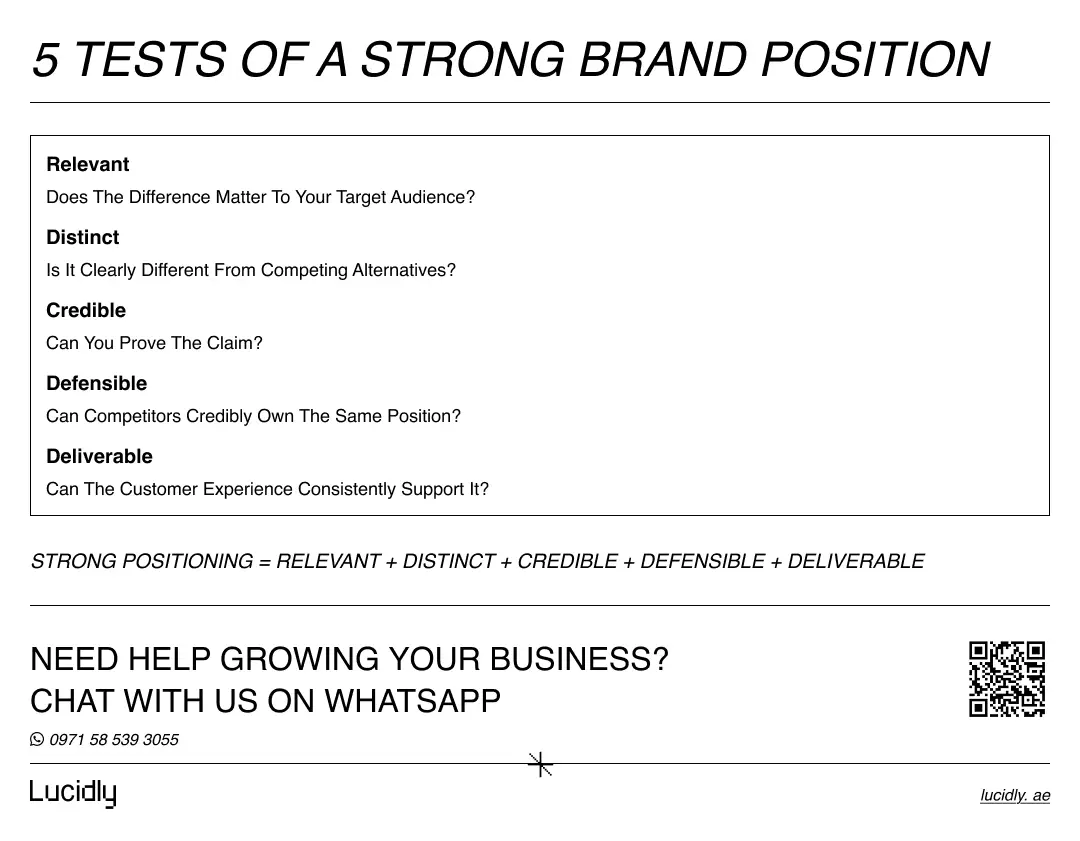 1. Relevant
The difference must matter to the target customer.
A technical feature, long history, internal process, or company achievement only becomes useful positioning when it connects with something that influences the customer's choice.
Ask:
Does our target audience actually care about this difference?
2. Distinct
The position should create clearer space than competitors already occupy.
If nearly everyone in the category claims “quality,” “innovation,” “trusted expertise,” and “customer-first service,” another version of those claims will rarely create meaningful brand differentiation.
A stronger position may come from a specific audience, specialization, benefit, methodology, experience, or business model.
3. Credible
Customers need a reason to believe the claim.
Harvard Business School Online explicitly includes reasons to believe in its positioning framework. Proof may come from expertise, product design, operating model, specialist capabilities, credentials, track record, customer evidence, or another observable advantage.
4. Defensible
A competitor can copy wording quickly. It is harder to copy specialist expertise, a distinctive operating model, ecosystem, community, distribution advantage, proprietary capability, or reputation built through repeated delivery.
The question is not simply:
Can competitors copy this sentence?
It is:
Can they credibly own the same position?
5. Deliverable
The customer experience must support the promise.
A brand positioned around simplicity cannot provide confusing onboarding and slow support without weakening its own claim. A business positioned as premium cannot depend constantly on discounting without creating conflicting signals.
The best brand positioning strategy connects what the company says with what it can repeatedly deliver.
Not sure whether your current positioning is genuinely different or simply using the same claims as competitors? Speak with Lucidly on WhatsApp to discuss where your brand stands today and which areas may need greater clarity.
How to Build a Brand Positioning Strategy
An effective brand positioning strategy should move from evidence to strategic choices, then from those choices to execution.
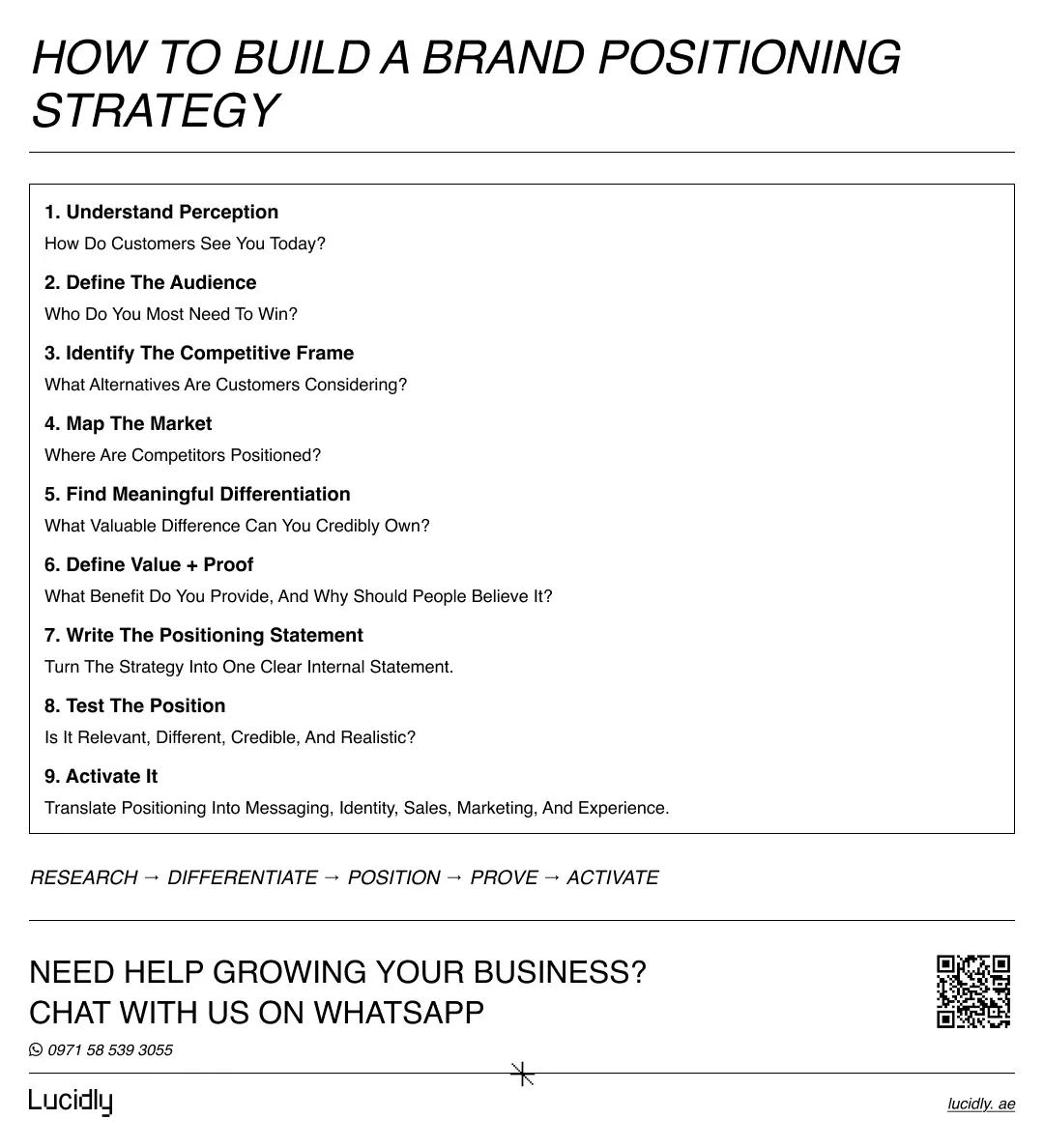 1. Understand Your Current Brand Perception
Start with the position customers already give you, not the position leadership assumes you have.
Review customer interviews, sales conversations, reviews, win/loss feedback, support conversations, and existing research.
Ask:
Why do customers choose us?
What do they think we do particularly well?
What do they misunderstand?
Which alternatives do they compare us with?
What do they remember after interacting with us?
Positioning is an internal strategic decision, but its success ultimately depends on external perception. Harvard Business School Online emphasizes that positioning is shaped by how consumers perceive and remember a brand relative to alternatives.
2. Define the Audience You Want to Win
“Everyone” is not a useful target market.
Choose the customer segment where the business can create the strongest combination of relevance, value, and competitive advantage.
Then understand more than demographics. Identify:
what customers are trying to achieve;
what frustrates them about existing options;
which risks they want to avoid;
what trade-offs they accept; and
what creates confidence or trust.
A sharper target audience usually makes stronger positioning possible.
3. Identify the Competitive Frame
Your competitive set is not always a list of businesses that look like yours.
It includes the options customers genuinely consider when solving the same problem. These may be direct competitors, indirect alternatives, an internal solution, delaying the decision, or even another category.
For example, a consultancy may compete not only with other consultancies but with hiring internally, adopting software, or postponing the project.
The better question becomes:
Why should the customer choose this approach over every realistic alternative?
4. Map Competitors and Find Meaningful White Space
A brand positioning map, also called a perceptual map, can help visualize how customers see competing options across two relevant dimensions.
Harvard Business School Online discusses competitive mapping as a way to understand relative positions, while HubSpot also includes positioning maps when examining competitive differentiation.
Choose dimensions customers genuinely care about, such as:
specialized vs. broad;
self-service vs. high-touch;
standardized vs. customized;
practical vs. aspirational;
accessible vs. premium.
But be careful with “white space.”
An empty part of a positioning map is not automatically a business opportunity. It becomes useful only when unmet customer demand intersects with a capability the company can credibly deliver.
5. Identify Meaningful Differentiators
Now look for differences customers value and competitors cannot claim with equal credibility.
Potential sources of brand differentiation include:
specialization in a particular customer or problem;
a distinctive methodology or operating model;
speed, simplicity, convenience, or access;
deep expertise in a complex category;
a unique product or service capability;
a distinctive customer experience;
a business model that changes value or accessibility; or
a belief or purpose that genuinely influences operations.
Do not choose a differentiator simply because it sounds impressive.
Test it:
Relevant → Distinct → Credible → Defensible → Deliverable
If it fails one of those tests, it may be a marketing message rather than a strong strategic position.
6. Define the Value Proposition and Reasons to Believe
A value proposition explains the benefit customers receive. Positioning puts that value into a competitive context.
For each potential position, define:
the customer need;
the main benefit;
the alternatives being considered;
the specific difference; and
the evidence supporting that difference.
Real positioning also requires trade-offs.
A specialist cannot meaningfully claim to be the ideal choice for every customer. A premium business cannot continuously behave like the cheapest option without making its market position harder to understand.
Your reasons to believe turn an attractive claim into something customers can evaluate.
7. Write a Brand Positioning Statement
A positioning statement is primarily an internal strategic tool, not necessarily customer-facing copy.
A practical structure is:
For [priority audience] that needs [important outcome], [brand] is the [competitive frame] that delivers [distinct value], supported by [specific reasons to believe].
The purpose is not to create elegant advertising copy.
It is to make the strategic choice clear enough that marketing, sales, product, design, and leadership can make decisions against it.
8. Test the Position Before Committing
Do not approve a brand positioning strategy simply because leadership likes the wording.
Test it with customers, prospects, sales teams, customer-facing employees, and relevant stakeholders.
Ask:
Is it immediately understandable?
Does the audience value the difference?
Is it genuinely different?
Is the proof convincing?
Can the business consistently deliver it?
Does it attract the customers we actually want?
One particularly useful test is:
Could a major competitor make exactly the same claim tomorrow and sound equally credible?
If the answer is yes, the position probably needs more work.
9. Translate Positioning Into Messaging and Experience
Positioning becomes useful when it changes decisions.
Translate the approved position into:
value proposition;
messaging pillars;
website copy;
sales narrative;
tone of voice;
visual identity principles;
campaign briefs;
customer experience standards; and
internal communication.
On a website, that same position should influence hierarchy, messaging, navigation, trust signals, and the overall customer journey. Learn how UX and UI design for websites can turn business and brand clarity into a more effective digital experience.
Qualtrics emphasizes internal stakeholder alignment as part of bringing positioning to life across an organization.
If the position exists only in a strategy presentation, it is not yet operating as a strategy.
Brand Positioning Statement Template
A practical brand positioning strategy usually produces a concise statement that teams can use as a strategic reference point.
Build it from five components:
Audience: Who should choose us?
Need: What important problem or outcome matters to them?
Competitive frame: What alternatives are they comparing?
Point of difference: What distinct value do we provide?
Reason to believe: What makes the claim credible?
Then combine them:
For [audience] that needs [outcome], [brand] is the [category or alternative] that [distinct benefit] because [proof].
Keep the statement strategic rather than promotional.
It should be specific enough to help your team reject messages, campaigns, product ideas, or creative directions that do not reinforce the desired market position.
Common Types of Brand Positioning Strategies
There is no universal positioning model. The right approach depends on what the target audience values and where competitors are already strong.
HubSpot and Qualtrics both describe several possible approaches to positioning rather than a single formula.
Common options include:
Value or Price Positioning
The brand is associated with affordability, efficiency, or strong value for money.
The operating model must be able to support that promise consistently.
Quality or Premium Positioning
The brand emphasizes performance, craftsmanship, expertise, exclusivity, superior materials, or a higher-level experience.
Price alone does not create premium positioning. The experience needs to justify it.
Benefit Positioning
The brand aims to own a specific outcome customers care about, such as simplicity, speed, safety, reliability, convenience, or control.
Audience or Specialization Positioning
The business becomes the specialist for a particular customer, industry, problem, or use case.
This can be especially useful for smaller companies competing against broad generalists.
Experience or Service Positioning
The difference comes from how customers are served, not only from the core product.
Belief or Purpose Positioning
The business is associated with a belief that matters to customers and visibly influences company decisions.
Whatever type you choose, a brand positioning strategy becomes stronger when it is narrow enough to mean something but broad enough to support realistic business growth.
Brand Positioning Examples: Why They Work
Strong brand positioning examples show how the promise and the business behind it reinforce each other.
The following examples are strategic interpretations of publicly stated brand choices, not claims that these are the companies' confidential internal positioning statements.
IKEA: Design, Function, and Accessibility Together
IKEA describes its business idea around offering well-designed and functional home furnishings at prices accessible to as many people as possible.
Why is that useful from a positioning perspective?
It brings together benefits that can otherwise feel like trade-offs:
Design + Function + Accessibility
The product range, pricing approach, and design philosophy help reinforce the same idea.
Positioning lesson: meaningful differentiation can come from combining customer benefits in a way that competitors do not own with the same clarity.
Volvo: Safety Supported by Operational Proof
Volvo Cars continues to place safety at the center of its product story, supported by safety technology and a long-running focus on protection and research.
The strength is not simply the word “safety.”
Safety is relevant to the category, easy to understand, and reinforced through the product itself.
Positioning lesson: a market position becomes more defensible when the organization invests in the capability behind the claim.
Patagonia: Purpose Backed by Business Decisions
Patagonia states that it exists to save the home planet. Its 2025 progress report says this purpose is embedded in its legal charter and the way the company is owned and governed.
That makes the environmental idea more than campaign language.
Positioning lesson: purpose can create differentiation when operational choices provide credible reasons to believe it.
What Does Strong Positioning Look Like for UAE Businesses?
For UAE companies, a brand positioning strategy should remain clear even when the business serves different cultures, languages, emirates, customer segments, or GCC markets.
Lucidly's existing UAE branding guide identifies a recurring problem: companies often rely on broad claims such as quality, innovation, experience, and customer satisfaction even though competitors can make similar promises. It also highlights the practical challenge of communicating across Arabic and English and maintaining clarity as businesses enter new services or markets.
Ask:
Does the core idea remain clear in both Arabic and English?
Is the position more specific than “premium,” “innovative,” or “customer-first”?
Can sales explain the same difference that appears on the website?
Will the position still work if the company enters another emirate or GCC market?
Is the brand trying to speak to too many segments with one generic message?
Does local relevance come from real capability or simply local wording?
The goal is not identical messaging everywhere.
It is consistent strategic meaning, adapted naturally to different audiences and touchpoints.
Common Brand Positioning Mistakes
A weak brand positioning strategy usually fails because the business avoids making clear choices.
Targeting everyone: Broad audiences usually produce broad claims.
Using generic differentiators: Quality, innovation, experience, and service need specificity and proof.
Copying competitor language: A different logo cannot compensate for identical messaging.
Confusing positioning with a tagline: A tagline is an expression; positioning is the strategic choice behind it.
Choosing a difference customers do not value: Uniqueness is not enough. The difference must influence the customer.
Making claims without proof: “Premium,” “trusted,” and “expert-led” need credible evidence.
Choosing a position the business cannot deliver: Customer experience eventually shapes customer perception.
Failing to align teams: Different stories from leadership, marketing, sales, and service create conflicting market signals.
How Do You Know If Brand Positioning Is Working?
A brand positioning strategy is working when the intended audience increasingly understands, remembers, and believes the difference the business wants to own.
Shopify recommends assessing brand perception through methods including customer surveys, feedback, brand audits, and social listening.
Useful indicators can include:
customer interviews;
brand perception surveys;
win/loss analysis;
sales feedback about why prospects choose or reject the business;
message recall;
customer reviews and language;
social listening;
quality of inbound opportunities; and
branded search behavior as a supporting signal rather than proof on its own.
Do not reduce positioning effectiveness to one metric.
A conversion rate can change for many reasons. High awareness also does not automatically mean the desired association is forming.
Measure both perception and commercial behavior, then look for consistent patterns over time.
When Should You Reposition a Brand?
Repositioning becomes useful when current market perception no longer supports the business strategy.
Common triggers include:
a new target audience;
entering a different category;
a merger or acquisition;
major competitive change;
an existing position becoming generic;
the business outgrowing a narrow legacy association;
expansion into new markets; or
a persistent gap between desired and actual customer perception.
Qualtrics notes that changing an internal position does not automatically change external consumer perception. Repositioning therefore requires research, organizational alignment, consistent execution, and time.
If repositioning will also change how the business presents itself online, planning the website around business goals before moving into wireframes and design can help keep the new position consistent across the digital experience.
Do not reposition simply because the current message feels old internally.
Consistency can make an effective position more valuable when the underlying strategy still fits.
When Does Professional Brand Strategy Support Become Useful?
Professional support can become valuable when a brand positioning strategy requires more than better copy or an internal workshop.
This may include:
leadership disagreement about where the company should compete;
customer or market research;
several audience segments or business units;
entering a new market;
unclear differentiation despite a strong product;
rebranding;
brand architecture questions; or
translating a new position across identity, messaging, website, sales, and digital execution.
The principle should remain simple:
Strategy before creative activity.
Clarify the business problem and competitive position first. Then build the brand system around that strategic choice.
Frequently Asked Questions
What is a brand positioning strategy?
A brand positioning strategy defines how a business wants a target audience to understand and value it relative to competing alternatives. It identifies the audience, customer need, competitive frame, point of difference, and reasons to believe, then guides messaging, identity, marketing, sales, and customer experience.
How do you create a brand positioning strategy?
Start by researching current customer perception, define the priority audience, identify direct and indirect competitors, map the market, choose meaningful differentiation, gather evidence, write a positioning statement, test it with customers and stakeholders, and translate it into messaging and experience.
What are the key elements of brand positioning?
The core elements are the target audience, customer need, competitive frame, primary point of difference, and reasons to believe. Strong positioning should also be relevant, distinctive, credible, defensible, and aligned with what the business can consistently deliver.
What is the difference between brand strategy and brand positioning?
Brand strategy is the wider framework covering areas such as purpose, values, audiences, architecture, personality, positioning, messaging, and long-term direction. Brand positioning is one part of that system and focuses specifically on how the brand should be perceived relative to competing alternatives.
What is a brand positioning statement?
A brand positioning statement is a concise internal statement defining who the brand is for, the need it addresses, the competitive frame, the distinct value it provides, and the evidence supporting that difference. It gives teams a reference point for later messaging and business decisions.
How do you know if brand positioning is working?
Look for evidence that customers and internal teams consistently associate the brand with the intended difference. Use customer interviews, perception surveys, sales feedback, win/loss analysis, reviews, social listening, message recall, and relevant commercial signals rather than relying on one metric alone.
Conclusion
A strong brand positioning strategy gives customers a clear reason to choose your business and gives internal teams a clearer direction for messaging, marketing, and growth. For UAE businesses, the goal is not to say more, but to define a position that is relevant, distinctive, credible, and consistent across markets and customer touchpoints.
If your current positioning feels unclear or too similar to competitors, speak with Lucidly on WhatsApp or contact Lucidly to discuss the strategic direction before moving into messaging, identity, or execution.
References