A logo vs brand identity comparison matters because the two are often treated as the same thing, even though they solve different problems.
A logo is a visual identifier: a recognizable mark, wordmark, or symbol used to identify a business.
Brand identity is the broader system that shapes how the brand looks, sounds, and presents itself consistently across customer touchpoints.
A strong logo can improve recognition, but it cannot by itself define typography, color, imagery, messaging, website expression, presentation design, or the rules that keep a brand consistent as more people begin using it.
For a new or growing business, understanding the difference helps answer a more practical question: Do you need one visual asset, a complete identity system, or clearer brand strategy before design begins?
Quick Answer: Logo vs Brand Identity
The simplest way to understand logo vs brand identity is:
A logo identifies the business.
A visual identity defines how the brand looks consistently.
A brand identity expresses the broader character of the brand through visual and verbal elements.
Brand strategy defines the audience, positioning, value, personality, and direction that should guide those elements.
A logo is therefore part of a brand identity, not a replacement for one.
If a business only needs a recognizable mark for a limited use case, logo design may be enough.
If the brand needs to work consistently across a website, social media, presentations, advertising, signage, packaging, or several teams and suppliers, it usually needs a wider logo and visual identity system that defines how those elements work together.
What Is a Logo?
A logo is a visual identifier designed to help people recognize a business, product, service, or organization.
It may be a wordmark, symbol, monogram, combination mark, or another distinctive visual signature.
A practical logo system may also include primary and secondary versions, horizontal or stacked lockups, monochrome versions, and simplified marks for smaller applications.
A good logo should remain recognizable and usable across environments such as:
Website headers.
Social profiles.
Presentations.
Business cards.
Signage.
App icons.
Packaging.
Favicons.
But the logo does not determine how every other branded element should look or behave.
It does not automatically answer which typefaces should appear in a presentation, how photography should look, which colors dominate a campaign, or how a website should visually express the business.
That is where the logo vs brand identity distinction becomes practical.
What Is Brand Identity?
Brand identity is the system a business uses to express who it is consistently and recognizably.
Depending on the scope, it may combine visual elements such as logo, colors, typography, imagery, iconography, layouts, and graphic devices with verbal elements such as tone of voice and messaging principles.
The important word is system.
A strong identity allows designers, marketers, sales teams, developers, agencies, and internal teams to create new materials without reinventing the brand every time.
As more people begin using the identity, those decisions should be documented in a clear brand guidelines document so teams know how the logo, typography, color, imagery, voice, and applications should be used consistently.
Brand identity design is therefore not simply a folder of attractive assets. It creates recognizable principles that can scale as the business adds new channels, campaigns, people, or markets.
Understanding what branding includes also helps clarify how identity connects with strategy, communication, and the wider customer experience.
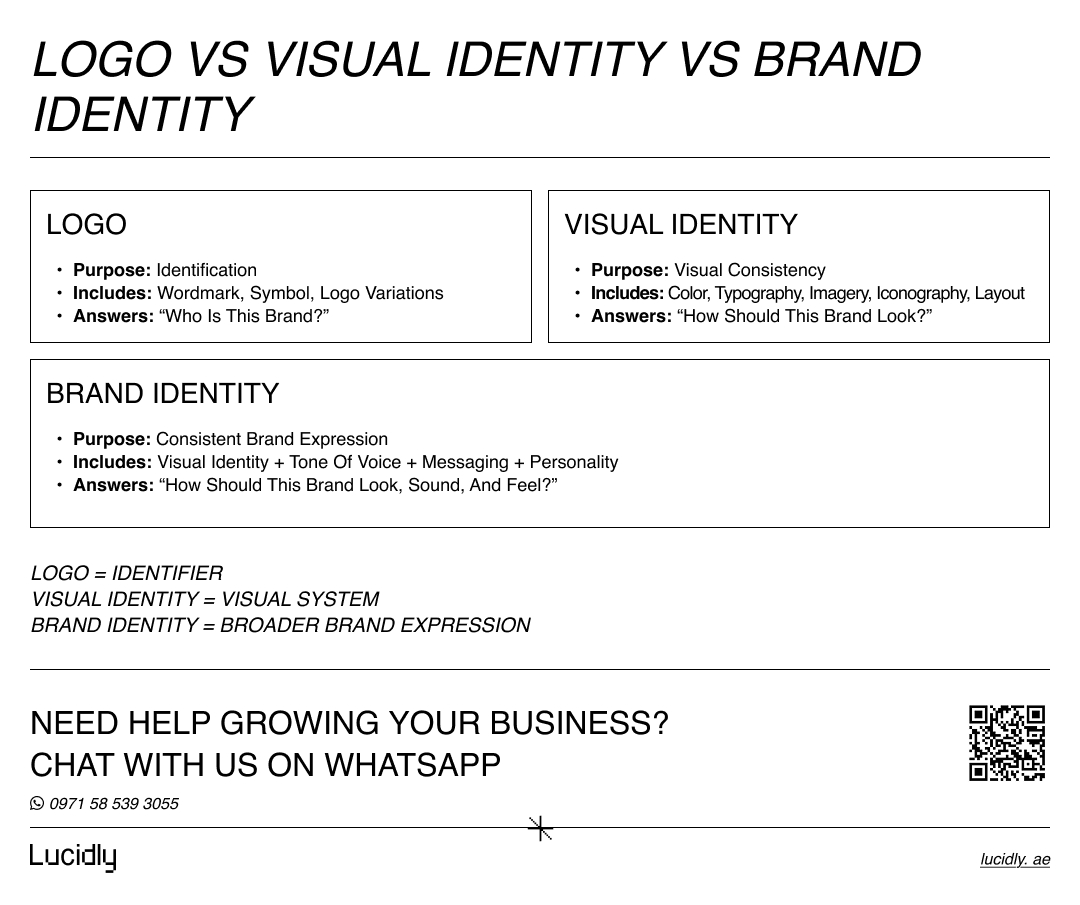
Logo vs. Visual Identity vs. Brand Identity
These terms are related, but they describe different levels of the brand system.
 Logo: The Identifier
The logo is the recognizable visual mark associated with the business.
Its main job is identification.
It may suggest aspects of the brand's personality, but it should not be expected to communicate the entire positioning or meaning of the business by itself.
Visual Identity: The Visual System
Visual identity defines how the brand looks beyond its logo.
It can include:
Color palette.
Typography.
Photography and imagery.
Iconography.
Illustration.
Graphic elements.
Layout principles.
Motion.
Logo usage rules.
Together, these elements create a recognizable visual language across different applications.
Brand Identity: The Broader Expression
Brand identity can go further by connecting the visual system with verbal expression, including tone of voice, messaging principles, personality, and other ways the organization presents itself.
There is an important practical point: agencies and designers do not always use brand identity and visual identity in exactly the same way.
When comparing a logo vs brand identity proposal, look at the actual scope rather than the package name.
Check:
What strategic work is included?
Which visual elements will be created?
Is verbal identity included?
Will brand guidelines be provided?
Which real applications will be demonstrated?
Is rollout or implementation support included?
Deliverables matter more than labels.
What Does a Complete Brand Identity Include?
The exact scope depends on the business, but a useful brand identity system normally gives teams enough direction to reproduce the brand consistently.
Logo System
This may include a primary logo, secondary versions, symbols or marks, lockups, monochrome options, minimum-size rules, clear space, and usage guidance.
The objective is not to create unnecessary variations. It is to make the logo usable across different formats without improvisation.
Color Palette
The color system defines primary and supporting colors and provides guidance on how they work together across digital and physical applications.
Typography
Typography establishes the typefaces and hierarchy used across website content, presentations, reports, campaigns, proposals, and other communications.
Imagery and Photography
Image direction may define subject matter, composition, lighting, cropping, treatment, illustration style, or broader creative principles.
Without this direction, even individually strong images can make a brand feel inconsistent.
Iconography and Graphic Language
Icons, shapes, patterns, illustration, data visualization, and other graphic devices help the identity extend beyond the logo.
Voice and Messaging
When the project covers broader brand identity rather than visual identity alone, it may also define tone of voice, messaging pillars, vocabulary, key propositions, and verbal personality.
Brand Guidelines
Brand guidelines bring these decisions together so teams understand what must stay consistent and where they have room to adapt.
This is the main difference in a logo vs brand identity project: one produces an identifier; the other creates a system that other people can continue using.
What Is the Real Difference Between Logo Design and Brand Identity Design?
The practical difference is asset versus system.
Logo design creates an identifier. Brand identity design creates a framework for consistent expression.
A logo helps customers identify who is communicating. A brand identity helps them recognize the same business across different formats even when the logo is not the dominant element.
That distinction becomes more important as the number of touchpoints increases.
A business represented only by a simple website and business card may have limited requirements.
A company operating across digital campaigns, social media, presentations, proposals, signage, products, events, or multiple locations needs more decisions to remain consistent.
The logo vs brand identity decision therefore depends less on company size and more on how many people, channels, and applications need to represent the brand.
Do You Need a Logo or a Full Brand Identity?
Start with the business problem rather than the design package.
The right scope depends on how established the business is, how many customer touchpoints need to stay consistent, and whether the challenge is mainly visual or more strategic.
The following scenarios can help clarify whether you need a standalone logo, a visual identity, a broader brand identity, or strategy work before design begins.
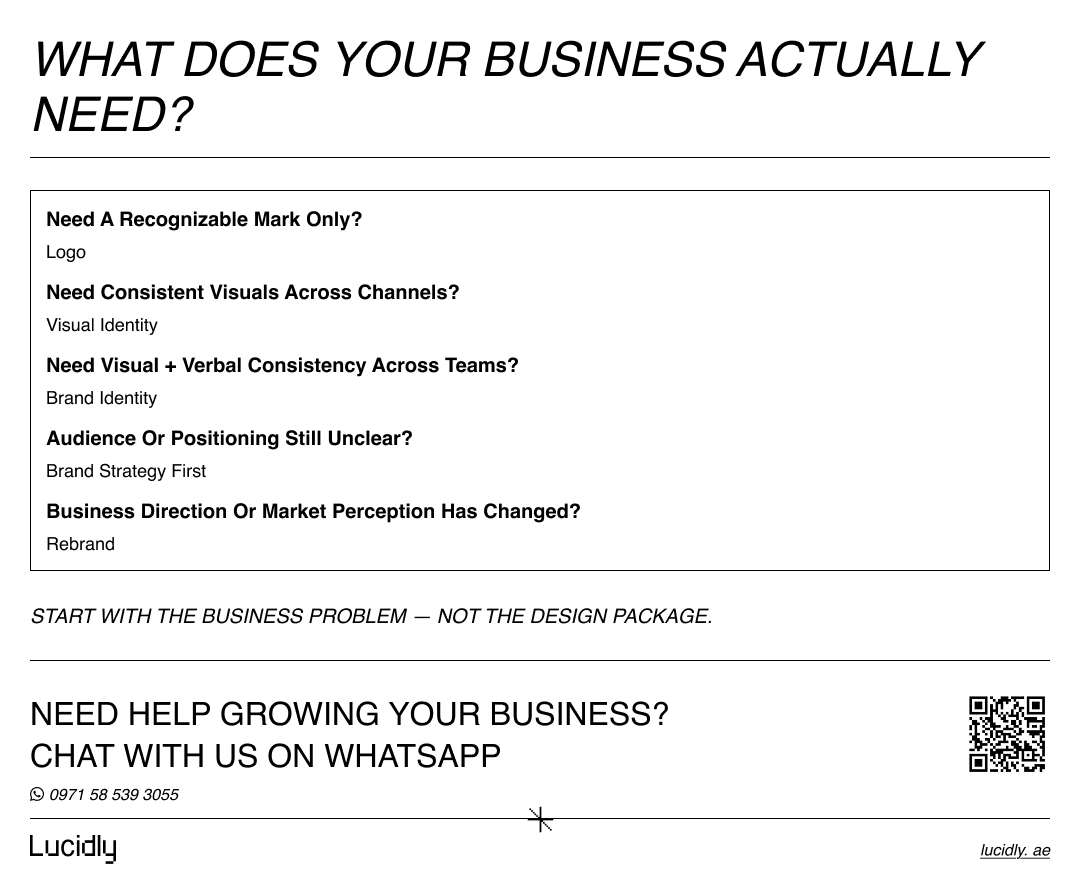 A Logo May Be Enough When:
A standalone logo can be a practical starting point when the business is still simple and there are very few applications to manage.
In this case, the immediate need is recognition rather than a complete identity system.
The business is testing an early idea.
The project is temporary or limited in scope.
There are very few customer-facing touchpoints.
One person still controls most branded communication.
Building an extensive identity before the business itself is clear can create unnecessary work.
A Visual Identity Is More Useful When:
Once the business appears across several channels, a logo alone usually provides too little guidance.
A visual identity creates a consistent design language that can be applied across different formats and by different people.
A website and social channels need to feel connected.
Presentations, campaigns, or sales materials are being created regularly.
Different designers or suppliers work on the brand.
Visual execution has become inconsistent.
The company needs a more scalable design system.
At this stage, the goal is not simply to create more assets. It is to establish visual rules that make the brand recognizable wherever it appears.
A Broader Brand Identity Makes Sense When:
Some businesses need consistency beyond visual design.
When messaging, personality, and communication also need to feel connected, the scope may need to extend into a broader brand identity.
Visual expression must connect with tone of voice and messaging.
Different teams communicate with different audiences.
The organization needs a recognizable personality across multiple touchpoints.
The business is entering new markets or expanding its offer.
A broader identity helps ensure that what the brand says and how it looks reinforce the same overall impression.
Brand Strategy Should Come First When:
Sometimes design is not the real problem.
If the business has not yet defined what it stands for, who it should prioritize, or how it should differ from competitors, strategy should be clarified before visual decisions are made.
A clear brand positioning strategy helps define the audience, competitive context, meaningful differentiation, and desired market position before those choices are translated into visual identity.
The audience is unclear.
The business struggles to explain its value.
Competitors make similar claims.
The desired market position is undefined.
Leadership does not agree on what the brand should represent.
In these cases, creating a new logo first risks giving a visual answer to a strategic problem that has not yet been solved.
A Rebrand May Be Needed When:
A rebrand becomes more relevant when the existing brand no longer represents the business it has become or the position it wants to occupy in the market.
The business direction has substantially changed.
A new audience has become the priority.
The company has entered new categories or markets.
Existing market perception no longer matches the desired position.
A rebrand may involve strategy, positioning, messaging, identity, and rollout rather than simply replacing the logo.
The logo vs brand identity question becomes much easier once the actual business problem is defined.
The goal is to choose the level of work the business genuinely needs, rather than starting with a predetermined design package.
Not sure whether your business needs a logo refresh, a complete visual identity, or deeper brand work first? Speak with Lucidly on WhatsApp to discuss the current challenge before deciding on the scope.
Why Can a Strong Logo Still Produce a Weak Brand?
A well-designed logo cannot compensate for an inconsistent system around it.
A company may have a strong logo while:
Its website uses unrelated typography.
Social media changes visual direction every week.
Sales presentations follow different layouts.
Advertising uses inconsistent messaging.
Photography has no recognizable direction.
In this situation, another logo redesign is unlikely to solve the problem.
The missing element is a coherent identity system.
Customers experience the business through many touchpoints, not through the logo file in isolation.
Consistency creates recognizable patterns across those touchpoints without requiring every piece of communication to look identical.
Should Brand Strategy Come Before Logo Design?
For a serious, scalable business, the essential strategic decisions should usually be clear before logo design begins.
The design team should understand:
Who the priority audience is.
What the business offers.
What it should be known for.
How it differs from competitors.
What personality it should express.
What perception it wants to create.
This does not mean every business needs an extensive strategy document before design can start.
It means the visual direction should respond to strategic decisions instead of attempting to replace them.
In a logo vs brand identity project, this strategic clarity helps reduce subjective design decisions based only on what leadership personally likes.
How Does Brand Identity Work Across Real Touchpoints?
A brand identity proves its value when teams can apply it consistently in real situations.
Website
On a website, brand identity influences typography, color, imagery, spacing, iconography, interface details, and visual hierarchy.
The identity must also work with usability rather than against it. Lucidly's guide to UX and UI design for business websites explains how clarity, hierarchy, trust, and interaction shape the wider digital experience.
Social Media
Templates, typography, imagery, and graphic devices can create recognition without forcing every post into the same layout.
Presentations and Sales Materials
A clear identity helps teams create presentations, proposals, reports, and sales documents without every asset appearing to come from a different organization.
Advertising
The system should allow creative flexibility while preserving enough recognizable brand signals.
Packaging and Signage
Physical applications introduce practical requirements such as scale, legibility, materials, production methods, and viewing distance.
Digital Products
Apps, portals, dashboards, and other interfaces may need brand identity to work alongside a product design system.
The goal is not to control every pixel.
It is to provide enough direction that the brand remains recognizable even when the original designer is not involved.
Logo Refresh vs. Identity Refresh vs. Rebrand
Another useful way to understand logo vs brand identity is to diagnose how deep the problem goes.
Logo Refresh
Choose this when the broader strategy and identity still work, but the logo has specific visual or technical limitations.
The work may improve legibility, simplify the mark, refine typography, or make it easier to use digitally.
Identity Refresh
Choose this when the logo remains usable but the broader visual system has become outdated or inconsistent.
The company may need updated typography, imagery, color, layouts, templates, or digital expression without changing its fundamental market position.
Full Rebrand
A broader rebrand becomes appropriate when the problem is strategic rather than primarily visual.
Triggers can include repositioning, a new target audience, mergers, expansion into new categories, or a major change in the business offer.
Before changing everything, identify what is actually broken.
If the problem is positioning, replacing the logo alone will not fix it. If the strategy still works and only the visual execution is weak, a full rebrand may be unnecessary.
Common Logo and Brand Identity Mistakes
A clear logo vs brand identity distinction helps businesses avoid several common mistakes.
Treating the Logo as the Whole Brand
Customers also experience language, imagery, websites, presentations, advertising, service, and physical touchpoints.
Designing Before Clarifying the Business Direction
When audience, positioning, and desired perception are unclear, design decisions can become subjective.
Creating Visual Elements Without Rules
Good colors, fonts, and images do not automatically create a coherent identity. Teams need principles for how those elements work together.
Skipping Brand Guidelines
Without documented guidance, different teams eventually recreate the brand based on memory or individual preference.
Buying a "Brand Identity Package" Without Checking Deliverables
Different providers define the term differently. Compare what is actually included rather than assuming every package delivers the same strategic, visual, verbal, and implementation work.
How to Choose the Right Scope for Your Business
The right choice should solve the problem you actually have.
If the problem is identification, a logo may be enough.
If the problem is inconsistent visual execution, you probably need a stronger visual identity.
If the challenge also involves messaging, personality, and communication across several teams, the scope may need to extend into a broader brand identity system.
If you cannot clearly define your audience, differentiation, or desired perception, solve those strategic questions first.
Frequently Asked Questions
Is a Logo the Same as Brand Identity?
No. In logo vs brand identity terms, a logo is one visual identifier within the broader system. Brand identity can include the logo, color, typography, imagery, graphic language, messaging, tone of voice, and guidelines that help the business present itself consistently.
What Is Included in a Brand Identity?
Depending on scope, a brand identity may include a logo system, color palette, typography, imagery, iconography, graphic elements, messaging principles, tone of voice, templates, and guidelines.
Because providers define packages differently, always review the actual deliverables.
What Is the Difference Between Brand Identity and Visual Identity?
Visual identity focuses specifically on how the brand looks, including logo, color, typography, imagery, icons, and layouts.
Brand identity can be broader, connecting visual expression with messaging, voice, personality, and other ways the organization expresses itself.
Do I Need a Logo or a Full Brand Identity?
A logo may be enough for an early concept or limited application. A fuller identity becomes more useful when the business needs to remain consistent across multiple channels, teams, suppliers, and customer touchpoints.
Can You Change a Logo Without Rebranding the Whole Brand?
Yes. If the strategy, audience, positioning, and wider identity remain relevant, a logo refresh can address specific visual problems without requiring a full rebrand.
Should Brand Strategy Come Before Logo Design?
Usually, the essential strategic decisions should be clear first. Designers should understand the audience, positioning, competitive context, personality, and desired perception before developing a logo intended to support a scalable business.
Conclusion
The simplest way to understand logo vs brand identity is identifier versus system. A logo gives the business a recognizable mark, while brand identity creates the visual and verbal consistency needed to represent that business across real customer touchpoints.
The right scope depends on the problem you need to solve, not on how many design assets you can add to a package.
If your current identity feels inconsistent or you are unsure whether the next step should be a logo refresh, a complete identity system, or broader brand work, speak with Lucidly on WhatsApp or contact Lucidly to discuss the right direction before moving into design.