A brand guidelines document should give anyone working with a brand enough direction to represent it consistently without guessing.
At minimum, it should define logo use, colors, typography, imagery, voice, and practical application rules. More complete guidelines can also cover positioning, digital use, accessibility, templates, approved assets, and governance.
The objective is not to document every possible design decision. Good guidelines establish the rules that matter most, demonstrate how those rules work in real situations, and make approved assets easy to access.
For UAE businesses, the document may also need to address Arabic and English applications, bilingual typography, right-to-left layouts, and consistency across different markets and customer touchpoints.
Quick Answer: What Should Brand Guidelines Include?
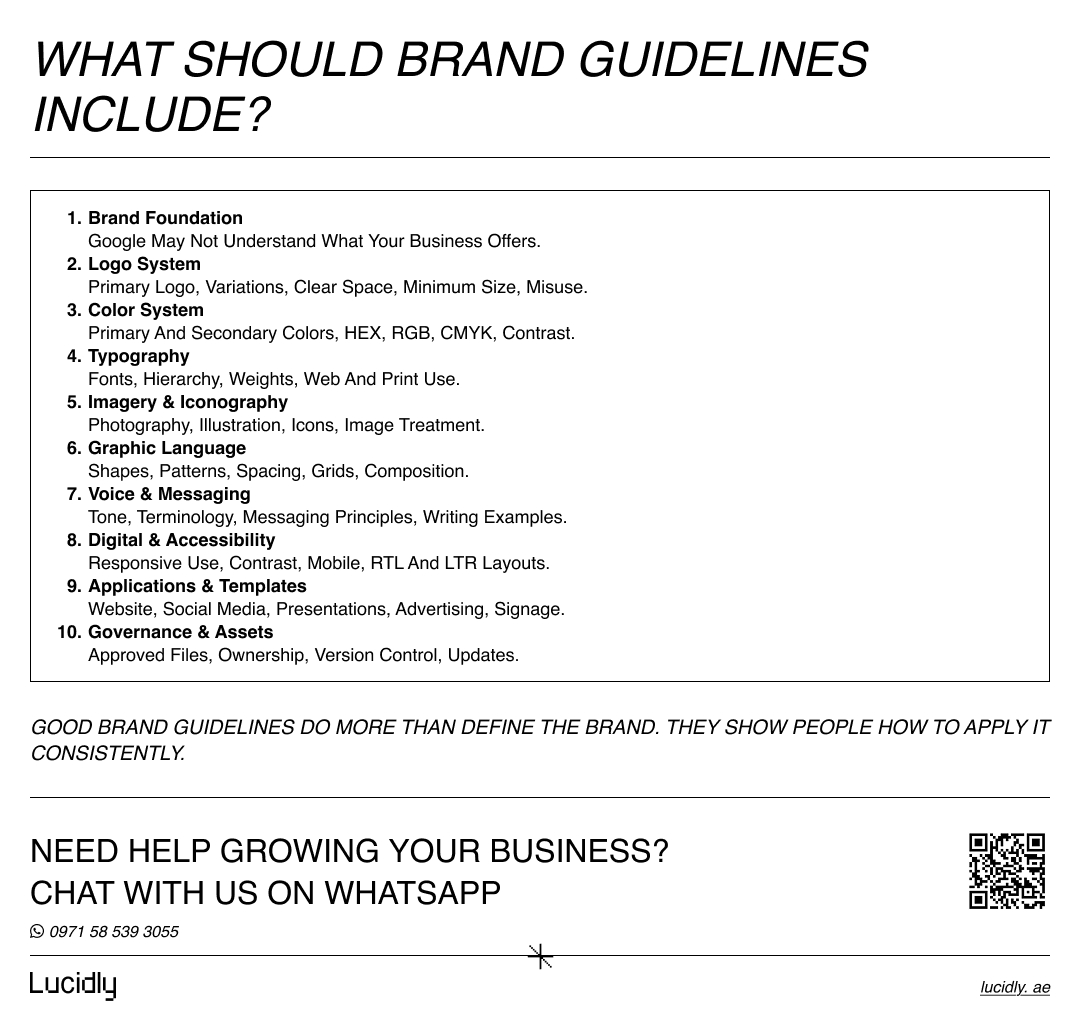
If you are asking what should brand guidelines include, these are the ten areas most businesses should consider:
Brand foundation: purpose, audience, positioning, values, and personality.
Logo rules: approved versions, spacing, sizing, backgrounds, and misuse.
Color system: primary and secondary colors, specifications, combinations, and accessibility.
Typography: fonts, hierarchy, weights, and digital or print use.
Imagery and iconography: photography, illustration, icons, and image treatments.
Graphic and layout principles: shapes, patterns, spacing, grids, and composition.
Voice and messaging: tone, terminology, messaging principles, and writing examples.
Digital and accessibility rules: responsive use, contrast, screen formats, and RTL considerations.
Applications and templates: websites, social media, presentations, advertising, signage, and other relevant channels.
Governance and asset access: where files live, who owns the guidelines, how exceptions are approved, and how the system is updated.
The important distinction is that a useful guide does not only list these elements. It explains how people should apply them.
Businesses that need to build or formalize these rules can start with a structured logo and visual identity system, where logo usage, typography, color, visual language, and practical brand guidelines are developed as one connected system.
 What Are Brand Guidelines?
Brand guidelines are the documented rules that translate a brand identity into a system other people can use consistently.
They may be used by designers, marketers, developers, sales teams, internal departments, external agencies, printers, content writers, and business partners.
That makes them different from simply receiving logo files and a color palette. Teams also need to know which logo version to use, how typography should be structured, what imagery fits the brand, how the brand should sound, and where approved assets can be found.
Brand guidelines sit within a wider brand system where strategy, identity, communication, and experience need to work together. Understanding what branding includes helps clarify where guidelines fit within that wider process.
Brand Guidelines vs. Brand Style Guide: Is There a Difference?
Terms such as brand guidelines, brand style guide, brand manual, and brand book are not used consistently across the industry.
A style guide may describe a narrower set of visual or editorial rules, while broader brand guidelines can include visual identity, voice, applications, asset management, and governance.
For businesses comparing deliverables, the terminology matters less than the actual scope.
A document called a "brand book" may be extensive, while another provider's "brand guidelines" may contain only basic logo and color rules.
The better question is:
Does the document answer the questions your teams will face when they use the brand?
What Should a Brand Guidelines Document Include?
A practical brand guidelines checklist should move from strategic context into visual and verbal rules, then show how those rules work across real applications.
1. Brand Foundation
Brand guidelines should briefly explain the strategic ideas behind the identity.
This may include:
Brand purpose.
Mission and vision.
Values.
Priority audience.
Market positioning.
Value proposition.
Brand personality.
Core brand idea.
This section should provide context rather than reproduce an entire strategy presentation.
Its job is to help users understand why the brand looks and communicates the way it does.
If the business is still unclear about its audience or competitive difference, those questions should be resolved before the identity is documented. A clear brand positioning strategy provides the strategic foundation for those later visual and verbal rules.
2. Logo Usage Rules
The logo section should document all approved versions and the situations in which each should be used.
It may cover:
Primary logo.
Secondary logo.
Symbol or brand mark.
Horizontal and vertical lockups.
Monochrome versions.
Minimum size.
Clear space.
Approved backgrounds.
Placement.
Co-branding where relevant.
Incorrect use.
For example, teams should know whether the white logo can appear over photography, whether the symbol can be used without the wordmark, and how small the logo can become before legibility suffers.
Rules work best when paired with visual examples. A diagram showing the required clear space is more useful than simply instructing users to "leave enough space."
For a deeper explanation of why the logo is only one part of a wider identity system, see Logo Design vs. Brand Identity.
3. Color System
Brand guidelines should explain both which colors belong to the brand and how they work together.
The color section may define:
Primary colors.
Secondary colors.
Accent colors.
HEX values.
RGB values.
CMYK values.
Pantone references where required.
Approved combinations.
Background use.
Color hierarchy.
Contrast requirements.
A list of color codes alone leaves too many decisions open.
If a specific color should dominate while another is reserved for accents, calls to action, or supporting graphics, the document should make that relationship clear.
Digital applications should also consider readable contrast rather than treating color only as an aesthetic choice.
4. Typography
Typography rules create a recognizable hierarchy across different formats and teams.
Useful guidance can include:
Primary typeface.
Secondary typeface.
Heading styles.
Body copy.
Font weights.
Size relationships.
Line spacing.
Print use.
Web use.
Fallback fonts.
Arabic fonts where relevant..
The aim is not to prescribe every possible font size. It is to establish a system that teams can adapt without making typography feel different every time.
For bilingual UAE brands, Arabic and English typography should be considered together, including how their visual weight, hierarchy, and spacing relate.
5. Imagery, Photography, Icons, and Illustration
A brand can use the correct logo, colors, and typography and still feel inconsistent if its imagery changes dramatically from one campaign to another.
Visual identity guidelines may therefore define:
Photography subjects.
Composition.
Cropping.
Lighting.
Color treatment.
People and environments.
Illustration style.
Iconography.
Image overlays.
Stock image principles.
AI-generated imagery where relevant.
Approved and unsuitable examples are especially valuable here. Visual direction is often easier to understand through real references than through vague descriptions such as "premium," "dynamic," or "human."
6. Graphic Elements and Layout Principles
Many identities rely on supporting visual elements beyond the logo.
These can include:
Shapes.
Patterns.
Frames.
Gradients.
Illustration devices.
Grids.
Spacing principles.
Composition.
Data visualization rules where relevant.
The guidelines should explain how these elements support recognition without overwhelming the content.
A simple business may need only a few rules. A company producing frequent reports, campaigns, presentations, and digital content may require a more developed graphic language.
7. Voice, Tone, and Messaging
Brand consistency also depends on language.
A verbal identity section may define:
Brand voice.
Tone by context.
Messaging pillars.
Key value propositions.
Approved terminology.
Words or phrases to avoid.
Writing style.
Taglines.
Example copy.
A useful distinction is:
Voice remains recognizable. Tone adapts to context.
The same business can sound calm and expert everywhere while becoming more concise in a digital interface, more explanatory in an article, and more conversational on social media.
Examples make this section much stronger. Words such as "professional," "friendly," or "premium" leave considerable room for interpretation unless teams can see what they mean in actual copy.
8. Digital and Accessibility Guidelines
Brand identity should work across screens, responsive layouts, and digital interactions.
Relevant rules may include:
Responsive logo behavior.
Web typography.
Mobile use.
Color contrast.
Social media formats.
Digital imagery.
Motion principles.
Video graphics.
Accessibility.
Right-to-left layouts.
The guidelines do not need to become a complete UX specification. They should simply explain how the visual identity adapts to digital environments.
This is particularly relevant in the UAE, where brands may need to support both left-to-right English interfaces and right-to-left Arabic layouts.
9. Applications and Templates
Application examples show how individual brand rules work together.
Depending on the business, these may include:
Website pages.
Social media.
Presentations.
Proposals.
Reports.
Email signatures.
Advertising.
Business cards.
Packaging.
Signage.
Event materials.
Internal communication.
The examples should reflect channels the company actually uses.
A SaaS company does not need extensive packaging examples simply because another brand guide includes them. A property developer, retailer, or hospitality business may need much deeper guidance for signage and physical environments.
Reusable templates can also reduce inconsistency by giving teams approved starting points for recurring materials.
10. Governance, Asset Access, and Updates
A brand system becomes difficult to manage when users know the rules but cannot find the right files or determine which version is current.
Brand governance should therefore address practical questions such as:
Where approved assets are stored.
Which formats should be used for print and digital work.
Who owns the guidelines.
Who approves exceptions.
How external agencies receive access.
Which version is current.
How updates are communicated.
How new team members are introduced to the system
The goal is simple: the brand should not depend on employees repeatedly asking the original designer for the correct file or latest rule.
If your teams already have a visual identity but still interpret it differently across websites, presentations, campaigns, or sales materials, speak with Lucidly on WhatsApp about where the current system may need clearer rules or applications.
What Should UAE Businesses Add to Their Brand Guidelines?
Businesses operating in the UAE often need brand guidelines that work across both Arabic and English rather than treating one language as an adaptation of the other.
Depending on the brand, this may include:
Arabic and English logo lockups.
Bilingual hierarchy.
Approved Arabic typography.
RTL and LTR layouts.
Arabic and English templates.
Bilingual signage.
Tone of voice across both languages.
Translation principles.
Language-switching interfaces.
Adaptation for wider GCC markets.
The UAE Federal Government's visual identity guidance includes defined Arabic-English logo arrangements, while the Dubai Design System provides explicit support for bilingual typography and RTL interfaces.
The objective is not to make Arabic and English executions mechanically identical. It is to preserve the same brand hierarchy, character, and quality across both.
Brand Guidelines vs. a Design System: What Is the Difference?
Brand guidelines define how the brand should look, sound, and be represented.
A design system goes further into reusable digital interface components and the technical rules needed to build products consistently.
For example, brand guidelines may define typography, colors, imagery, and visual principles. A design system may then define buttons, form fields, navigation components, spacing tokens, interaction states, and developer implementation.
Digital businesses may eventually need both brand guidelines and a design system, especially when visual identity needs to translate into reusable interface components and developer-ready rules.
Should Brand Guidelines Be a PDF or Digital Document?
Both formats can work.
A PDF is practical when the identity is relatively stable, the team is small, and updates are infrequent. It is portable and easy to distribute.
A digital brand portal becomes more useful when many teams, markets, or agencies need ongoing access to changing rules, templates, and assets.
Digital documentation can make it easier to:
Search for specific guidance.
Download current assets.
Update rules centrally.
Manage versions.
Share templates.
Control access.
The better question is not PDF or digital?
It is:
Which format will your teams actually use and keep current?
A concise PDF that answers real questions can be more effective than a sophisticated platform nobody uses.
How Detailed Should Brand Guidelines Be?
Brand guidelines are detailed enough when the people using them can answer common brand questions without repeatedly asking the original designer.
There is no ideal page count.
The appropriate depth depends on factors such as:
Number of channels.
Number of teams.
Number of markets.
Identity complexity.
Volume of content.
External suppliers.
Multilingual requirements.
Accessibility requirements.
A startup may need clear rules for its core identity and most common applications.
A growing company may need more templates, digital guidance, verbal identity, and asset management.
A larger organization may also require brand architecture, co-branding rules, permissions, governance, and market-specific guidance.
More pages do not automatically create better guidelines. The document should be as detailed as the operating reality requires.
Should Brand Guidelines Include AI Content Rules?
If teams regularly use generative AI for copy or visual production, the guidelines can include a concise set of standards for AI-assisted content.
These may address:
Approved voice and tone.
Required terminology.
Claims requiring human verification.
Human review before publication.
Image style.
Logo use within generated visuals.
Confidential information.
Approval requirements.
The purpose is not to turn the brand guide into an AI policy.
It is to ensure that content created with new tools follows the same standards as content created by designers, writers, and marketers.
How Do You Know If Your Brand Guidelines Are Good Enough?
A practical test is to give the guidelines to a new employee, freelancer, or external agency.
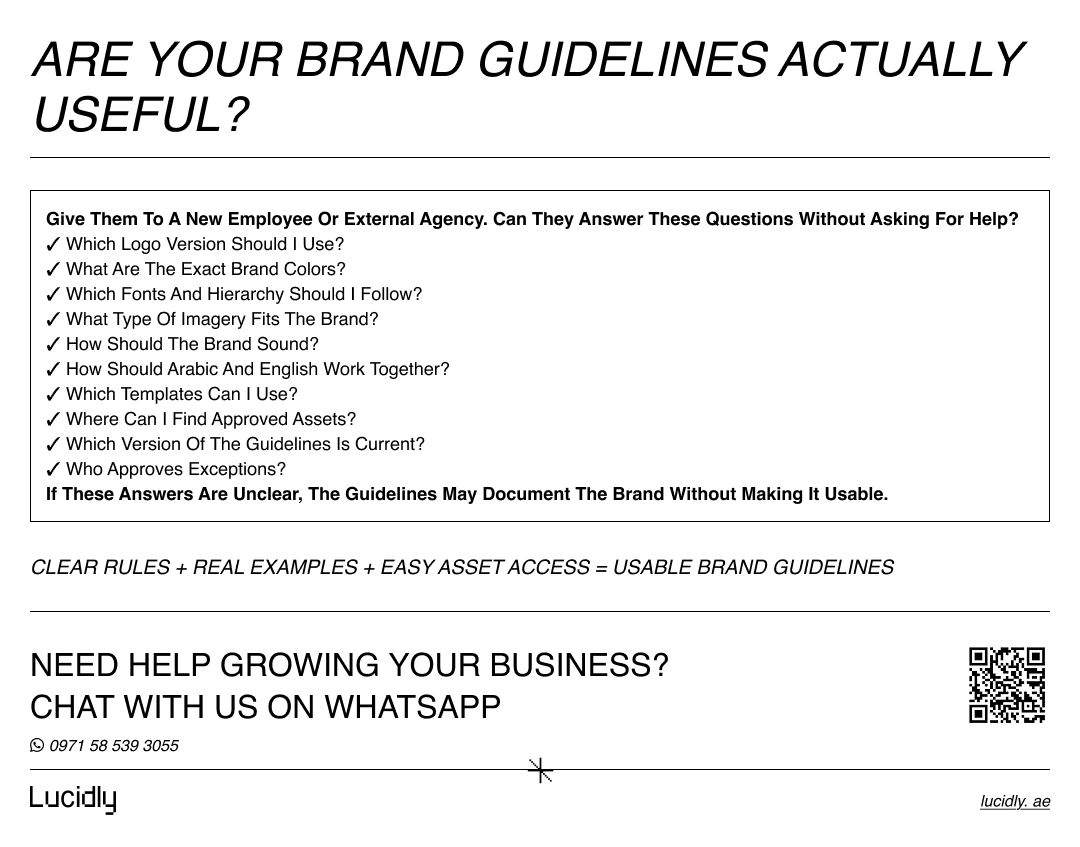 Without additional explanation, they should be able to determine:
Which logo to use.
How the logo should be placed.
The exact brand colors.
Which typography to use.
What appropriate imagery looks like.
How the brand should sound.
How templates may be adapted.
How Arabic and English work together.
Where approved assets are stored.
Who approves exceptions.
If these everyday questions repeatedly require clarification, the guidelines may describe the identity without making it operational.
The strongest brand guidelines reduce unnecessary interpretation without eliminating useful creative flexibility.
Common Brand Guidelines Mistakes
Several problems can make otherwise attractive guidelines difficult to use:
Prioritizing presentation over instruction: polished mockups without clear rules leave teams guessing.
Writing rules without examples: practical examples make abstract guidance easier to interpret.
Ignoring verbal identity: visual consistency cannot compensate for contradictory messaging.
Documenting irrelevant applications: examples should reflect real business channels.
Making the system unnecessarily restrictive: guidelines should support good work rather than block it.
Ignoring digital and accessibility requirements: static identity rules may not work automatically on screens.
Treating Arabic as a late translation step: bilingual use should be considered in typography, layouts, messaging, and templates.
Leaving ownership unclear: someone needs responsibility for maintaining the system as new needs emerge.
When Does Professional Support Become Useful?
Professional support becomes useful when the challenge is broader than documenting existing colors and logo files.
This may be the case when:
The identity is inconsistent across channels.
Teams disagree about correct usage.
Brand assets are fragmented.
Existing guidelines do not cover real applications.
Arabic and English execution feels disconnected.
A new website or digital product exposes gaps in the identity.
External suppliers repeatedly reinterpret the brand.
The business is preparing for wider rollout or growth.
If your team is still making inconsistent brand decisions despite having guidelines, speak with Lucidly on WhatsApp to identify where the current system may need more clarity.
Frequently Asked Questions
Do Small Businesses Need Brand Guidelines?
Yes, although they may not need an extensive document. Even a small business can benefit from clear rules for logo use, colors, typography, imagery, and voice once more than one person is creating customer-facing material. The guidelines can expand as the number of channels and teams grows.
Should Brand Guidelines Include Tone of Voice?
Yes, when language plays an important role in how customers experience the brand. Tone-of-voice guidance can define verbal personality, terminology, messaging principles, and examples that help marketing, sales, customer service, and external partners communicate consistently.
How Long Should Brand Guidelines Be?
There is no ideal length. The document should contain enough guidance to resolve recurring decisions without becoming unnecessarily difficult to use. A simple identity may need concise documentation, while a multi-market or multilingual organization may require significantly more detail.
How Often Should Brand Guidelines Be Updated?
Review the guidelines when new channels, markets, teams, tools, or recurring use cases create questions the existing system does not answer. Larger revisions may also follow a rebrand, repositioning, major expansion, or significant change in the business.
Can Brand Guidelines Cover Both Arabic and English?
Yes. For UAE and GCC businesses, bilingual guidelines can define Arabic and English typography, logo arrangements, RTL and LTR layouts, translation principles, templates, and tone so both languages express the same brand consistently.
Conclusion
When deciding what should brand guidelines include, focus on the decisions teams need to make repeatedly. Logo rules, color, typography, imagery, voice, digital applications, templates, and governance should work together as one usable system.
Strong guidelines make the brand easier to apply, not harder to understand.
If your current guidelines leave too much room for interpretation, speak with Lucidly on WhatsApp or contact Lucidly to discuss how your identity can become a clearer and more scalable brand system.
References