Launching a website often feels like crossing the finish line.
In reality, it’s only the starting point.
In competitive markets like Dubai and the UAE, a website that is not properly maintained quickly becomes slow, insecure, outdated, and invisible on Google. Website maintenance and support are what keep your site stable, secure, fast, and ready to generate leads and sales long after launch day.
This guide explains what website maintenance really means, why it matters so much in the UAE, and how ongoing support protects your investment and fuels growth.
Contact Lucidly on WhatsApp for a website maintenance audit and uncover hidden issues impacting speed, security, and SEO performance.
What Website Maintenance Really Means
Website maintenance is the ongoing process of keeping a website healthy, secure, and performing at its best. It includes technical updates, security checks, performance optimization, content updates, and proactive monitoring.
Many businesses confuse maintenance with support or development. While they are related, each plays a different role.
Website maintenance focuses on prevention and stability.
Website support handles issues when something breaks.
Website development is about building new features or functionality.
Without proper maintenance, even the best-designed website will slowly degrade.
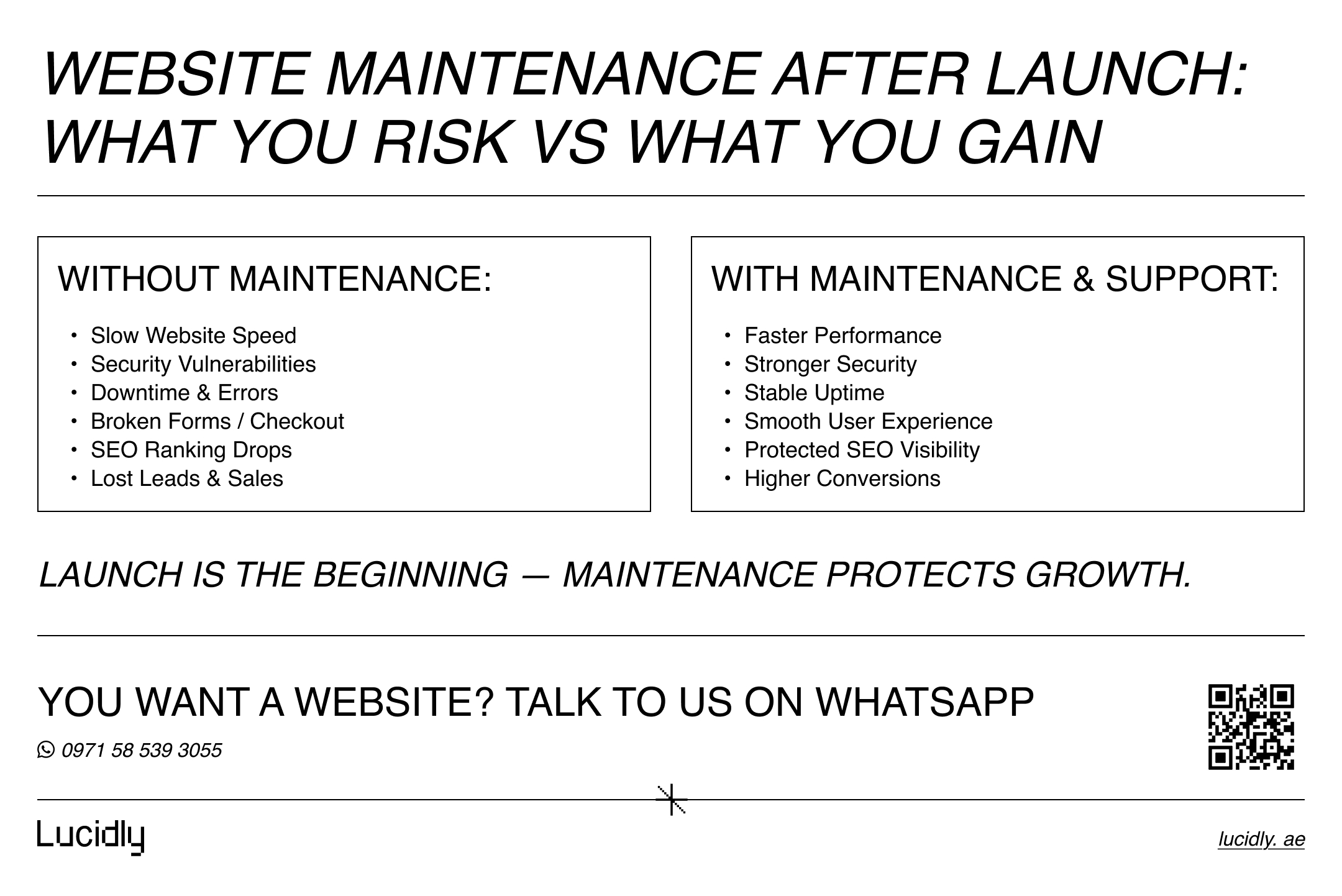
A neglected website often suffers from:
Slow loading times
Security vulnerabilities and malware risks
Broken forms or checkout issues
SEO ranking drops
Unexpected downtime
Launching a website often feels like crossing the finish line. In reality, it’s only the starting point.
Learn how web development powers modern business websites in the UAE and sets the foundation for speed, scalability, and security.
The Post-Launch Reality Most Businesses Ignore
Once a website goes live, real-world usage begins. Traffic increases, updates are released, plugins evolve, and security threats appear. The first 90 days after launch are especially critical.
In the early phase, the focus should be on stability and visibility. This includes setting up analytics, uptime monitoring, and verifying that backups actually work.
As the site matures, security hardening and performance optimization become essential. Regular updates prevent vulnerabilities, while speed improvements directly impact conversions and SEO rankings.
Later, content updates, SEO health checks, and conversion optimization ensure the website continues to grow rather than stagnate.
A website without a post-launch roadmap slowly falls behind its competitors.
The Six Core Pillars of Website Maintenance and Support
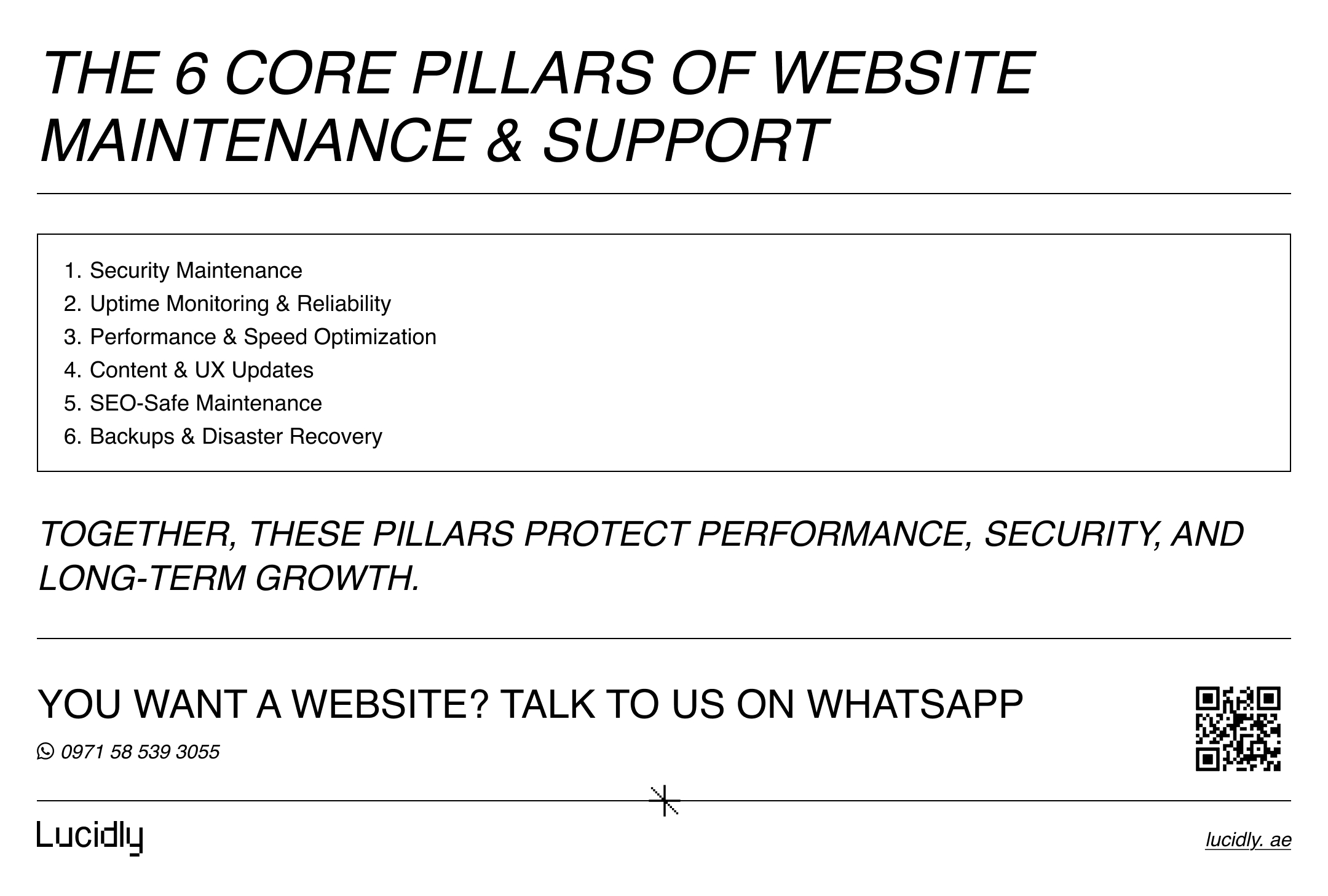
Strong website maintenance and support isn’t one task—it’s a system.
These six pillars work together to keep your website secure, fast, reliable, and ready to grow after launch.
To make this practical, each pillar below includes: what it is, what it covers, and why it matters.
Security Maintenance (Protect Your Website From Attacks)
Security is the most critical part of website maintenance. A website can look perfect and still be vulnerable.
A proper security maintenance process typically covers:
Core/CMS, theme, and plugin updates
Vulnerability patching and security hardening
Malware scanning and cleanup readiness
Firewall/WAF configuration (where applicable)
Access control (roles, admin restrictions, login protection)
A simple incident response plan (what happens if the site is hacked)
Without regular security maintenance, websites become easy targets—especially in competitive markets like Dubai and the UAE.
Security is the most critical part of website maintenance. A website can look perfect and still be vulnerable.
For a deeper dive, see our website security essentials guide to understand how to protect your site from hacks, malware, and data loss.
Uptime Monitoring and Reliability (Prevent Costly Downtime)
Downtime isn’t just technical—it’s lost revenue and lost trust. Even a short outage can mean missed leads, abandoned carts, and a damaged brand image.
Uptime and reliability maintenance usually includes:
Uptime monitoring (alerts when the site goes down)
Error monitoring (critical pages like forms, checkout, login)
Defined response rules based on severity (SLA-style priority levels)
Optional 24/7 website support for urgent issues
Reliability builds confidence for users—and signals stability to search engines too.
Performance and Speed Optimization (Keep Your Site Fast)
Website speed directly affects user experience, conversions, and SEO. Google considers performance signals like Core Web Vitals, and users expect pages to load quickly on mobile.
Performance maintenance often includes:
Image compression and next-gen formats
Caching and CDN setup (when relevant)
Database cleanup and optimization
Code cleanup (removing heavy scripts, reducing page weight)
Regular speed testing and fixes
Faster websites keep visitors longer and convert better—especially for lead-gen and eCommerce sites in the UAE.
Content and UX Updates (Stay Relevant and Keep Converting)
Websites aren’t static brochures. Your offers change, your services evolve, and users expect fresh, clear content.
Content and UX maintenance usually includes:
Updating key pages (services, pricing, contact, about)
Replacing outdated banners, promos, or messaging
Fixing layout issues across devices
Improving UX based on user behavior (where users drop off or get stuck)
Fresh, accurate content improves trust, engagement, and leads—while also signaling quality to Google.
SEO-Safe Maintenance (Avoid Ranking Drops After Updates)
Many SEO problems happen quietly. A small change can cause broken redirects, missing pages, or indexing issues—then rankings drop without obvious warnings.
SEO-safe maintenance typically includes:
Monitoring crawl errors and broken links
Redirect management (especially after page changes)
Indexing checks (robots/noindex/canonical issues)
Schema validation and structured data checks
Internal linking health checks
Good maintenance protects your organic traffic and prevents avoidable SEO losses
Backups and Disaster Recovery (Your Safety Net)
Backups are only useful if you can restore them. Many sites have backups that fail when they’re needed most.
Backup and recovery maintenance should include:
Automated backups (with clear frequency)
Offsite storage (not only on the same server)
Regular restore tests (proof that recovery works)
A clear recovery plan for hacking, data loss, or server failure
A tested backup strategy reduces downtime and business damage—an essential standard for professional website maintenance services in the UAE.
Ready to Build a High-Performance Website?
Turn strategy into results with Lucidly’s custom web development solutions — built for speed, SEO, and business growth.
👉 Book Your Web Development Consultation
Clear Signs Your Website Needs Maintenance Now
Some issues don’t require deep technical analysis. They are direct indicators that your website is no longer being properly maintained.
Common warning signs include:
Noticeable drops in website speed or page load time
Sudden decline in organic traffic or Google visibility
Contact forms or lead forms not working correctly
Security warnings, SSL errors, or suspicious activity
Broken pages, 404 errors, or missing content
Delayed updates due to fear of “breaking the site”
If even one of these signs appears, it’s time to implement a structured website maintenance plan.
Website Maintenance Checklists That Actually Work
Well-structured maintenance follows a clear schedule.
On a weekly basis, tasks typically include updates, uptime review, security scans, and form testing.
Monthly maintenance focuses on performance reports, SEO health checks, plugin audits, and backup verification.
Quarterly reviews often include deeper security assessments, content pruning, UX improvements, and technical cleanups.
These checklists help ensure nothing important is missed.
Platform-Specific Website Maintenance
Different platforms require different maintenance approaches. Professional website maintenance services adapt based on the CMS or eCommerce system used.
WordPress maintenance includes core, theme, and plugin updates, security monitoring, backups, and performance optimization.
Shopify maintenance focuses on theme updates, app compatibility, checkout testing, and analytics accuracy.
WooCommerce and Magento maintenance require extra attention to payment gateways, product catalogs, performance tuning, and security hardening.
Platform expertise is essential for reliable support.
What’s Included in Website Maintenance (and What’s Not)
One of the most important parts of a maintenance agreement is clarity.
Website maintenance typically includes:
Core, theme, and plugin updates
Security monitoring and vulnerability patching
Performance and speed optimization
Automated backups and restore support
Technical issue resolution and monitoring
Website maintenance usually does not include:
New feature development
Full page redesigns
Large-scale content creation
Major structural or platform changes
Clear boundaries prevent misunderstandings and build long-term trust between businesses and maintenance providers.
Website Maintenance Pricing in the UAE
The UAE operates in a highly digital-first environment, where businesses rely heavily on online platforms to build trust, deliver services, and compete effectively.
Reliability, security, and continuity are no longer optional—they are core expectations in a market regulated and guided by national digital transformation standards.
As outlined by the UAE’s Telecommunications and Digital Government Regulatory Authority (TDRA), maintaining secure, reliable digital services is essential for protecting users and ensuring sustainable digital growth.
This makes ongoing website maintenance and support a critical requirement for businesses operating in the UAE, not just a technical choice.
How to Choose the Right Website Maintenance Partner
Choosing the right maintenance provider is a strategic decision.
A reliable partner should have clear processes, documented SLAs, transparent reporting, and proven experience in your platform. They should also explain what is included and what is excluded from the contract.
Asking the right questions before signing prevents frustration later.
DIY vs Agency vs In-House Maintenance
Some businesses attempt DIY maintenance, while others rely on agencies or internal teams.
DIY may work for very small sites but carries high risk.
Agencies provide expertise, tools, and scalability.
In-house teams offer control but require higher long-term investment.
For most UAE businesses, an experienced website maintenance agency provides the best balance.
Why Website Maintenance Matters More in the UAE Market
The UAE is a high-competition, always-online digital environment. Users expect fast, secure, and professional websites, especially in sectors like real estate, healthcare, legal services, hospitality, and eCommerce.
A few seconds of delay or a security warning can cost you trust instantly.
In addition, many businesses in Dubai and across the UAE prefer structured service models such as Annual Maintenance Contracts (AMC). These contracts provide predictable costs, guaranteed response times, and continuous website support without surprises.
Website maintenance in the UAE is not just technical upkeep.
It’s a trust signal, a brand asset, and a competitive advantage.
Frequently Asked Questions
Do you provide 24/7 website support in Dubai/UAE?
Yes, 24/7 website support is typically available for businesses in Dubai and the UAE that require continuous monitoring and fast response times, especially for high-traffic or revenue-critical websites. This level of support is usually included in advanced maintenance plans or annual maintenance contracts.
How often should I update WordPress themes and plugins?
WordPress themes and plugins should be checked regularly and updated after proper testing. Security and critical updates should be applied promptly, while feature updates are usually scheduled to avoid compatibility issues and downtime.
Do you handle backups and restores (and how often)?
Professional website maintenance includes automated backups and restore support. Backup frequency depends on how often the website changes—static sites may require less frequent backups, while eCommerce websites often need daily or more frequent backups, along with periodic restore testing.
What SLA / uptime guarantee do you provide?
Service Level Agreements (SLAs) typically define response times based on issue severity, such as complete site outages versus minor bugs. While uptime is influenced by hosting, a strong maintenance plan includes monitoring, rapid response, and clear escalation procedures during incidents.
Can you maintain eCommerce sites (Shopify / WooCommerce / Magento)?
Yes, eCommerce website maintenance covers platforms such as Shopify, WooCommerce, and Magento. It focuses on checkout stability, payment gateway monitoring, performance optimization, security hardening, and preventing issues that could impact sales.
A successful website is not built once.
It is maintained, protected, optimized, and improved over time.
In the UAE’s competitive digital landscape, website maintenance and support are what turn a launch into long-term success.
If your website is live, the real work has just begun.
Contact us — or message Lucidly on WhatsApp for a focused website maintenance review—so you can identify speed, security, and uptime gaps before they impact leads and sales.
References
Google Search Central – Website maintenance, SEO, and Core Web Vitals
Google PageSpeed Insights – Performance & Core Web Vitals
WordPress.org – Maintenance, updates, security, and backups