Images play a bigger role in SEO than most people realise. They affect page load speed, accessibility, and whether your site can show up in Google Images and visual search results.
But search engines don’t “see” images like humans do—they rely on context, alt attributes, file names, and performance signals to understand them.
That’s why image seo matters. In this guide, you’ll learn practical ways to optimise images for search and accessibility, so they load faster, rank better, and support a stronger user experience.
What Is Image SEO and Why It Matters
Image SEO is an on-page seo practice of optimising images so search engines can discover, understand, and rank them properly.
It goes beyond adding pictures to a page and focuses on how images support relevance, usability, and performance.
When done well, image seo turns visuals into assets that improve both visibility and user experience.
Here’s what strong image optimisation can do for your site:
Help your content appear in Google Images and visual search results
Improve page load speed by reducing image weight and delivery time
Support accessibility through clear, useful alt text for screen readers
Strengthen topical context, helping search engines understand the page better
Increase engagement by making pages easier and faster to consume
Ignoring image optimisation means missed opportunities. Unoptimised images can slow down your site, weaken user experience, and limit your visibility in image search—especially for visual-first queries.
How Google Finds and Understands Images
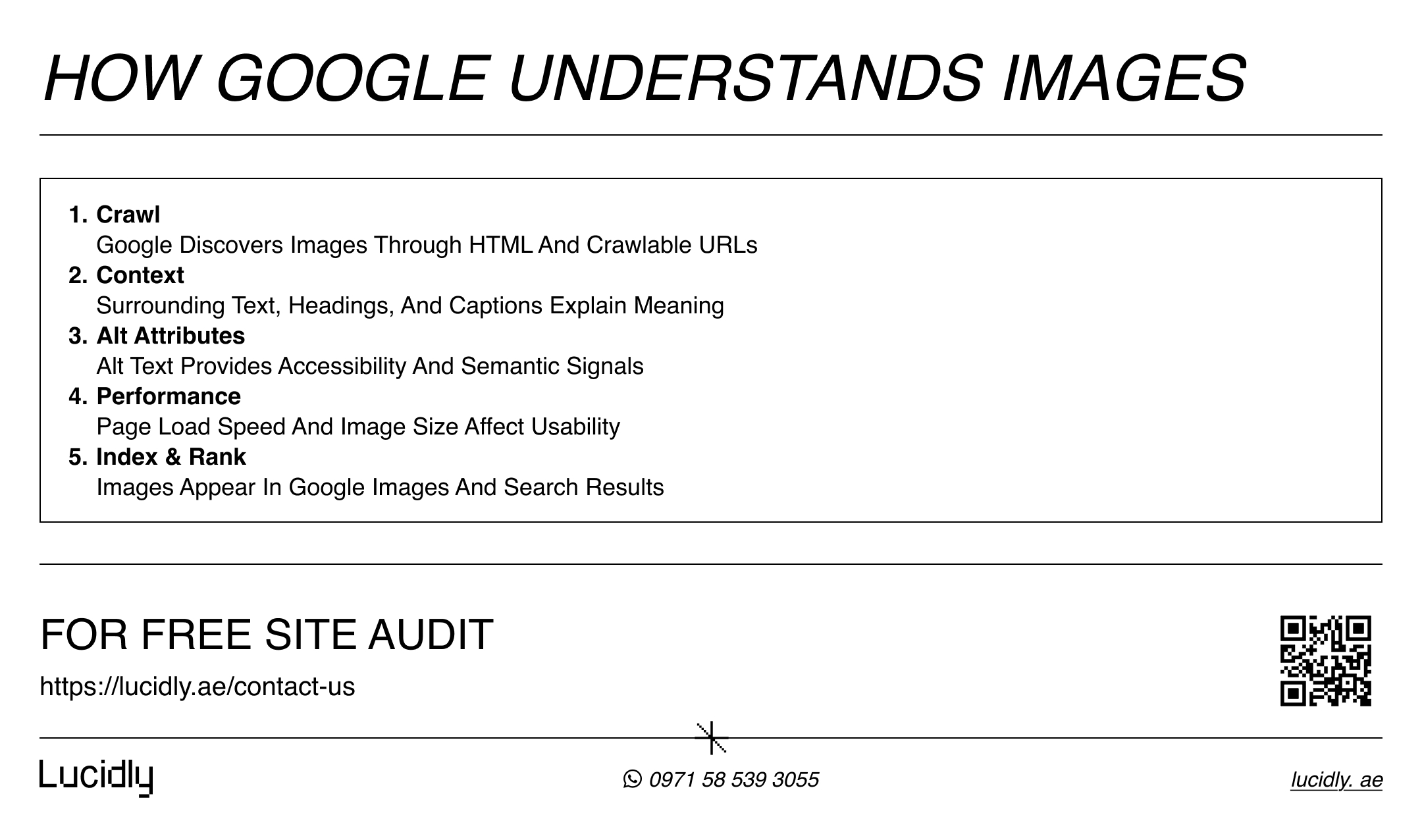
Before an image can rank, Google must be able to discover it, access it, and interpret its meaning. This process depends on both technical setup and contextual signals.
Helping Google Discover and Index Images
Search engines primarily discover images through HTML image elements placed directly within a page’s content. Images hidden behind scripts, blocked by robots directives, or loaded in inaccessible ways may never be indexed.
To support seo for images, your goal is simple: make every important image easy to crawl, easy to fetch, and easy to understand in context.
To improve discovery and indexing, focus on these essentials:
Place images directly in the HTML content whenever possible (not “invisible” behind scripts)
Make sure image URLs are crawlable and not blocked by robots directives
Use clear surrounding text that explains what the image shows and why it matters
Keep images on pages that are themselves indexable and accessible
Avoid “orphan” images with no context, headings, or descriptive content nearby
When your pages provide clear context and your images are technically accessible, Google can discover, interpret, and index them far more reliably.
When Image Sitemaps Are Necessary
Image sitemaps are not required for every site, but they are useful when images are difficult to discover through standard crawling.
This often applies to galleries, eCommerce product images, or images loaded dynamically.
An image sitemap provides search engines with direct information about image URLs and their relationship to pages, improving discovery and indexing when normal crawling is not enough.
The Core Pillars of Image SEO
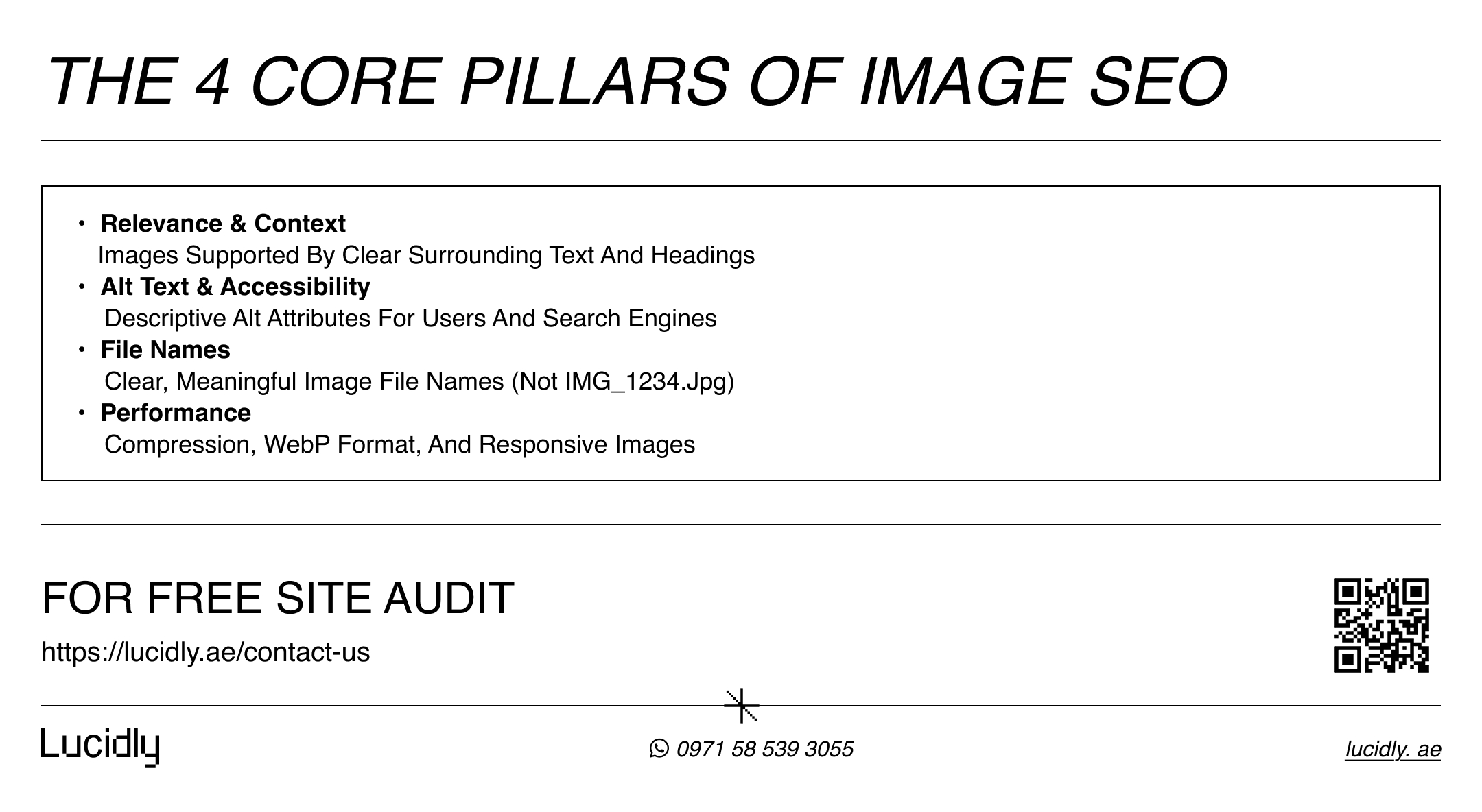
Effective image optimisation rests on a few consistent principles. These pillars help search engines understand relevance while improving usability and accessibility.
Relevance and Context Signals
Search engines evaluate images based on the context around them. Headings, surrounding paragraphs, captions, and page topic all contribute to how an image is interpreted.
Random stock photos that don’t match the content weaken relevance. In contrast, images that clearly support the topic strengthen image search seo by reinforcing topical alignment.
Alt Text SEO and Accessibility
Alt text plays a critical role in both accessibility and search understanding. Alt attributes describe an image for screen readers and provide search engines with textual context.
Good alt text seo is specific, descriptive, and natural. It explains what the image shows and why it matters in the context of the page.
Decorative images that add no meaning can use empty alt attributes, ensuring assistive technologies skip them.
Image File Names That Make Sense
Image file names are another signal used to understand image content. Generic names like “IMG_1234.jpg” provide no value, while descriptive names clarify relevance.
Using meaningful image file names supports image optimisation by reinforcing topical context without relying solely on alt text.
Visual Search Optimisation
Modern optimisation goes beyond traditional search. Visual search optimisation considers how images match visual intent—such as product images, step-by-step visuals, infographics, or comparisons.
Matching image type to query intent improves visibility and engagement, especially as visual discovery becomes more prominent.
Performance Optimisation for Images
Images are often the heaviest assets on a page. Without careful optimisation, they can significantly impact page load speed and user experience.
Image Compression for SEO
Image compression reduces file size while preserving visual quality. Proper image compression for seo ensures faster loading without degrading clarity.
Uploading oversized original images and relying on browsers to scale them down is a common seo mistake that negatively affects performance.
Using Modern Image Formats
Modern formats such as the WebP format provide smaller file sizes with comparable quality. Using next-generation formats improves delivery speed and supports better performance metrics.
Page load speed is a direct usability factor, and image optimisation plays a major role in achieving fast-loading pages.
Responsive Images and Layout Stability
Responsive images ensure the correct image size is delivered based on device and screen resolution. This prevents unnecessary data usage on mobile devices and improves performance consistency.
Defining image dimensions also prevents layout shifts, creating a more stable visual experience as pages load.
Want help implementing this checklist across your key pages? Learn more and request on-page support from our Professional SEO agency.
Optimising Images for Google Images Results
Ranking in Google Images requires more than technical optimisation. Search engines evaluate the usefulness of the page hosting the image, not just the image itself.
Pages that perform well in image search provide clear context, descriptive titles, and meaningful content around images. Accessibility, relevance, and performance all contribute to success in image seo for Google Images.
Structured Data and Image Visibility
Structured data can enhance image visibility when used appropriately. For products, recipes, or articles, structured data helps search engines understand how images relate to content entities.
Accuracy is essential. Structured data should always reflect what users see on the page and support—not replace—core optimisation practices.
Measuring Image SEO Performance
Optimisation is incomplete without measurement. Tracking performance shows whether your efforts are improving visibility and engagement.
Google Search Console provides insights into how images perform in Google Images, including impressions, clicks, and queries.
Monitoring this data helps identify which images attract visibility and where improvements are needed.
Patterns in the data often reveal actionable insights, such as high impressions with low clicks indicating a need for better context or presentation.
Common Image SEO Mistakes
Many issues that harm image performance are easy to avoid. Missing alt attributes, generic file names, oversized images, and blocked resources are among the most common problems.
Another frequent mistake is ignoring image sitemaps when images are difficult to discover. These oversights quietly limit search visibility and usability.
FAQs
What is image SEO?
Image SEO is the process of optimising images so search engines can discover, understand, and rank them. It focuses on accessibility, relevance, performance, and context to improve visibility in search and image results.
How do I write good alt text?
Good alt text describes what the image shows and why it matters. It should be specific, natural, and helpful for users relying on screen readers, without unnecessary keyword stuffing.
Do images affect page speed and SEO?
Yes. Images are often the largest files on a page. Poorly optimised images slow down load times, negatively affecting user experience and performance signals.
Can images rank in Google Images?
Yes. Images can rank when they are accessible, relevant, fast-loading, and supported by high-quality page content.
Image optimisation is not about adding more visuals—it’s about making every image work harder.
When images are accessible, relevant, and fast, they support stronger visibility, better usability, and improved search performance.
Websites that treat images as strategic assets—not decorative extras—gain a competitive advantage in both traditional and visual search. Used correctly, image seo turns visuals into measurable contributors to growth.
Contact us for an Image SEO audit—message us on WhatsApp and we’ll review your images, identify what’s slowing your pages, and give you a clear plan to improve visibility and accessibility.
References
Google Search Central — Image SEO Best Practices
web.dev — Optimize images for performance