You might be creating great content and seeing ranking improvements, but still wondering: is SEO actually driving results? That’s where SEO analytics comes in.
It’s not about staring at traffic numbers—it’s about understanding impressions and clicks, user behavior, and conversion tracking that connects rankings to real business impact.
In this guide, you’ll learn how to measure, track, and improve your organic performance using data that actually matters.
Message Lucidly on WhatsApp to get a clear snapshot of your SEO performance—what’s working, what’s holding you back, and which metrics actually deserve your attention.
What Is SEO Analytics?
SEO analytics is the process of collecting, analyzing, and interpreting data to understand how your website performs in organic search.
It goes beyond rankings and traffic numbers to answer the questions that actually matter: Are people finding your site? Are they clicking? And most importantly—are they taking action?
Good SEO analytics connects search visibility (impressions and clicks) with user behavior and conversion tracking, so you can make decisions based on evidence, not assumptions.
Why SEO Analytics Matters for Organic Performance
Without analytics, SEO becomes guesswork.
SEO analytics helps you identify what’s working, what’s wasting effort, and where the biggest growth opportunities are. It shows you which pages attract qualified organic traffic, which queries drive visibility, and where users drop off before converting.
In short, SEO analytics turns organic search from a “hope it works” channel into a measurable, improvable growth system.
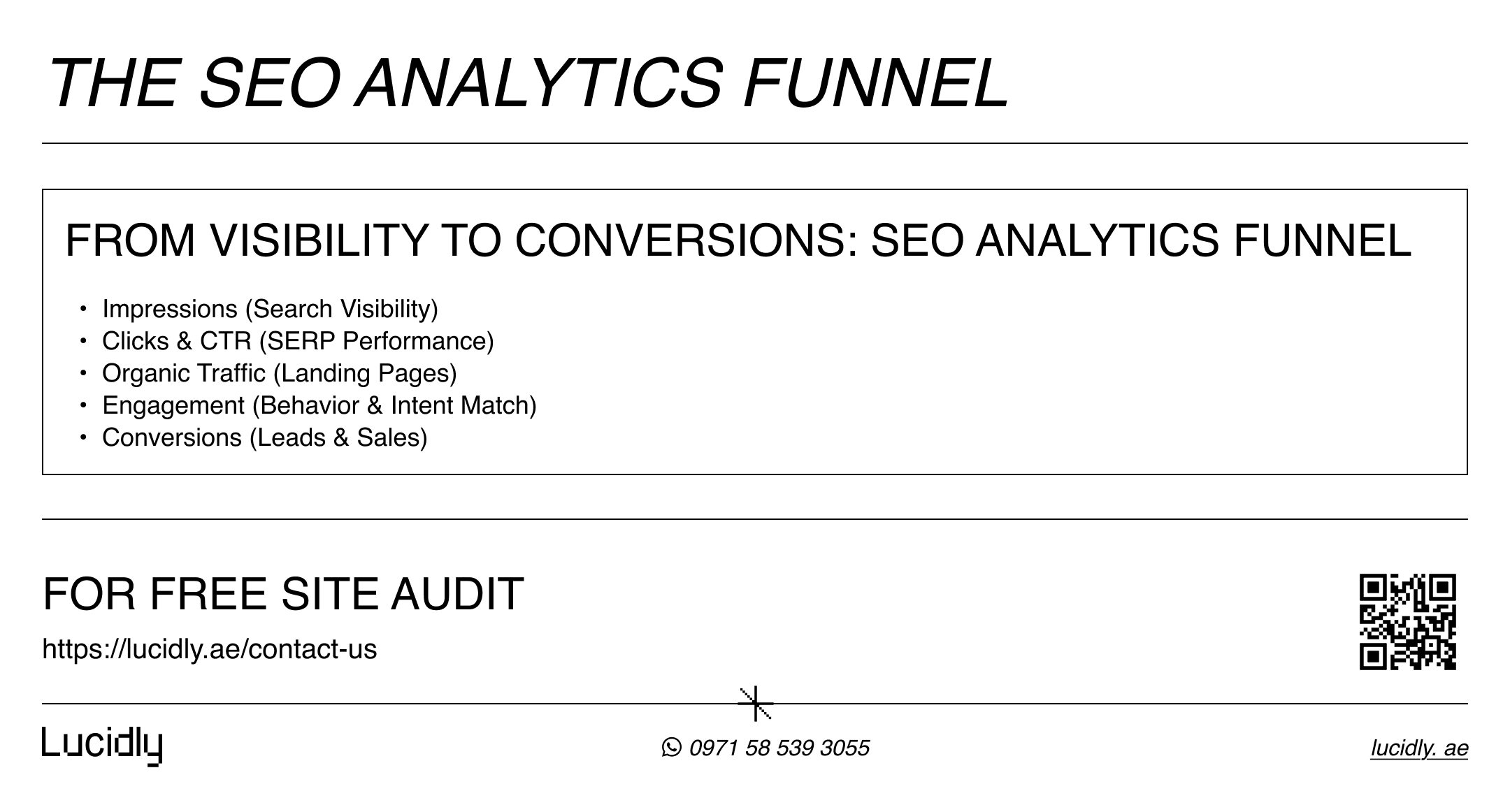
Before You Measure Anything, Define Your SEO Goals
Before diving into dashboards and reports, you need one thing: a clear SEO goal.
Measuring everything without a goal is like checking your speed without knowing your destination.
Are you trying to increase organic traffic, generate leads, or drive sales? Each goal requires different metrics.
Defining your SEO goals upfront ensures your analytics focus on outcomes—not just numbers that look impressive in a report.
Turn Business Objectives into Measurable SEO Metrics
Once your goal is clear, the next step is turning it into measurable SEO metrics.
For example, if your objective is lead generation, rankings alone don’t matter—conversion tracking does.
If your goal is visibility, impressions and clicks from Search Console become your priority.
Good SEO analytics always starts by connecting business objectives to specific metrics you can track and improve over time.
Essential SEO Analytics Tools: What You Actually Need
Let’s keep this simple: you don’t need 17 tools, 9 browser extensions, and a “SEO crystal ball.”
For most websites, you can measure, track, and improve organic performance using three core tools:
Google Search Console (visibility + queries).
Google Analytics 4 (behavior + conversions).
A dashboard tool like Looker Studio (reporting without headaches).
Start with these, master them, and only add extras when you’ve outgrown the basics.
Google Search Console: The “Truth” About Search Visibility
Search Console tells you what’s happening on Google Search, before anyone even lands on your site.
It answers questions like:
What queries are showing your pages
How many impressions and clicks are you getting?
Which pages have low CTR (meaning your title/meta might be boring)?
Are you gaining visibility—or quietly disappearing?
If SEO is a movie, Search Console is the trailer: it shows how often you’re being shown… and whether people want to watch.
Google Analytics 4: What Users Do After They Click
Search Console gets you the click. GA4 tells you what happened after the click.
This is where you measure things like:
Which landing pages bring organic traffic.
Engagement and key actions (scrolls, form submissions, WhatsApp clicks).
Conversion tracking (the part your business actually cares about).
Because traffic without action is like a crowded store where nobody buys anything. Looks busy, feels sad.
SEO Dashboards: Reporting Without Losing Your Mind
Dashboards help you see trends without jumping between tabs. A good SEO dashboard should show, at a minimum:
Organic traffic trend.
Conversions from organic.
Top landing pages.
Impressions/clicks/CTR (from Search Console).
Biggest winners/losers month over month.
Keep it simple. If your dashboard needs a training course, it’s not a dashboard—it’s a punishment.
SEO Metrics to Track: What You Should Actually Measure
Tracking everything is easy. Tracking the right things is what makes SEO analytics useful.
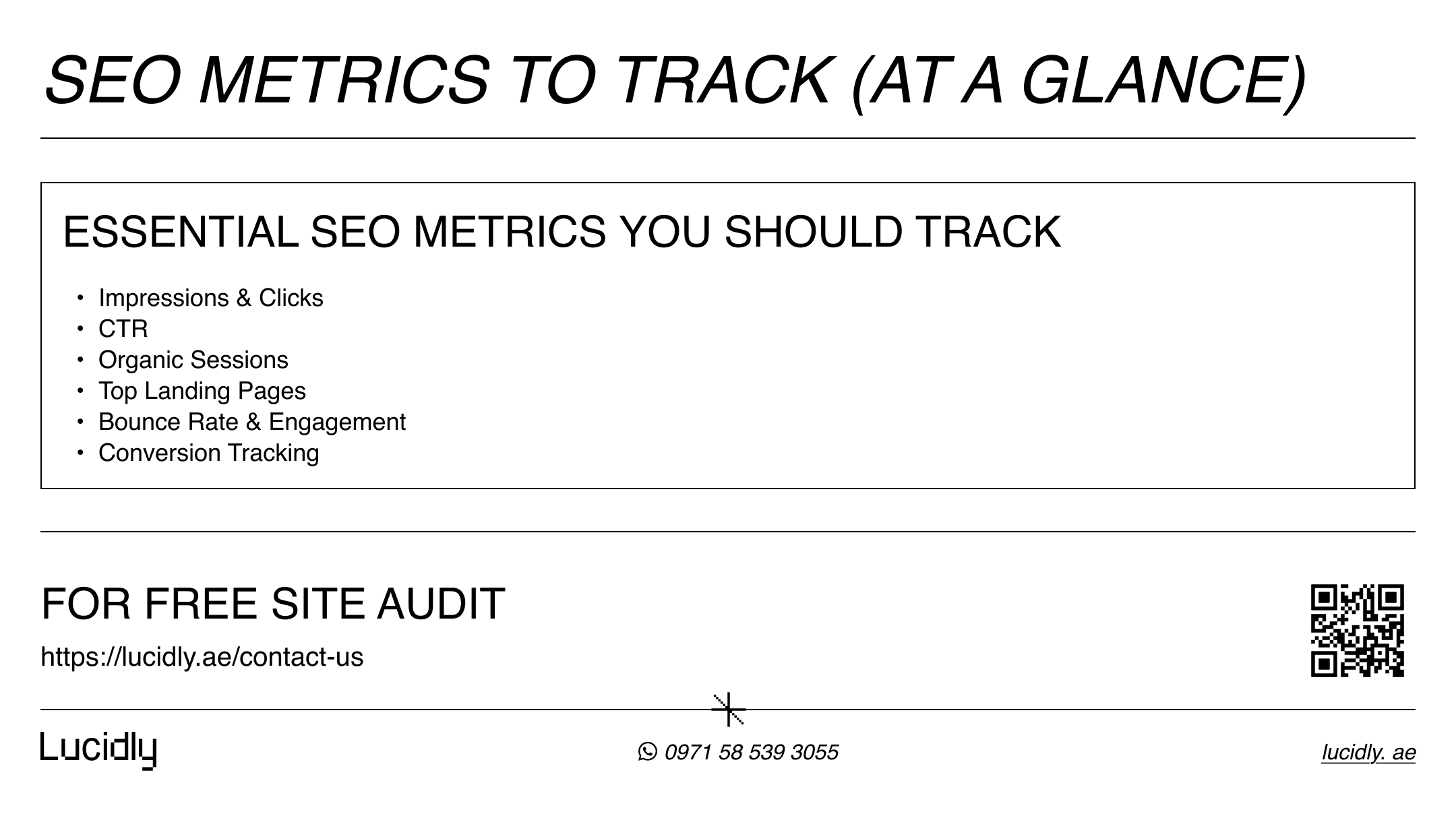
Instead of drowning in numbers, focus on metrics that show three things: visibility, traffic quality, and results.
If a metric doesn’t help you decide what to improve next, it’s probably just noise.
Visibility Metrics (Impressions, Clicks, CTR)
Visibility metrics show how your site performs directly inside search results.
They help you understand whether your pages are being seen—and whether users find them attractive enough to click.
Key visibility metrics include:
Impressions.
Clicks
Click-through rate (CTR).
High impressions with low CTR usually mean your page is visible, but your title or meta description needs improvement.
Organic Traffic Metrics
Organic traffic metrics explain what happens after users click your result.
They focus on the quality and behavior of visitors coming from search engines.
Important organic traffic metrics:
Organic sessions and users.
Top landing pages from organic search.
Traffic trends over time.
Strong SEO doesn’t just increase traffic—it attracts the right audience to the right pages.
Engagement & Bounce Rate
Engagement metrics help you evaluate whether users interact with your content strategy.
Bounce rate can be useful, but only when analyzed alongside engagement time and conversions.
A high bounce rate may indicate:
Poor search intent match.
Weak content structure.
Slow page speed.
Conversion Tracking Metrics
Conversion tracking connects SEO performance to real business outcomes.
It shows how organic traffic contributes to leads, sales, or other valuable actions.
Without conversion tracking, SEO analytics lacks meaning.
How to Measure SEO Performance
Measuring SEO performance isn’t about chasing one “magic metric.” It’s about building a simple system that answers three questions:
Are we getting more visibility?
Are we attracting the right organic traffic?
Are we converting that traffic into results?
If your measurement doesn’t lead to a clear next action, it’s not measurement—it’s entertainment.
Step 1 — Set Your Baseline
Start by capturing a baseline for the last 28–30 days (or the last full month). Record:
Total clicks and impressions (Search Console).
Organic sessions and key landing pages (GA4).
Conversions from organic traffic (GA4).
This baseline becomes your “before” snapshot—so you can prove improvement instead of guessing.
Step 2 — Compare the Right Timeframes
SEO moves in trends, not in daily mood swings. Compare:
Month over Month (MoM) to spot recent shifts.
Year over Year (YoY) when seasonality matters.
Avoid comparing random weeks unless you’re testing a specific change. Otherwise you’ll panic for no reason… and SEO will laugh quietly.
Step 3 — Segment Your Data
Averages hide problems. Segments reveal them.
Break down SEO data by:
Page (blog posts vs service pages).
Query type (brand vs non-brand).
Device (mobile vs desktop).
Country/City (if relevant).
This is how you find the real story behind “traffic is up/down.”
Step 4 — Track SEO Changes Like Experiments
Treat improvements like experiments:
Change one thing at a time (title, intro, CTA, internal links).
Wait long enough to see impact (usually a few weeks).
Measure the effect on impressions → CTR → clicks → conversions.
If you change five things at once, you didn’t optimize—you created a mystery novel.
Step 5 — Define “Success” by Goal Type
Success looks different depending on your goal:
Visibility goal: impressions up, CTR improving.
Traffic goal: organic sessions up, stronger landing pages.
Lead/sales goal: conversions up, higher conversion rate from organic.
This keeps your reporting focused—and stops the “but rankings changed!” drama.
To learn more about tracking the right SEO metrics and improving organic conversions, talk to our Professional SEO firm.
SEO Reporting Metrics: How to Create Reports That Actually Matter
SEO reporting is not about flooding dashboards with numbers—it’s about telling a clear story.
A good SEO report should answer three simple questions: What changed? Why did it change? And what should we do next?
When reports focus on outcomes instead of vanity metrics, SEO becomes easier to explain, easier to defend, and easier to improve.
Weekly SEO Reporting: Quick Health Checks
Weekly SEO reports should be short and actionable.
Their purpose is to spot problems and opportunities early—not to overanalyze trends.
Key metrics to review weekly:
Total impressions and clicks from organic search.
Pages with sudden drops or spikes.
CTR changes on high-impression pages.
New pages gaining visibility.
If something breaks, a weekly report is how you catch it before it turns into a disaster.
Monthly SEO Reporting: Performance and Growth
Monthly SEO reports are where strategy lives.
This is where you zoom out and evaluate whether SEO efforts are moving the business forward.
A strong monthly SEO report should include:
Organic traffic trends (month over month).
Conversions from organic traffic.
Top-performing landing pages.
Pages and queries with growth potential.
Clear priorities for the next month.
If your monthly report doesn’t end with “here’s what we’ll improve next,” it’s incomplete.
SEO Dashboards: One View, No Guessing
SEO dashboards help you track progress without digging through multiple tools.
Instead of jumping between Google Search Console and GA4, dashboards bring key metrics into one place.
An effective SEO dashboard should show:
Organic traffic and conversion trends.
Impressions, clicks, and CTR.
Top landing pages.
Biggest winners and losers over time.
Keep dashboards simple. If it takes longer to understand the dashboard than to take action, it’s too complex.
Reporting the Right Metrics to Stakeholders
Different audiences care about different metrics.
SEO reports should adapt to who’s reading them.
Executives care about conversions, revenue, and growth trends.
Marketing teams care about traffic, content performance, and CTR.
SEO specialists care about queries, pages, and technical signals.
Good SEO reporting translates data into language each audience understands—without overwhelming them.
How to Improve Organic Performance Using SEO Analytics
SEO analytics is only valuable when it leads to action.
Data should tell you what to fix, what to scale, and what to stop doing. Instead of guessing, you use patterns to improve visibility, traffic quality, and conversions—systematically.
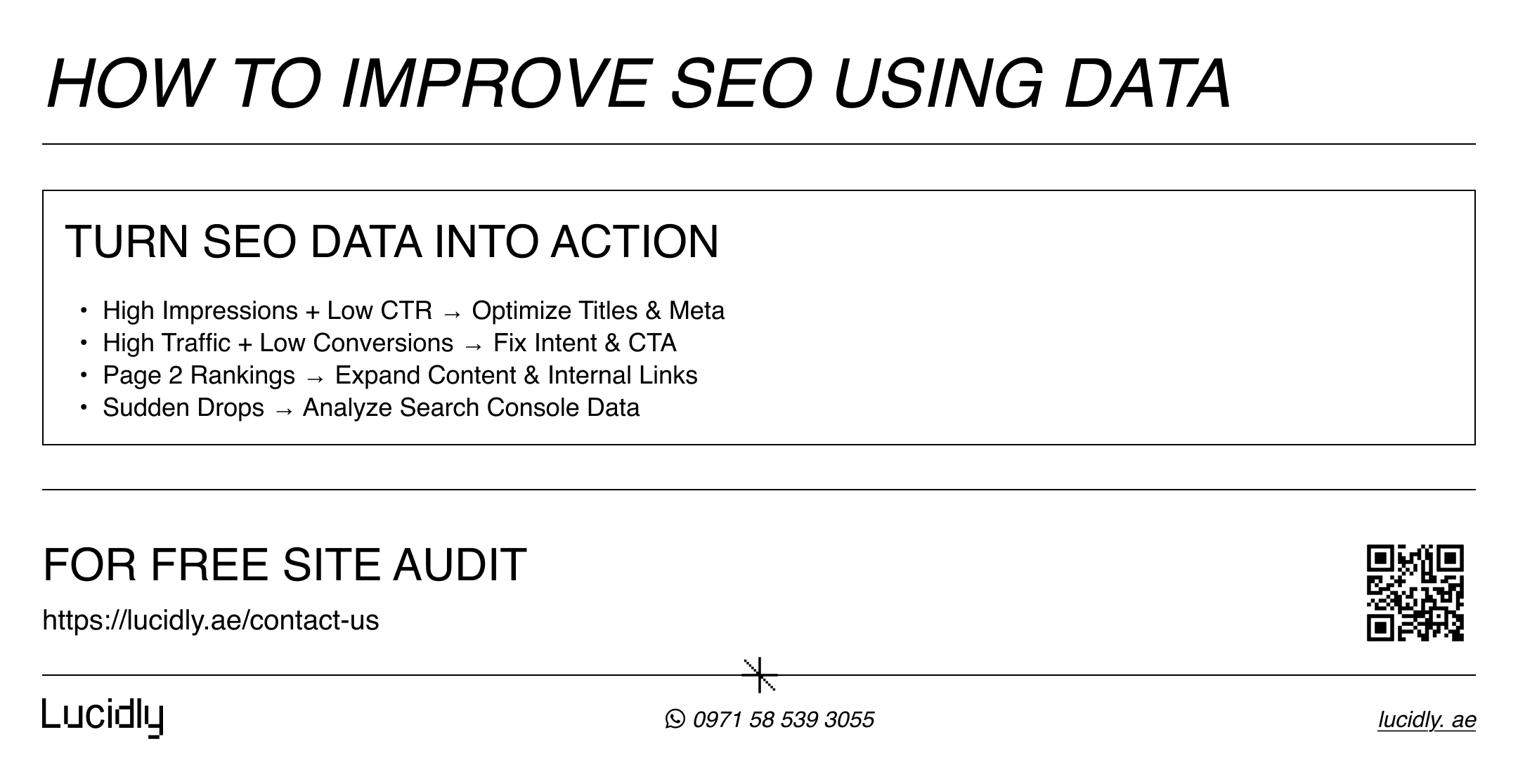
Below are practical playbooks you can apply based on what your data is telling you.
Playbook 1 — High Impressions, Low Clicks
If your pages get a lot of impressions but few clicks, visibility isn’t the problem—appeal is.
This usually means:
Your title tag isn’t compelling
Your meta description doesn’t communicate value
Your result doesn’t match search intent clearly
What to do:
Rewrite titles to highlight benefits, not keywords
Add numbers, clarity, or a strong promise
Align the page title more closely with the query wording and keyword research.
Small snippet changes can dramatically increase CTR without changing rankings.
Playbook 2 — Good Traffic, Poor Conversions
When organic traffic is growing but conversions are not, the issue is rarely SEO—it’s alignment.
Common causes:
The page doesn’t fully answer the search intent
Calls to action are unclear or buried
The page lacks trust signals (proof, clarity, reassurance)
What to do:
Revisit the primary intent behind the query
Make your CTA obvious and friction-free
Improve structure, readability, and credibility
SEO brings visitors. Conversion optimization turns them into results.
Playbook 3 — Sudden Drops in Performance
Sudden drops are stressful—but data makes them manageable.
How to investigate:
Check Search Console for affected pages and queries
Compare date ranges to isolate when the drop started
Segment by device, country, or page type
Most drops are caused by content changes, intent mismatches, or technical issues—not mysterious algorithm punishments.
Playbook 4 — Pages Stuck on Page Two
Pages ranking just outside the top results are often your fastest wins.
Signs of opportunity:
Average position between 8–20
Consistent impressions
Stable or improving clicks
What to do:
Expand or update the content
Strengthen internal linking
Improve clarity and topical depth
These pages already have momentum—they just need a push.
Playbook 5 — Turning SEO Data Into a Monthly Action Plan
At the end of each month, SEO analytics should produce a short action list.
A simple framework:
Fix 2–3 pages with high impressions and low CTR
Improve 2 pages with traffic but weak conversions
Refresh 1–2 older pages losing visibility
Consistency beats complexity. Small improvements, applied regularly, compound over time.
FAQs
What should I track for SEO?
You should track metrics that reflect visibility, traffic quality, and results.
At a minimum, focus on impressions, clicks, CTR, organic sessions, top landing pages, and conversion tracking. These metrics show not only how often you appear in search, but whether your SEO efforts lead to meaningful actions.
How do I measure SEO success?
SEO success depends on your goals.
If your goal is visibility, success means rising impressions and improved CTR. If your goal is traffic, look at organic sessions and landing page performance. If your goal is leads or sales, conversions from organic traffic are the true measure of success—not rankings alone.
What tools do I need for SEO analytics?
Most websites can measure SEO performance using three tools:
Google Search Console for search visibility, Google Analytics 4 for user behavior and conversion tracking, and a dashboard tool like Looker Studio for reporting. Master these tools before adding advanced SEO platforms.
How often should I review my SEO reports?
SEO data should be reviewed regularly, but not obsessively.
Weekly reviews help you catch issues early, while monthly reviews allow you to evaluate trends, performance, and growth. Daily monitoring is rarely useful and often leads to overreaction.
SEO analytics is not about collecting data—it’s about creating clarity.
When you track the right metrics, review them consistently, and act on what they reveal, SEO stops being confusing and starts becoming predictable.
The sites that win in organic search are not the ones with the most data, but the ones that use it best.
Contact us for an SEO analytics audit—message us on WhatsApp and we’ll review your tracking setup, identify what’s skewing your data, and give you a clear, actionable plan to improve your organic performance.
References
Google Search Central — Performance reports in Search Console
Google Analytics Help — Measure organic search traffic with GA4
Google Looker Studio Help — Create dashboards with Google Analytics and Search Console