Choosing between SEO vs paid ads is one of the most common — and most expensive — decisions businesses make in digital marketing.
Should you invest in long-term organic growth, or pay for immediate visibility through advertising?
The truth is that SEO and paid ads serve different purposes, work on different timelines, and deliver results in very different ways.
Understanding those differences is the key to choosing the right strategy — or combining both without wasting budget.
This guide breaks down SEO vs PPC, explains organic vs paid traffic, compares costs and ROI, and shows exactly when SEO, Google Ads, or a hybrid approach makes the most sense.
Message Lucidly on WhatsApp and we’ll guide you toward the strategy that fits your business best.
SEO vs Paid Ads: The Core Difference (In One Minute)
The core difference between SEO and paid ads comes down to timing and cost: SEO builds long-term visibility you earn, while paid ads buy immediate exposure that stops when spending stops.
What Is SEO?
SEO (Search Engine Optimisation) is the process of improving your website so it ranks organically in search results.
You don’t pay for clicks — you invest in:
High-quality, helpful content
Technical performance and site health
Authority signals like links and brand mentions
SEO is a long-term investment. Results take time, but they compound.
read our guide if you are wondering how long does seo take.
What Are Paid Ads (PPC / Google Ads)?
Paid ads place your website at the top of search results instantly — but you pay every time someone clicks.
This is commonly known as pay-per-click (PPC) advertising.
With PPC:
You control targeting, budget, and timing
Traffic stops the moment you stop paying
Cost per click can rise quickly in competitive niches
This is the classic pay-per-click vs SEO trade-off.
Organic vs Paid Traffic in Search Results
Organic results earn clicks through relevance and authority
Paid results are labeled as ads and bought through bidding
Users often trust organic results more, but ads capture high-intent searches immediately.
SEO vs Paid Ads: Which One Should You Choose?
If you want the short answer without diving into details, use this quick rule of thumb to decide between SEO and paid ads based on your goals, timeline, and budget:
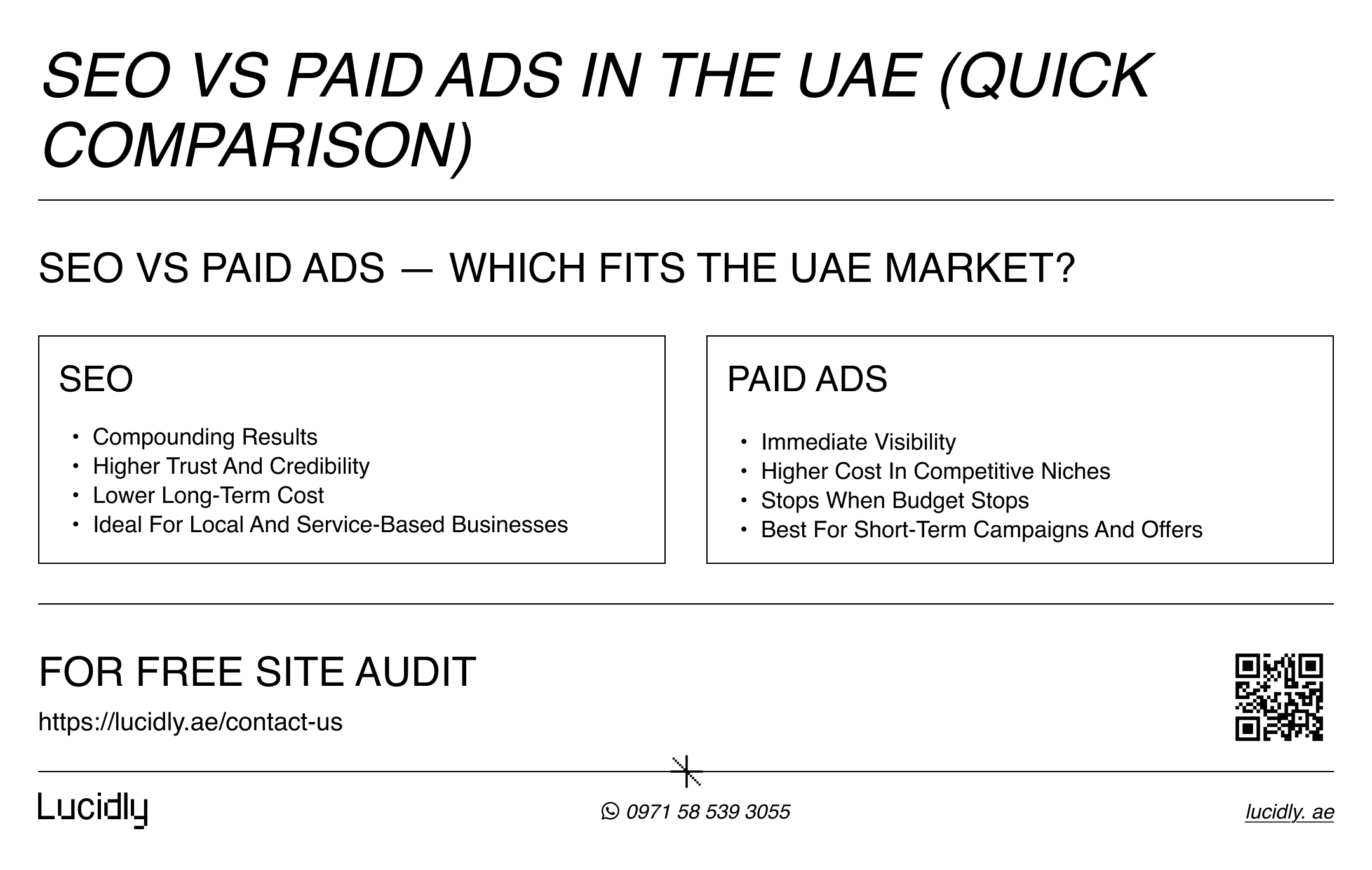
Choose SEO if you want long-term, compounding growth and sustainable ROI
Choose Paid Ads (PPC) if you need immediate traffic, leads, or sales
Choose Both if you want speed and stability (this is what most successful brands do)
There’s no universal winner in the seo vs paid ads debate — only the right choice for your goals, timeline, and marketing budget.
Pros and Cons of SEO
SEO offers powerful long-term benefits, but it also comes with trade-offs that are important to understand before choosing it as your primary growth strategy.
Pros of SEO
SEO delivers long-term value by building organic visibility that compounds over time. Instead of paying for each click, you invest in assets that continue to generate traffic and leads, including:
Long-term, compounding organic traffic
Higher trust and credibility with users and search engines
Lower cost per acquisition over time
Strong return on investment once rankings stabilize
Cons of SEO
Despite its long-term advantages, SEO comes with limitations that businesses must consider before relying on it as their primary growth channel, such as:
Takes time to show measurable results
Requires ongoing consistency and high-quality execution
Not ideal for urgent or time-sensitive campaigns
Overall, SEO clearly wins in long term vs short term results—but only for businesses that are patient, strategic, and committed to sustained growth.
Pros and Cons of Paid Ads (PPC)
Paid ads offer speed and control, but that convenience comes with trade-offs that can impact cost, sustainability, and long-term growth.
Pros of Paid Ads
Paid ads deliver several clear advantages that make them a powerful channel for fast growth and short-term campaigns, including:
Immediate visibility and traffic
Precise targeting and budget control
Ideal for launches, promotions, and seasonal offers
Easy to test keywords and landing pages
Cons of Paid Ads
Despite their speed and flexibility, paid ads also come with notable drawbacks that can limit long-term effectiveness, such as:
Traffic disappears when spend stops
Rising cost per click in competitive markets
Easy to waste marketing budget with poor pages
This is why seo vs sem is often misunderstood — SEM can include paid ads, but ads alone don’t build lasting equity.
Which Is Cheaper: SEO or Google Ads?
This is one of the most common questions in seo vs paid ads comparisons.
Short-Term Costs
In the short term, PPC is often cheaper to start.
You can launch ads today and generate leads tomorrow.
Long-Term Costs
Over time, SEO usually becomes cheaper per lead.
Once pages rank, you don’t pay for each click — traffic keeps coming.
The Simple ROI Framework
Instead of asking which channel is cheaper upfront, the better question is which one delivers results at a lower cost over time. Paid ads charge for every click, while SEO spreads its cost across months or years of organic traffic.
For businesses where a single customer generates ongoing value, SEO often becomes the more cost-effective option in the long run.
When SEO Wins (Best-Fit Scenarios)
SEO is usually the better choice when your priority is building sustainable growth rather than relying on short-term spikes. In practical terms, SEO clearly wins in the following situations:
When you want long-term, sustainable growth
If your goal is to build a marketing channel that compounds over time, SEO is ideal. Every page, article, or optimisation becomes a long-term asset that can generate traffic and leads for months or even years, especially when successful pages are continuously improved.
When your product or service has evergreen demand
SEO works best when people search for your offering year-round, not just during a short campaign or season.
Common examples of evergreen demand include:
Healthcare and medical services.
Professional services (legal, accounting, consulting).
B2B solutions.
Education and training.
In these cases, consistent organic visibility creates a steady flow of qualified leads.
When trust and authority are critical
In industries such as B2B, healthcare, legal, and finance, users rarely convert after a single visit. They research, compare, and look for credible sources before making a decision.
SEO helps build authority through:
In-depth educational content.
Service pages that clearly explain value.
Guides, comparisons, and case studies.
This level of trust is difficult to achieve through ads alone.
When you want to reduce reliance on paid ads over time
Paid ads are powerful, but relying on them entirely ties your growth to ongoing spend and rising cost per click. SEO reduces this dependency by:
Driving traffic without paying for each click.
Protecting performance when ad costs increase.
Creating a more resilient marketing channel.
When you have limited ad budget but time to invest
If your marketing budget is constrained but you can invest time and consistency, SEO often delivers better long-term returns than paid advertising.
In these scenarios, the comparison between search engine optimisation vs advertising isn’t even close — SEO delivers significantly stronger long-term value.
What About the UAE? (Local SEO Considerations)
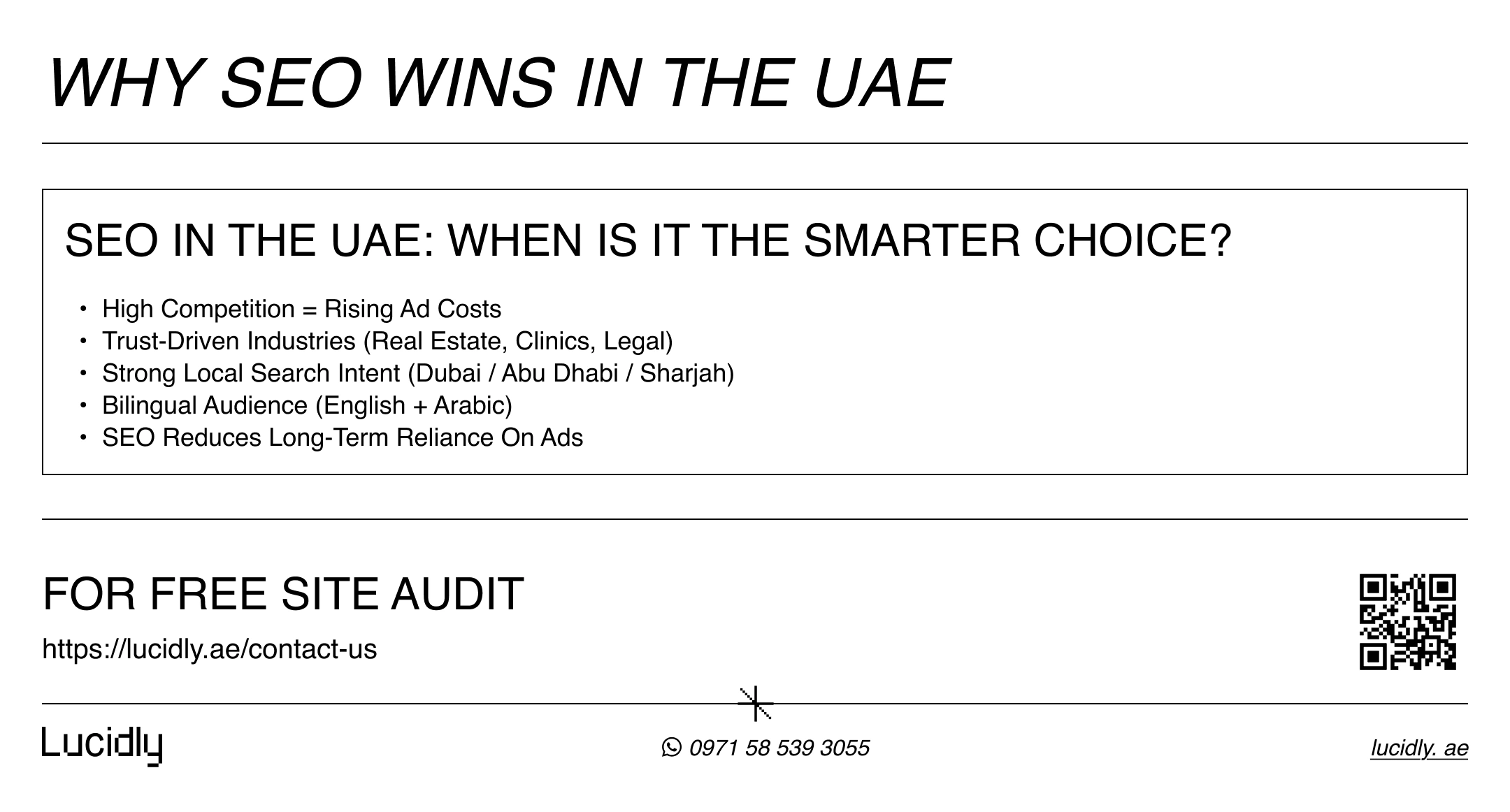
In the UAE, SEO often delivers even stronger long-term value when your business depends on local intent and high-trust buying decisions.
Markets like Dubai and Abu Dhabi are competitive and highly commercial, which can make paid ads expensive—especially in sectors such as real estate, clinics, legal services, hospitality, and ecommerce.
In these cases, SEO helps you build sustainable visibility that keeps working even when ad costs rise.
To win in the UAE, prioritize English + Arabic content, optimize for city- and emirate-level searches (e.g., “in Dubai,” “in Abu Dhabi”), strengthen your Google Business Profile for local discovery, and earn authority through relevant local coverage and partnerships.
When executed consistently, UAE-focused SEO reduces long-term reliance on ads while improving trust and lead quality.
To learn more about tracking the right SEO metrics and improving organic conversions, partner with our Professional SEO company.
When Paid Ads Win (Best-Fit Scenarios)
Paid ads are the better option when speed, control, and immediate demand capture matter more than long-term compounding.
In these scenarios, SEO vs paid ads isn’t a theoretical debate—paid campaigns are simply the fastest path to measurable results.
When you need leads or sales immediately
If your business needs results this week—not in three months—paid ads win. You can launch campaigns quickly,
target high-intent keywords, and start generating traffic and conversions almost instantly. This is especially useful for:
New businesses trying to create momentum
Sales targets that can’t wait for organic growth
Services with urgent demand (repairs, appointments, bookings)
When you’re testing a new offer, product, or market
Paid ads are one of the best “testing tools” in digital marketing. Before you invest months into SEO content, PPC helps you validate:
Which keywords actually convert
Which messaging works best
Which landing page layouts drive sign-ups or purchases
Which audience segments respond to your offer
In other words, seo vs ppc often starts with PPC because it provides fast feedback and clear data.
When your business is seasonal or time-sensitive
If your demand peaks during specific periods—holiday promotions, Ramadan campaigns, back-to-school, or limited-time offers—SEO may be too slow to fully capitalize on the moment. Paid ads allow you to:
Scale visibility during peak weeks
Turn spend up or down instantly
Target specific times, locations, or device types
For seasonal businesses, long term vs short term results matters: ads dominate short-term windows.
When organic rankings are too slow in your niche
In highly competitive niches, ranking organically for valuable keywords can take 6–12 months (or longer), especially for new or low-authority sites.
Paid ads let you appear at the top immediately—while SEO works in the background. This is common in:
Legal services
Finance and insurance
Real estate
High-CPC medical niches
Competitive ecommerce categories
Even if cost per click is high, PPC can still be profitable if conversion rates and lifetime value justify it.
When you need hyper-specific targeting and budget control
SEO targets search intent, but PPC gives you extra layers of control, such as:
Geographic radius targeting.
Audience segments (remarketing, similar audiences).
Device targeting (mobile vs desktop).
Day/time scheduling.
Budget caps and bid strategies.
That level of control can make PPC more efficient in the short term—especially when you’re managing a strict marketing budget.
In these cases, “seo or Google Ads” isn’t really a debate—ads are the fastest route to visibility, leads, and sales.
SEO or Google Ads: A Practical 90-Day Decision Plan
If you’re unsure where to invest first, this simple 90-day framework helps you decide whether to focus on SEO, Google Ads, or a combination of both—based on your goals and timing.
If You Need Leads in 30 Days
Do this:
Launch Google Ads.
Fix landing pages and conversion tracking.
Start basic technical SEO.
If You Can Invest for 6+ Months
Focus on:
Build an SEO content cluster.
Improve existing pages.
Strengthen internal linking and authority.
If You Want Both
Balance it:
Split the marketing budget.
Use ads for immediate ROI.
Use SEO for compounding growth.
This approach balances cost per click with return on investment.
Common Mistakes Businesses Make
Even strong strategies can fail if they’re executed poorly, and these are some of the most common mistakes businesses make when comparing SEO and paid ads:
Treating SEO as “free”.
Running ads without conversion tracking.
Sending paid traffic to weak pages.
Publishing SEO content without search intent.
Measuring results too early.
Avoiding these mistakes is critical in any seo vs paid ads strategy.
FAQ
Is SEO better than paid ads?
SEO is better for long-term growth and trust, while paid ads are better for immediate results. Most businesses benefit from using both.
Should I invest in SEO or PPC?
If you need fast results, start with PPC. If you want sustainable growth, invest in SEO. Ideally, combine both.
Can I use SEO and paid ads together?
Yes. Combining SEO and paid ads often produces the highest overall ROI.
Which is cheaper: SEO or Google Ads?
PPC is usually cheaper short term. SEO is usually cheaper long term once rankings are established.
SEO vs Paid Ads — The Smart Choice
The seo vs paid ads debate isn’t about choosing one forever.
It’s about choosing the right tool for the right goal.
Paid ads deliver speed.
SEO delivers durability.
The brands that win in 2026 use both strategically — capturing demand today while building authority for tomorrow.
Contact us for an SEO vs Paid Ads audit—message us on WhatsApp and we’ll review your goals, budget, and timeline, then recommend the best mix of SEO and Google Ads to maximize ROI.
References
Google Search Central — Organic Search Results & How Search Works
Google Ads Help — About Google Ads & Pay-Per-Click Advertising
Think with Google — Measuring Marketing ROI Across Channels