How long does SEO take? Most sites see early signals in weeks, but meaningful growth usually takes 3–6 months—and competitive niches can take 6–12.
Your SEO timeline depends on three things: technical health, content that truly answers search intent, and authority signals earned over time.
In this guide you’ll get a realistic month-by-month roadmap, the metrics to watch first (indexing, impressions, rankings, traffic), and the fastest safe ways to accelerate results without shortcuts. So you can set expectations and invest.
Message Lucidly on WhatsApp to get clarity on your SEO timeline and next steps.
TL;DR: How Long Does SEO Take? (Quick, Honest Answer)
If you’re looking for a short answer to how long does SEO take, here it is: most websites start seeing early signs within 4–6 weeks, noticeable progress within 2–3 months, and meaningful traffic growth between 4–6 months.
Strong results in competitive niches often take 6–12 months.
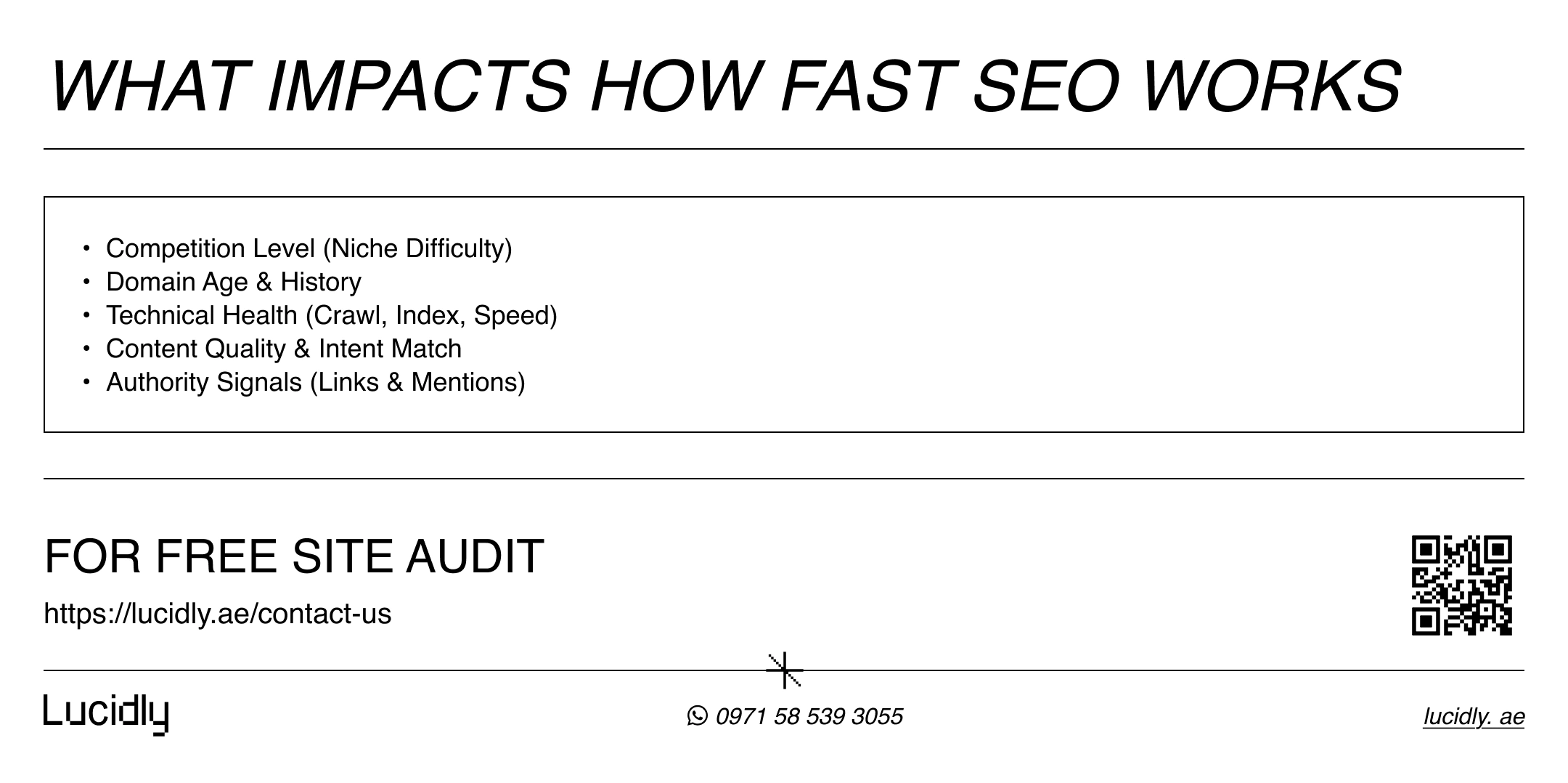
This SEO timeline isn’t random—it depends on your site’s technical foundation, the quality and relevance of your content, your domain age, and how competitive your market is.
What Do “SEO Results” Really Mean?
When people ask how long does SEO take, they often mean “when will I see results?”—but SEO results don’t appear all at once.
Search engines show progress in stages, and understanding these stages helps set realistic SEO expectations.
Early SEO results usually start with technical signals, then visibility, and only later translate into traffic and conversions.
That’s why judging SEO too early often leads to wrong conclusions about its effectiveness or ROI.
The 5 Stages of SEO Results
Crawling and indexing – Google discovers and processes your pages
Impressions – your pages start appearing in search results
Rankings – especially for long-tail and low-competition keywords
Organic traffic – clicks increase as rankings stabilize
Conversions – leads or sales from organic search
Most websites notice impressions long before they see traffic, which is normal in any SEO results timeline.
Why Does SEO Take So Long? (The Real Reasons)
If you’re wondering why SEO takes time, the answer is simple: search engines don’t reward changes instantly.
Google needs time to crawl pages, process updates, compare them against competitors, and evaluate long-term quality signals.
This is why even well-executed SEO campaigns follow a gradual SEO time frame rather than producing overnight wins.
Understanding these reasons helps set realistic SEO expectations and prevents frustration during the early stages.
1. Search Engines Need Time to Re-evaluate Pages
After you publish or update content, Google must crawl it, index it, and reassess its relevance and quality. This process alone can take weeks, especially for new or low-authority sites.
2. Authority and Trust Are Built Gradually
SEO rewards consistency. Backlinks, brand mentions, and user engagement signals accumulate over time, which is why ranking improvements rarely happen all at once.
3. Competitive Niches Slow the Timeline
In highly competitive niches, you’re not just improving your site—you’re competing with established domains that already have years of authority.
4. Domain Age and History Matter
Older domains with a clean history usually move faster in search results, while new domains often experience a longer SEO duration before gaining traction.
The SEO Timeline: What to Expect Month by Month
Understanding the SEO timeline helps answer the most common question: how long does SEO take in real-world scenarios.
While every website is different, most SEO results follow a predictable pattern when the basics are done right and execution is consistent.
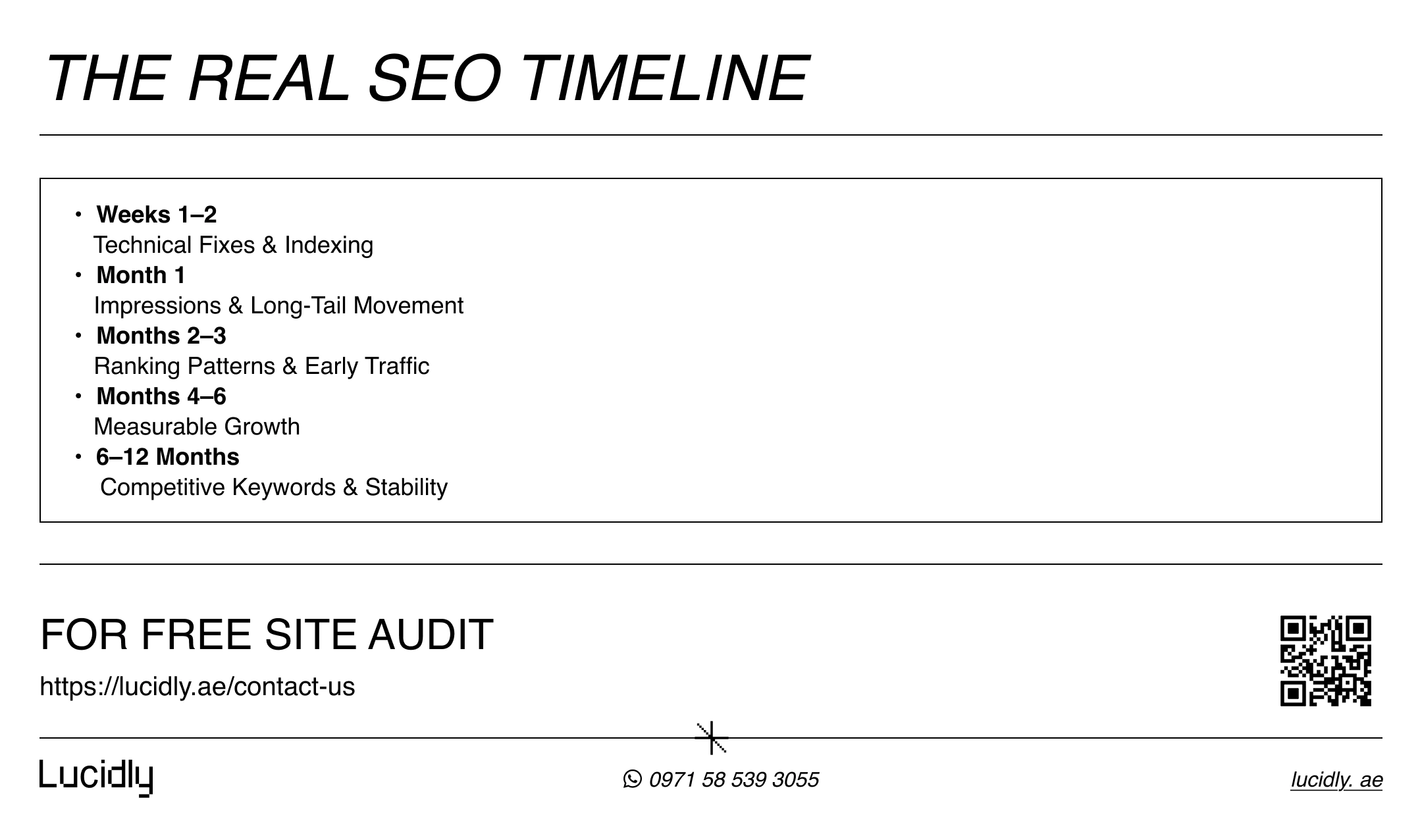
Weeks 1–2: Technical Setup and Indexing
At this stage, SEO work focuses on fixing technical issues that block search engines. This includes crawlability, indexing, internal linking, and tracking setup.
What you’ll see:
Improved indexing and coverage in Search Console
Little to no traffic change yet
Month 1: On-Page Optimisation and Early Signals
Once technical foundations are stable, on-page SEO and intent alignment start to matter. Pages are refined to match what users are actually searching for.
What you’ll see:
More impressions in search results
Early ranking movement for long-tail keywords
Months 2–3: Content Momentum and Ranking Improvements
As content ages and search engines gather more data, SEO gains traction. Supporting pages strengthen topical relevance and internal links guide authority.
What you’ll see:
More consistent rankings
First noticeable organic traffic growth
Months 4–6: Measurable Traffic Growth
This is where SEO investment usually pays off. Pages that performed well earlier start ranking higher, even in more competitive niches.
What you’ll see:
Clear traffic growth
Higher-quality leads or conversions
For most businesses, this 4–6 month window defines the realistic SEO results time frame.
request on-page support from our Professional SEO firm in Dubai.
How Long Does It Take to Rank on Google? (By Scenario)
There’s no single answer to how long does it take to rank on Google, because SEO timelines change based on context.
The same strategy can produce very different results depending on the type of website, market, and competition level.
Understanding these scenarios helps set realistic SEO expectations and plan smarter SEO campaigns.
New Website vs. Established Website
New websites usually take longer to rank because they lack authority and trust signals. An established site with a clean history and existing backlinks often sees faster ranking improvements within the same SEO time frame.
Local SEO vs. National or Global SEO
Local SEO can show results sooner, especially for service-based searches with clear geographic intent.
National or global SEO takes longer due to higher competition and broader keyword targeting.
Ecommerce vs. Service vs. B2B Sites
SEO timelines vary by business model—here’s how ecommerce, service businesses, and B2B typically differ:
Ecommerce: Rankings depend heavily on site structure, category optimisation, and competition.
Service businesses: Often rank faster for intent-driven keywords.
B2B: Longer SEO duration due to niche audiences and lower search volumes.
After a Website Redesign or Migration
Following a redesign or migration, rankings may fluctuate. Recovery and growth typically take several weeks to a few months, depending on how well SEO best practices were preserved.
Can You Speed Up SEO Results? (What Actually Helps)
While there’s no shortcut to instant rankings, you can influence how long SEO takes by focusing on the right priorities.
The fastest SEO results don’t come from tricks—they come from removing friction, improving relevance, and strengthening trust signals early in the SEO timeline.
What Actually Speeds Up SEO Results
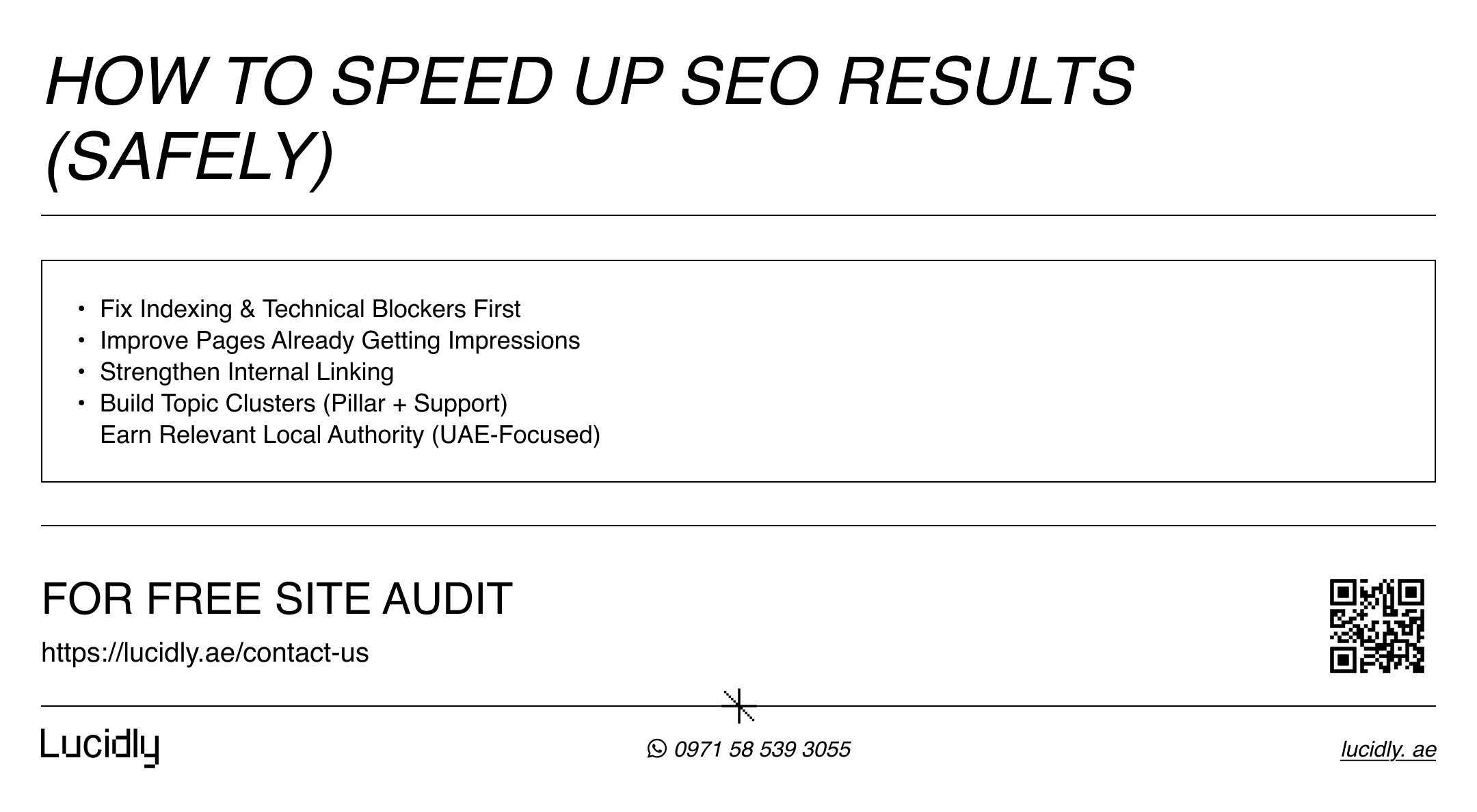
Fix technical blockers first: indexing issues, slow pages, poor mobile experience
Improve existing pages before publishing new ones: pages with impressions respond faster
Match search intent precisely: content strategy that answers the query clearly moves sooner
Strengthen internal linking: helps Google understand importance and topical structure
Earn relevant mentions and links: quality signals accelerate ranking improvements
When these elements align, the SEO results timeline becomes shorter and more predictable—without risking penalties.
LEARN how to measure your website performance, with SEO ANALYTICS guide.
SEO Timelines in the UAE: What’s Different?
In the UAE, SEO timelines are often influenced by local competition, multilingual audiences, and high commercial intent. Many industries—real estate, clinics, legal services, hospitality, and ecommerce—are highly competitive, which can extend the SEO time frame compared to less saturated markets.
However, UAE-based businesses can see faster results when they:
Optimise for local intent (city- or emirate-level searches)
Maintain strong Google Business Profile signals
Publish content tailored to English and Arabic search behavior
Build authority through local media, directories, and partnerships
For most UAE businesses, early visibility can appear within 1–2 months, while consistent traffic growth typically aligns with the global SEO results time frame of 4–6 months.
many could think paid ads is better, so we clarified the differences in our guide: SEO VS PAID ADS.
What Slows SEO Down? (Common Timeline Killers)
If you feel SEO is taking longer than expected, the issue is often execution—not time itself. Several common mistakes can significantly extend the SEO duration and delay ranking improvements, even with good content.
The Most Common SEO Timeline Killers
Targeting too many keywords per page
This confuses search engines and weakens relevance, so that you have to so keyword research better.Publishing thin or repetitive content
Content that doesn’t add real value rarely performs well.Ignoring search intent
Even well-written pages won’t rank if they don’t match what users want.Weak site structure and internal linking
Orphan pages slow down discovery and authority flow.Unsafe link-building tactics
Low-quality links can stall or reverse SEO progress.
Avoiding these issues helps keep your SEO results timeline on track.
FAQ
How long does SEO take to work?
Most websites see early signals within the first month, but meaningful SEO results usually take 3–6 months. In competitive niches, strong and stable rankings can take up to 12 months.
Why does SEO take so long?
SEO takes time because search engines need data to evaluate quality, relevance, and authority. Trust and rankings are earned gradually, not instantly.
Can I speed up SEO results?
You can’t skip the process, but you can speed it up by fixing technical issues early, improving existing pages, matching intent precisely, and earning relevant authority signals.
When should I expect traffic growth?
For most sites, noticeable traffic growth appears between months 3 and 6. Earlier growth is possible for low-competition or local keywords.
So, how long does SEO take? There’s no fixed number—but there is a realistic range. SEO is a long-term investment where results compound over time.
When technical foundations are solid, content is genuinely helpful, and authority is built consistently, SEO becomes one of the most predictable and sustainable growth channels.
Contact us for an SEO timeline audit— or message us directly on WhatsApp to get a quick evaluation showing where your site stands today and when you can realistically expect SEO results.
References
Google Search Central — How Search Works
Google Search Central — Creating Helpful, Reliable, People-First Content
Think with Google — Measuring Long-Term SEO Performance